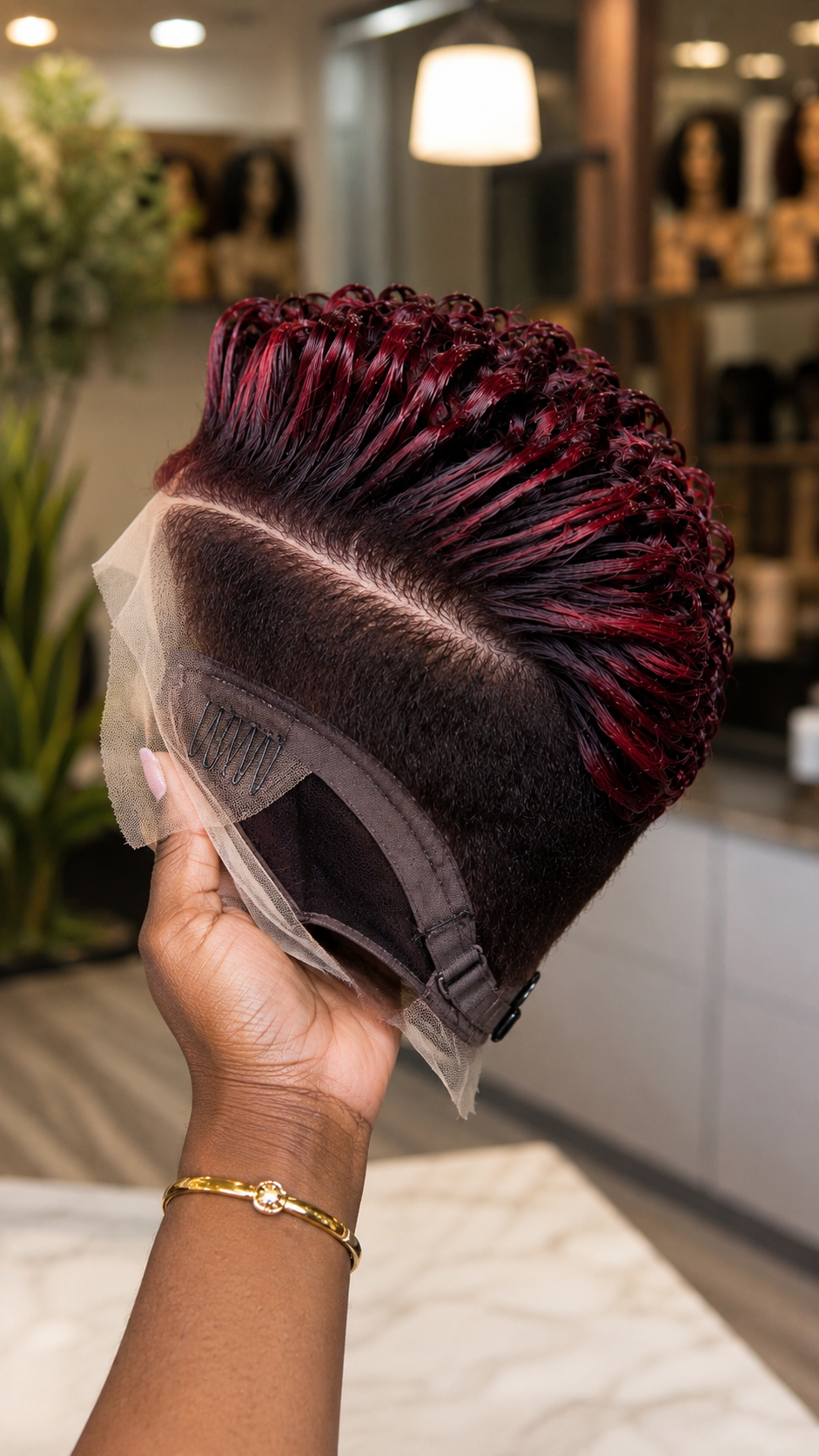
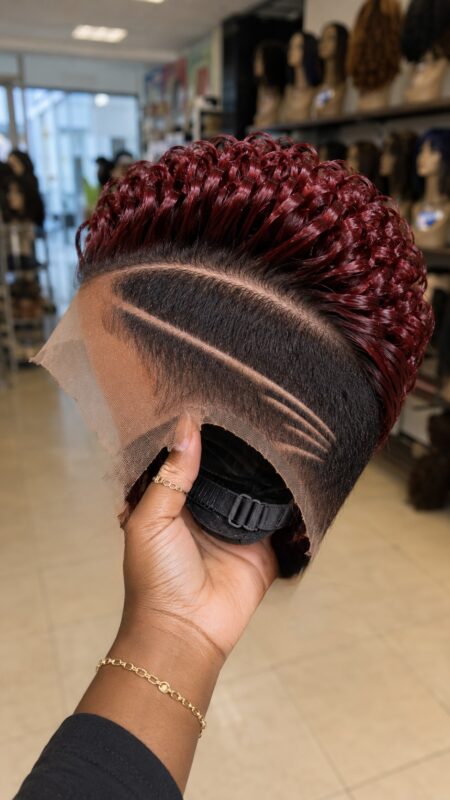
Count the wide sections running from the front of this burgundy pixie toward the crown. What looks at first like a collection of ordinary curls is actually a carefully grouped set: several strands have been brought together, smoothed in the same direction, and shaped as one wider ribbon before the hair bends into loops farther back.
That grouping changes almost everything about the finished style. Wide sections make the crown look cleaner, stronger, and more sculpted. Narrow sections create more individual curls and more visible separation. If the sections become too wide, however, the wig can start looking heavy or molded. If they become too narrow, the smooth ribbon effect disappears and the crown can turn stringy.
Before ordering a pixie like this, do not ask only for burgundy curls or a swept-back crown. Ask how wide the stylist sections the hair before setting it. That hidden styling decision is one of the reasons two wigs made with similar hair can look completely different.
Where To Buy A Sculpted Burgundy Pixie Wig
Custom wig makers. A custom maker is usually the best option when you want this precise ribboned crown. Send a clear side-profile reference and point out that you want broad, smooth sections rather than dozens of tiny separated curls.
Instagram and TikTok sellers. Ask for a close rotating video. Still photos can hide uneven section widths, especially when strong shine makes several neighbouring pieces visually merge together.
Etsy. Independent makers may give you more control over section size, crown height, colour, cap sizing, and the balance between the sleek front and looped back. Describe the structure, not only the colour.
Marketplaces like Amazon, AliExpress, and Temu. Listings may call several very different styles “curly pixie” or “finger curl pixie.” Study customer photos carefully. A factory unit with many thin curls will not suddenly produce this broad ribbon effect simply because the product picture looks similar.
Local beauty supply shops and salons. Local shopping gives you an excellent test. Look closely at the crown and count how many major sections create the style. Then gently separate one section with your fingers to see whether it is naturally grouped or heavily glued together with product.
Vendors and wholesalers direct. Ask whether the crown is individually sectioned and set after construction or whether the fibre arrives in a predetermined curl pattern. That tells you how repeatable and maintainable the design may be.
Regionally. Wig makers in Lagos, Accra, Atlanta, London, and major South African hair markets may use different names for this type of sculpted set. A photograph is more reliable than terms such as barrel curl, loop curl, ribbon curl, or molded pixie.
Vet the seller. Favor sellers who can show another completed unit with similar sectioning. Reproducing a colour is relatively easy; reproducing the same crown architecture repeatedly requires more styling control.
Red flags. Be cautious if some crown sections are extremely broad while others are very thin, if large gaps appear between them, or if every piece stays together only because it is coated in visible gel.
When you order, send. Provide your cap size, colour reference, desired crown height, approximate section width, and photographs showing how much individual separation you want between the ribbon-like pieces.
Contact / order inquiries: WhatsApp [WhatsApp: +XX XXX XXX XX XX]
How Much It Costs
Premium custom human hair. A carefully styled human-hair burgundy pixie with lace, a tapered side, controlled sectioning, colour work, and sculpted crown styling can commonly range from around $250–$470 depending on the hair quality and amount of hand work.
Standard custom human hair. Around $190–$330 can cover many good short human-hair units. The price difference should come from real hair, cap, colour, and workmanship rather than simply using more styling product to make the sections look smooth.
Basic human hair. Around $150–$250 may buy a simpler version with less precise grouping, more generic crown styling, heavier lace, or less consistent colour.
Good synthetic. Around $60–$160 can work well for a highly sculpted crown because quality synthetic fibre can preserve grouped shapes with relatively little daily manipulation.
Basic synthetic. Around $25–$75 is common for budget versions. Check whether the ribbon sections feel naturally shaped or simply stiff and plastic from a heavy factory coating.
Colour premium. Burgundy, wine red, or cherry-red work on human hair may add roughly $60–$140 depending on the starting colour, lightening requirements, and the richness of the final shade.
What the price may exclude. Custom cap sizing, lace tinting, knot work, colour refreshing, crown resetting, and professional first fitting may all be separate charges.
Shipping and duty. International shipping, customs fees, and local taxes can increase the total considerably. Compare the delivered cost rather than only the advertised wig price.
Ongoing costs. A sculpted ribbon crown may need mousse, setting product, colour-safe washing, and occasional re-sectioning after a full wash.
First-year total. Include curl products, colour maintenance, lace care, and any salon reset you may need if you cannot rebuild the broad sections yourself.
Cost per wear. A more expensive unit that naturally falls back into organized sections may be better value than a cheaper wig that requires twenty minutes of reshaping every time it is worn.
What a very low price may signal. It can indicate generic fibre, ordinary curls temporarily slicked together, inconsistent section widths, or a crown arranged specifically for one product photograph.
Deposit structure. Custom wig makers commonly request around 30–50% upfront and the balance before shipping. Keep your crown reference and sectioning instructions in writing.
Shipping, Delivery, And What To Expect After Ordering
When the wig arrives, inspect the crown before adding more product. Look at the major sections while they are still in the seller’s original set.
Check whether similar amounts of hair appear to have been used across neighbouring sections. They do not need to be identical, but one ribbon should not suddenly be twice as thick as the next unless the design intentionally calls for it.
Also look between the sections. You want enough separation to read the pattern without seeing large empty channels exposing the cap underneath.
Section Width Changes The Entire Texture You See
Imagine dividing the same amount of crown hair into ten sections and then into thirty sections.
With ten sections, each group contains more strands. When those strands are smoothed together, they form broad shiny ribbons. The eye reads the crown as sculpted and architectural.
With thirty sections, each group becomes much narrower. You gain more individual pieces and more texture, but the bold ribbon effect begins disappearing.
The hair amount can stay exactly the same while the visible texture changes completely.
Wide Sections Create A Stronger Surface
When several strands lie side by side in the same direction, they create a larger continuous surface for light to hit.
That is one reason the burgundy portions in this wig look so glossy. You are not seeing only colour. You are seeing many hairs aligned closely enough to reflect light as a group.
If those same strands were separated into tiny curls, the reflections would break into smaller pieces and the crown would look more textured and less ribbon-like.
This is why sectioning can influence perceived shine without changing the fibre itself.
Too Much Hair In One Section Can Become Heavy
There is a limit to how broad the ribbons should become.
If too much hair is grouped together, the section becomes thick and difficult to curve cleanly. It may sit heavily above the cap, lose flexibility, or require far more product to stay organized.
The finished wig can then begin looking molded rather than sculpted.
A good stylist uses enough hair to create a visible ribbon while keeping the section light enough to bend naturally.
Sections That Are Too Thin Can Look Stringy
The opposite problem occurs when each section contains too little hair.
Instead of seeing broad intentional pieces, you begin seeing many narrow wet-looking strands. The crown can look stringy, especially when styling product causes small groups to separate unevenly.
This is particularly noticeable on dark burgundy and red-black wigs because glossy highlights make every individual strand easy to read.
If your reference has broad ribbon sections, make sure the delivered unit does not replace them with dozens of thin pieces.
Consistency Matters More Than Exact Measurement
No stylist needs to measure every section with a ruler.
The important thing is visual consistency. Front sections may naturally differ from the crown because the head shape changes, and rear sections may need slightly different amounts of hair to form loops.
But the overall rhythm should remain coherent.
If the first three sections are broad and polished, the next is extremely thin, and another is twice as wide again, the crown begins looking accidental.
The Sections Need Enough Negative Space
The narrow gaps between grouped sections are also part of the design.
Without any separation, every ribbon merges into one large slick surface and the texture disappears. With too much separation, the crown begins exposing unnecessary scalp or cap.
The best result gives each section enough room to be read independently while keeping the overall coverage full.
Think of the empty space as punctuation between the ribbons.
The Root Should Be Neater Than The Curl End
This style becomes more complex toward the back. Near the root, the hair is comparatively sleek and organized. Farther along the strand, the sections begin bending and looping.
That progression matters.
If the roots are already messy and highly separated, the crown loses its strong directional base. If the loop ends remain as rigidly compressed as the roots, the wig loses movement.
A successful set allows the section to begin controlled and finish with more shape.
Product Can Fake Good Sectioning For A Photograph
Heavy gel can force almost any collection of strands to stick together temporarily.
That does not necessarily mean the sectioning underneath is good.
Ask to see a gently handled or previously refreshed unit. If every ribbon instantly breaks into random pieces once the product softens, the photograph may be showing product control more than actual styling architecture.
Good sectioning should still leave a logical map even after the wet-look finish becomes softer.
The First Wash Is The Real Test
Human-hair styling products eventually wash out.
When that happens, the burgundy colour may remain and the hair may still have curl, but the organized ribbon sections will need to be rebuilt if you want the original salon finish.
This is where ownership becomes different from simply admiring the product photo.
Before the first wash, photograph the crown from several angles. Those photos become your sectioning map when you style it again.
Rebuild The Crown Section By Section
Trying to restyle the entire crown at once is usually where the structure gets lost.
Instead, identify the major sections first. Separate one group, smooth it, apply only the amount of setting product it needs, shape it in the intended direction, and then move to the next.
Working section by section helps preserve the rhythm of the original wig.
It also prevents loose neighbouring hairs from becoming trapped inside the wrong ribbon.
Do Not Comb The Finished Ribbons Apart
A traditional comb-through routine can destroy this look quickly.
Once the crown has been organized, dragging a comb across several finished sections mixes the boundaries and turns wide ribbons into uncontrolled smaller pieces.
Detangle human hair before the final set whenever possible. Afterward, use fingers or a small tool only where necessary.
The finished surface should be handled as a design, not treated like loose wash-and-go hair.
Burgundy Makes Section Differences Easier To Notice
The deep red tone adds another visual layer to this wig.
Raised areas catch brighter cherry or wine reflections while deeper portions remain almost black. That makes the width and curvature of each section easy to see.
The colour does not create the grouping, but it reveals it.
On a completely black unit, some neighbouring sections could visually merge. Burgundy gives the eye more information about where one ribbon stops and another begins.
The Short Dark Side Keeps The Crown From Looking Too Heavy
This wig pairs its highly organized upper section with a very short dark side.
That contrast is useful. The crown already contains large glossy shapes and vivid burgundy reflections. Keeping the lower side close to the head prevents the entire wig from becoming visually bulky.
The short side acts almost like a quiet base beneath a more complicated upper design.
If both crown and sides carried broad sculpted sections, the silhouette would feel much heavier.
Section Width Affects Drying Time Too
Broad grouped sections can hold more moisture and product together than very small separated curls.
After refreshing human hair, give the crown enough time to dry in its intended shape before repeatedly touching the sections.
Breaking them apart while still damp can produce frizz and destroy the smooth ribbon surface.
For a sculpted finish, patience during drying is part of the styling technique.
Human Hair Gives You Control Over Section Size
Human hair allows a stylist to rebuild the crown with wider or narrower sections later.
That flexibility means you are not permanently locked into the exact grouping shown in the original photograph.
But it also means the salon-perfect grouping is not permanent. After washing, you have to recreate the organization yourself or pay someone else to do it.
Human hair gives freedom in exchange for styling work.
Synthetic Fibre Can Preserve Grouping More Easily
Some synthetic pixies have the directional bends and grouped shapes set more firmly into the fibre.
That can make them easier to maintain if you want the same look every time.
The downside is reduced flexibility. If you later want to break broad ribbons into soft individual curls, a strongly preset synthetic unit may resist the change.
Ask whether the fibre is heat-safe before trying to alter the factory shape.
Before You Pay
- Can you show the crown closely enough for me to see how wide the individual sections are?
- Are the ribbons created by intentional sectioning or mainly held together with heavy gel?
- What happens to the grouped sections after the first full wash?
- Can you show another finished wig with approximately the same section width?
- Can you explain how to rebuild the broad sections without turning them into thin individual curls?
Trimming The Lace
Place the wig in its intended position before trimming the lace. The organized crown gives the unit a strong directional shape, so you should not rotate the cap simply to make one ribbon sit better.
Check the front edge, temples, short side, and crown direction first. Once the cap is correctly positioned, trim the excess lace gradually.
Do not use excessive cap tension to flatten the roots of the sections. The crown should sit correctly because of its set and construction, not because the lace is being pulled unnaturally tight.
Search Terms
burgundy ribbon curl pixie wig · sculpted section pixie wig · red black ribbon curl wig · grouped curl short pixie wig · wine red sculpted pixie wig · wide section curly lace wig · burgundy loop pixie wig · slick ribbon crown pixie wig
Final Thoughts
The most useful detail on this burgundy pixie is easy to miss if you focus only on the colour. Its crown is organized into broad groups of hair that behave like ribbons before bending into loops toward the back.
Those section widths control the visual texture. Wider groups create a cleaner sculpted surface; narrower groups create more individual curl detail. Neither is automatically better, but they are not interchangeable looks.
If this is the pixie you want, order the grouping as carefully as you order the burgundy shade. The colour attracts the eye, but the size and consistency of the sections are what give the crown its structure.