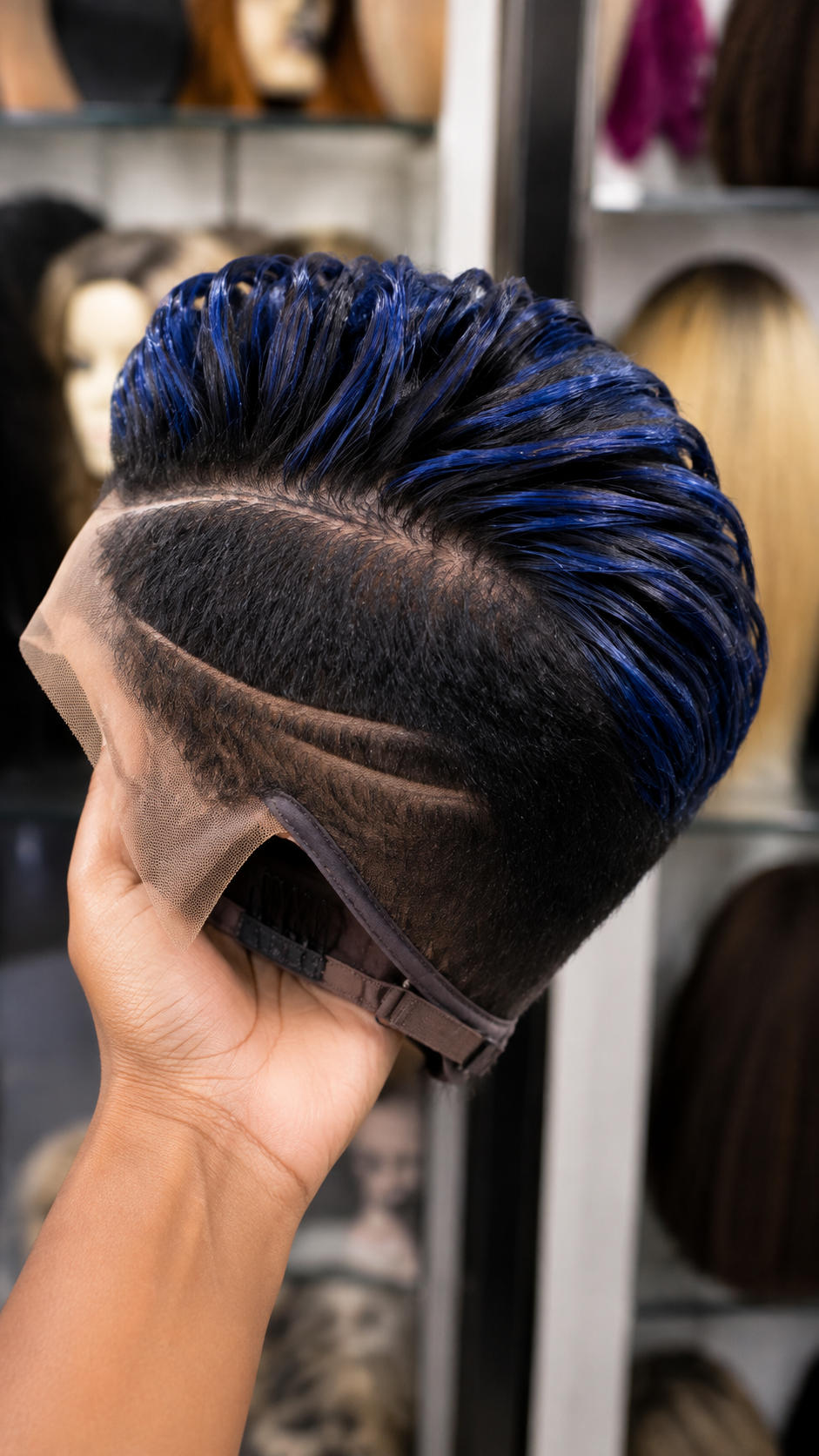
Electric blue can completely change a black pixie wig, but the colour itself is only half of what you are seeing here. The stronger design decision is where those blue sections travel.
On this short swept-back unit, the brighter streaks move in almost the same direction as the longer black strands. They begin close to the dark root area, stretch backward across the upper section, and continue through the curve of the crown. Because the colour and the hair are travelling together, the blue visually traces the movement of the style instead of interrupting it.
That is the buying detail to pay attention to. Two wigs can contain the same black and royal-blue shades and still look completely different if one has colour mapped along the hairstyle while the other has random blue pieces scattered through it.
Where To Buy A Black And Blue Swept-Back Pixie Wig
Custom wig makers. A custom maker is usually the strongest choice if you want the blue to follow this exact backward flow. Send a side-profile reference and explain that the streaks should travel with the longer swept sections rather than appearing as random highlights.
Instagram and TikTok sellers. Ask for a slow rotating video. One still photograph can make a few perfectly positioned blue pieces look like a full directional colour design. Rotation reveals whether the pattern continues through the crown and opposite side.
Etsy. Independent makers may offer more control over the base colour, blue intensity, streak width, crown direction, cap size, and placement. Ask whether the colour layout can be reproduced from a reference rather than choosing only from a generic “blue highlight” option.
Marketplaces like Amazon, AliExpress, and Temu. Product names such as blue-black pixie, royal-blue highlight wig, or blue streak short wig do not explain the placement. Look closely at customer photos because the delivered unit may contain the correct colours but a completely different distribution.
Local beauty supply shops and salons. If you can inspect the unit in person, view it from the side and follow individual blue sections with your eye. The strongest pieces should reinforce the overall sweep rather than suddenly crossing against it.
Vendors and wholesalers direct. Ask for photographs of several finished units using the same black-and-blue pattern. This tells you whether the colour-flow effect is repeatable or whether the listing shows one unusually successful sample.
Regionally. Wig makers in Lagos, Accra, Atlanta, London, and major South African hair markets may use different names for directional streak colouring. Sending a clear reference image is safer than relying on terms such as royal blue, electric blue, or blue highlight.
Vet the seller. Look for front, side, top, and rear three-quarter photographs. Directional colour should still make visual sense once the camera moves away from the hero angle.
Red flags. Be cautious if the blue is concentrated only on the camera-facing side, if some streaks abruptly cross the hair direction, or if the seller cannot show another finished unit with similar placement.
When you order, send. Provide your cap size, base colour, preferred blue shade, streak width, crown direction, and at least two reference angles showing where the blue should remain visible.
Contact / order inquiries: WhatsApp [WhatsApp: +XX XXX XXX XX XX]
How Much It Costs
Premium custom human hair. A carefully coloured black-and-blue human-hair pixie with lace, a short faded side, directional crown work, and selective colour placement can commonly range from around $250–$470 depending on the hair, cap construction, colouring process, and styling labour.
Standard custom human hair. Around $190–$330 can cover many strong short human-hair units. At this level, ask whether the blue placement is mapped intentionally or whether ordinary highlighted hair is simply styled backward after colouring.
Basic human hair. Around $150–$250 may buy a simpler version with broader streaks, more generic placement, heavier lace, or less precise colour distribution.
Good synthetic. Around $60–$160 can work well for vivid blue because the colour can be manufactured into the fibre without chemically lifting dark human hair.
Basic synthetic. Around $25–$75 is common for budget units. Watch for blue that looks overly bright, plastic-like, or distributed in thick blocks instead of following the individual swept sections.
Colour premium. On human hair, vivid royal or electric blue usually requires selected strands to be lightened before the blue pigment is deposited. That extra process can add roughly $70–$150 depending on the amount of coloured hair and starting base.
What the price may exclude. Custom cap sizing, lace tinting, knot work, colour refreshing, professional crown resetting, and later correction of faded blue sections may all cost extra.
Shipping and duty. International shipping, customs charges, and local taxes can significantly increase the final cost. Compare the complete delivered total rather than only the listed wig price.
Ongoing costs. Human-hair vivid blue may need colour-depositing products and careful cold-water washing. The black base usually requires less colour maintenance than the blue sections.
First-year total. Include colour-safe shampoo, conditioner, blue depositing products, styling products, lace care, and any professional colour refreshes needed to preserve the directional contrast.
Cost per wear. A slightly more expensive unit with correctly mapped colour may offer better value than a cheaper wig whose blue placement always needs to be rearranged before it photographs or wears correctly.
What a very low price may signal. It may indicate ordinary mixed-colour fibre, inconsistent streak placement, a generic cap, or a colour effect arranged specifically for one product photograph.
Deposit structure. Custom makers often request around 30–50% upfront with the remainder due before shipping. Keep both the colour and the directional placement instructions in writing.
Shipping, Delivery, And What To Expect After Ordering
When the wig arrives, inspect it before cutting the lace. Place it in the intended orientation and look at the blue sections from the front, side, top, and back.
Do not simply count how many blue streaks you received. Follow their direction. They should visually cooperate with the black strands around them.
Also check whether the blue remains distributed through the crown instead of being concentrated only in the front half where listing photos are usually taken.
Colour Direction And Hair Direction Should Agree
This is the central idea behind the look.
The upper hair on this pixie travels backward in long, narrow sections. The blue colour follows those sections. As a result, the eye reads one continuous movement from front toward the crown.
If a bright blue streak suddenly travelled sideways through that arrangement, it would interrupt the visual flow. The colour would become an isolated stripe rather than part of the hairstyle.
Good directional colouring therefore uses the shape of the haircut as a map.
The Blue Acts Like A Line Drawing Over The Black Base
The deep black sections create a dark field underneath the brighter colour. Against that field, every royal-blue piece becomes easy to see.
That allows the blue to function almost like a drawn line showing the direction of the hair.
You can follow individual streaks as they leave the upper front area and move backward. The colour makes the sweep easier to read than it would be on a completely black unit.
This is why selective vivid colour can change the apparent structure of a pixie without changing the actual cut.
Streak Width Changes The Result
Thin and thick blue sections do not create the same effect.
Very thin pieces create flashes of colour between the black and preserve a mostly dark appearance. Medium streaks make the direction much easier to see. Extremely broad blue panels can overpower the black base and turn the unit into a stronger two-colour block design.
This wig sits closer to the middle. The blue is visible enough to trace the movement while black still controls most of the silhouette.
When ordering, specify how dominant you want the blue to be instead of discussing only the shade.
Spacing Matters As Much As Streak Width
Even perfectly sized streaks can look wrong if they are packed together in one area.
Directional colour needs rhythm. A blue section appears, black space separates it, then another blue section continues the movement farther across the crown.
If every blue piece sits beside another blue piece, they merge into one large block. If the spaces are too wide, the colour looks accidental.
The placement should feel repeated without looking mechanically identical.
The Blue Should Follow The Strand, Not Fight The Curl
Near the rear of the crown, some of the longer swept sections begin curving into loops. That creates another placement challenge.
The blue should continue to make sense as the strand bends. If the colour is visible only while the hair is straight and then disappears completely when it curves, the directional line suddenly ends.
A skilled colour layout considers the finished shape rather than only the strand while it is stretched out.
That is why the final styled wig is the real test of placement.
This Is Different From Random Highlighting
Random highlighting can create dimension by distributing lighter pieces through a darker base without a strict pattern.
That can look beautiful on loose curls where natural variation is the goal.
This pixie is more controlled. The crown has a strong backward orientation, so completely random blue placement would fight the architecture of the hairstyle.
Here, the colour is more successful when it behaves like part of the directional styling.
This Is Also Different From A Blue Ombre
An ombre normally changes colour according to strand length: darker near one area and gradually lighter or brighter toward another.
That is not what creates this effect.
The blue appears selectively among black sections rather than gradually replacing the black from root to end across the entire crown.
The buying language matters. If you ask a seller for black-to-blue ombre when you actually want directional blue streaks, you can receive a technically correct colour job that looks nothing like this reference.
Vivid Blue Needs A Clean Dark Base
Royal blue becomes especially strong when it sits beside deep black.
If the dark base turns warm brown, reddish, or faded, the relationship changes. The blue may still look attractive, but the sharp cool contrast becomes weaker.
This means maintaining the design is not only about preserving the blue. The black base also needs to remain visually clean enough to support it.
A good colour-safe routine should protect both parts rather than constantly depositing blue across the entire wig.
Blue On Human Hair Usually Means More Processing
On naturally dark human hair, vivid blue usually cannot simply be painted over black and remain this visible.
Selected sections generally need to be lightened enough for the blue pigment to show. That means those blue strands may have experienced more chemical processing than the untouched black sections.
Over time, they can become drier or more fragile if repeatedly recoloured or exposed to unnecessary heat.
Treat the coloured sections gently even if the rest of the wig feels very strong.
Synthetic Fibre Can Be A Strong Option For This Colour
Synthetic fibre has an important advantage for vivid blue: the colour can be manufactured into the strand without lifting natural dark pigment first.
That can preserve strong blue-black contrast with less colour maintenance.
The tradeoff is restyling flexibility. If the directional crown is heavily preset into the fibre, changing the silhouette later may be more difficult.
For someone who wants this exact look repeatedly, that may be a reasonable trade.
Fading Can Break The Directional Pattern
When vivid blue begins fading, it does not only become lighter. Depending on the dye and base underneath, it may shift toward a duller blue, teal, grey-blue, or muted tone.
If some streaks fade faster than others, the visual rhythm across the crown begins changing.
The hair can still be perfectly healthy and the swept-back shape can still be intact while the directional colour design starts looking less coordinated.
That is why selective refreshing matters on a patterned colour job.
Refresh The Blue Without Flooding The Black
If this is human hair, repeatedly applying strong blue pigment across the entire crown may gradually tint sections that were meant to remain black or create unnecessary buildup.
Where practical, refresh the visible blue pieces selectively or ask a colourist to restore them individually.
The goal is not simply maximum blue. The goal is preserving the spacing between blue and black.
That negative space is part of the design.
The High Dark Side Makes The Blue Flow More Obvious
The short side remains almost entirely black and sits close to the head. That removes coloured distraction from the lower half of the wig.
As a result, the eye concentrates on the brighter swept section above.
If blue extended heavily through the faded side as well, the entire wig would feel more uniformly colourful. Keeping the lower area dark turns the upper blue flow into a clearer focal point.
The colour boundary therefore supports the silhouette without needing to become the main subject of the side.
Ask For A Rotation Video, Not Just More Photos
Directional colour is unusually dependent on viewing angle.
A photograph can capture every blue streak at the moment it reflects the most light. Rotate the wig slightly and some sections may disappear behind black strands while others become stronger.
That is normal to a degree. What you are checking is whether the overall blue flow remains coherent.
A ten-second rotation tells you more about this colour technique than ten photographs taken from nearly the same angle.
Before You Pay
- Can you show the wig rotating so I can follow the blue streaks from the front toward the crown?
- Are the blue sections positioned to follow the swept-back hair direction or distributed randomly?
- How wide are the blue streaks, and can that width be customized?
- If this is human hair, were the blue sections lightened before the vivid colour was applied?
- Can you show another finished unit with the same directional blue placement?
Trimming The Lace
Place the wig in its correct wearing position before trimming the lace. The directional blue sections make the intended orientation easy to identify because they should flow naturally toward the crown.
Check the front hairline, dark faded side, and overall crown direction before removing excess lace.
Trim gradually. Do not rotate or pull the cap simply to make a particular blue section sit in a more flattering place. If the streak placement only works when the entire wig is worn crooked, the colour mapping itself is the problem.
Search Terms
black and blue swept back pixie wig · royal blue highlight pixie wig · electric blue streak short wig · directional blue pixie wig · black blue shaved side pixie wig · blue streak lace pixie wig · cobalt blue swept back wig · black royal blue pixie hair
Final Thoughts
The electric-blue sections on this pixie are effective because they are not fighting the hairstyle. They travel in the same backward direction as the longer black strands, making the movement of the crown easier to see and giving the colour a purpose beyond simply being bright.
That is the difference between choosing colours and designing with colour. Black and blue alone do not create this result. The streak width, spacing, direction, and relationship with the final swept shape do.
If you want this exact look, show the seller how the blue should travel. A colour name tells them the palette. The direction tells them the design.