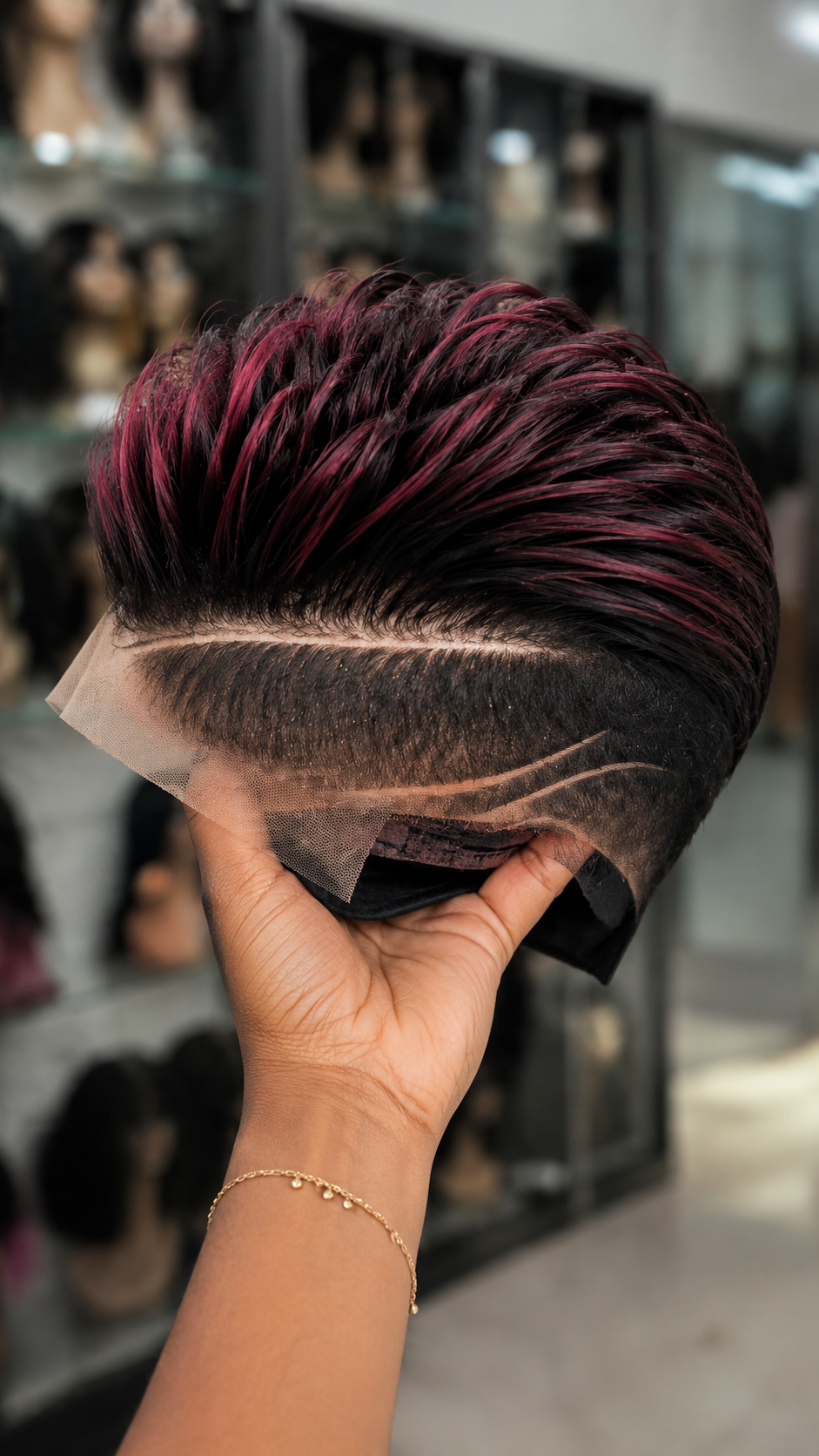
Look closely at the top of this black-and-burgundy pixie wig and the first thing that matters is not the colour. It is the space between the strands. The upper hair has been swept backward in many narrow pieces instead of being compressed into a few thick ribbons or packed into tight ringlets.
That separation gives the crown movement. You can follow individual burgundy and dark strands from the roots toward the back, and small gaps between them prevent the surface from becoming one heavy glossy block. The wig therefore looks full without necessarily needing extreme density.
This is an important buying distinction. More hair does not automatically create a better swept-back pixie. If too much hair is packed together or covered with heavy product, the crown can lose the light feathered appearance that makes this style work.
Where To Buy A Feathered Burgundy Pixie Wig
Custom wig makers. A custom maker is usually the best option when you want this exact amount of strand separation. Send a clear side-profile reference and explain that the top should remain individually readable rather than being molded into thick solid sections.
Instagram and TikTok sellers. Ask for a slow video of the crown moving slightly. A photograph cannot tell you whether the separated appearance comes naturally from the set or whether the stylist spent twenty minutes arranging every strand specifically for the shot.
Etsy. Independent makers may allow control over crown length, density, burgundy placement, cap size, and how separated or compact the swept sections appear. Use words such as feathered, separated, swept-back, and narrow-section rather than simply ordering a burgundy pixie.
Marketplaces like Amazon, AliExpress, and Temu. Similar product photos may hide very different crown densities. Compare buyer photos to see whether the hair remains light and separated after unpacking or arrives as one compressed block.
Local beauty supply shops and salons. Local shopping gives you a useful physical test. Lightly lift the crown with your fingers. The strands should separate without revealing huge empty areas underneath and should fall back into a coherent backward direction.
Vendors and wholesalers direct. Ask for the approximate density, top length, fibre type, and an unfiltered side video. Also ask whether the crown has been heavily coated with gel or serum before photography.
Regionally. Wig makers in Lagos, Accra, Atlanta, London, and major South African hair markets may describe this look differently. Reference photographs are more reliable than terms such as feathered pixie, brushed-back pixie, or burgundy tapered wig.
Vet the seller. Favor sellers who show the same unit under normal lighting and from several angles. A separated crown should still look organized from the front, side, and back rather than only from one carefully positioned camera angle.
Red flags. Be cautious if the crown looks completely solid under ordinary light, if every strand is stuck together with wet-look product, or if the seller refuses to show the wig after gently running fingers through the top.
When you order, send. Provide your cap size, colour reference, preferred crown length, desired amount of separation, and whether you want a light feathered finish or a more tightly sculpted salon set.
Contact / order inquiries: WhatsApp [WhatsApp: +XX XXX XXX XX XX]
How Much It Costs
Premium custom human hair. A carefully styled human-hair burgundy pixie with lace, tapered sides, selective colour, and a hand-shaped feathered crown can commonly range from around $250–$460 depending on the hair quality and construction.
Standard custom human hair. Around $190–$320 can cover many good short human-hair units. At this level, pay close attention to whether the crown remains flexible or depends on excessive product to create separation.
Basic human hair. Around $150–$240 may buy a simpler unit with more generic density, heavier lace, or less controlled movement through the top.
Good synthetic. Around $60–$150 can provide a strong version of this silhouette. Quality synthetic fibre may maintain its backward direction well, although the strands can appear stiffer than human hair.
Basic synthetic. Around $25–$70 is common for budget pieces. Check carefully for plastic shine, thick clumping, visible cap gaps, and a crown that refuses to move naturally.
Colour premium. Burgundy, wine red, cherry red, or magenta-red work on human hair may add roughly $60–$140 depending on the starting colour and amount of pre-lightening required.
What the price may exclude. Custom cap sizing, lace tinting, knot work, colour refreshing, crown restyling, and professional fitting may all cost extra.
Shipping and duty. International shipping, customs fees, and local taxes can increase the real purchase price. Compare the full delivered amount rather than only the listing price.
Ongoing costs. Human-hair versions may need lightweight mousse, leave-in product, colour-safe care, and occasional reshaping of the swept crown.
First-year total. Include colour products, lace care, setting products, and possible professional restyling if the feathered crown becomes too flat or compact after repeated washing.
Cost per wear. A unit that naturally keeps its separated shape can offer better value than a cheaper wig that needs heavy restyling every time you put it on.
What a very low price may signal. It may indicate generic fibre, excessive density, poor crown direction, or a look created mainly with styling product rather than thoughtful cutting and sectioning.
Deposit structure. Custom wig makers commonly request around 30–50% upfront and the remaining balance before shipping. Keep your crown reference and colour instructions in writing.
Shipping, Delivery, And What To Expect After Ordering
When the wig arrives, inspect the crown before adding serum, mousse, or gel. Shipping can temporarily compress swept-back hair, so first determine whether the strands simply need light lifting or whether the crown was built much heavier than expected.
Use your fingers rather than a fine comb. Gently separate several pieces and watch whether they return to the backward flow.
Then examine the gaps. Some visible separation is necessary for this style, but you should not see large uncontrolled openings that expose the base from normal viewing distance.
Strand Separation Creates Volume Without Extra Density
This is the central buying lesson in the image.
When every strand sits tightly against the next, the hair forms one dense surface. That can look polished, but it does not necessarily look airy or full.
Separate those strands slightly and each piece begins occupying its own visual space. Small shadows appear between them. Burgundy highlights become easier to see. The crown looks larger because the eye can identify multiple layers instead of one solid mass.
The actual amount of hair can remain unchanged.
This is why a medium-density pixie with intelligent separation may appear fuller than a much denser unit covered in product.
This Is The Opposite Of A Ribbon-Set Crown
A ribbon-set pixie deliberately groups many hairs together into broad polished sections. This style takes the opposite approach.
The pieces are narrower. Individual strands and small groups remain visible. The surface looks more feathered and less molded.
Neither construction is automatically better. They simply create different finishes.
If you like a sculpted, graphic crown, broad grouped sections may suit you. If you prefer movement and visible strand detail, this narrower separated arrangement is the one to look for.
Too Much Product Destroys The Effect
The easiest way to ruin this crown is to keep adding heavy product.
Gel, wax, thick curl cream, and oily serum can pull neighbouring strands together. As those strands merge, the narrow spaces between them disappear.
The crown becomes flatter and visually heavier even though nothing has been cut away.
This is why a lightweight mousse or small amount of setting product often works better for a feathered human-hair pixie.
The goal is control without gluing the surface together.
Too Little Control Creates Frizz Instead
The opposite extreme is not ideal either.
Separation should look intentional. If every hair begins moving independently, the clean swept direction disappears and the crown becomes fuzzy.
A successful feathered finish therefore sits between clumped and frizzy.
You want enough hold to keep groups travelling backward, but enough flexibility for those groups to remain individually visible.
Density Must Be Judged At The Root
Do not estimate the density of this wig by looking only at the ends of the swept strands.
Because the pieces spread apart as they travel backward, the crown can appear extremely full from the outside.
Instead, look closer to the root. That is where you can judge how much hair is actually attached and whether the spacing remains appropriate.
If the roots are packed extremely tightly but the tips are artificially separated, you may be looking at a very dense wig that simply photographs light.
If the roots have sensible spacing and the crown still looks full, the maker has used the direction efficiently.
The Burgundy Streaks Make Separation Easier To See
The dark burgundy-red pieces in this crown make the strand architecture easier to read.
A black strand may visually merge with another black strand beside it. A brighter red section immediately creates contrast and shows where one narrow group travels through the crown.
That makes the colour functional as well as decorative.
The burgundy does not create the separation, but it makes the existing separation much more visible.
Fine Highlights Need Fine Strand Control
When colourful pieces are narrow, messy grouping becomes especially obvious.
If a burgundy section keeps crossing several black sections, disappears, then reappears randomly, the crown can look tangled even when the actual hair is not tangled.
The stronger version keeps most narrow pieces travelling coherently backward.
They do not need to form perfect parallel lines. Natural variation is desirable. But the overall movement should remain readable.
Root Lift And Strand Separation Work Together
Separation alone does not create the full effect. The strands also need enough lift from the root.
If narrow sections lie completely flat against the cap, you may still see them individually, but the crown loses volume.
Give the roots a small amount of lift and the pieces begin sitting above one another instead of only beside one another.
That produces layered fullness without requiring large curls.
The Front Should Not Become A Wall
Swept-back pixies can sometimes become too dense immediately behind the hairline.
If every front strand is packed upright with no separation, the crown begins like a solid wall and only becomes feathered farther back.
A more natural transition allows the roots to remain organized while gradually showing greater separation as the hair moves upward and backward.
That makes the silhouette look intentional instead of stiff.
Short Sides Make Separation More Important
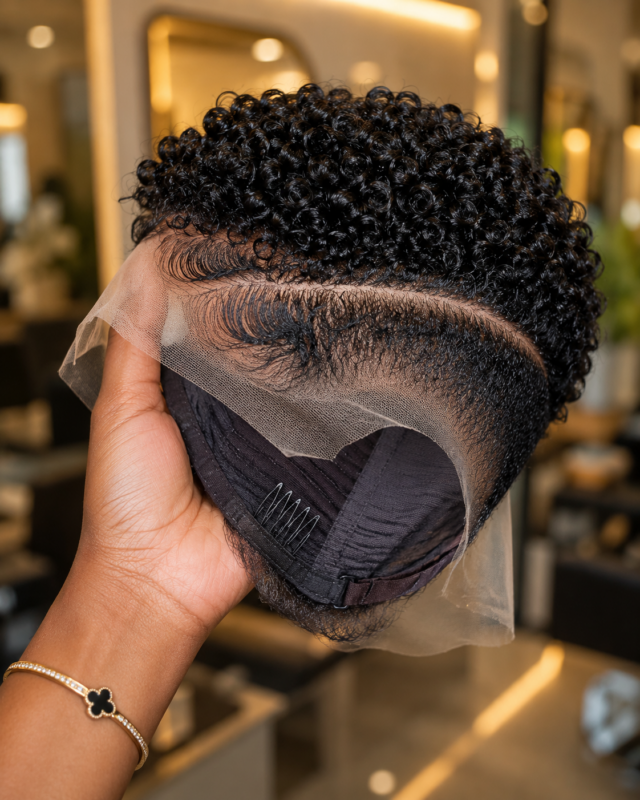
This wig uses a very short tapered side with two curved carved lines. That lower section carries almost no visual volume.
As a result, the upper crown has to provide most of the shape of the hairstyle.
If the crown becomes flat or clumped, the entire wig can suddenly appear much smaller because there is no fuller side hair to compensate.
Good separation therefore matters even more on high-contrast short-side pixies than it does on fuller cuts.
The Crown Should Move Without Falling Apart
A useful seller test is gentle movement.
Ask the seller to tilt the wig slightly or pass fingers lightly through the upper section.
The strands should move and separate, then settle back into the general swept direction.
If the entire crown moves as one rigid shell, heavy product may be doing most of the styling work.
If every section immediately loses its direction, there may not be enough structure in the set.
Human Hair Makes Feathering Easier To Adjust
Human hair gives you flexibility. You can increase separation, soften it, change the direction slightly, or rebuild the crown after washing.
That makes human hair attractive for someone who likes this light swept finish but may occasionally want a more compact style.
The tradeoff is maintenance. The exact salon arrangement will not necessarily return by itself after washing.
You have to recreate the balance between direction, lift, and separation.
Synthetic Fibre Can Hold The Shape Longer
A synthetic swept-back pixie may preserve the original direction and strand grouping more consistently between wears.
That can be useful when you want the exact same silhouette repeatedly with less styling work.
But very cheap synthetic fibre can behave too rigidly. Instead of feathered separation, it may create stiff pointed pieces that move unnaturally.
Look for flexibility as well as shape retention.
Sleeping In This Style Can Collapse The Separation
Pressure is a major enemy of a feathered crown.
If you sleep directly on the wig, narrow sections become compressed together. The next morning, the hair may still point backward but the airy gaps can disappear.
Whenever practical, remove the unit and store it on a form that preserves the crown.
If you must refresh it, begin with your fingers before reaching for more product.
Do Not Brush Everything Into One Direction At Once
A large brush can make a swept-back pixie look neat quickly, but it can also combine too many sections.
That destroys the small-scale separation responsible for the feathered appearance.
For maintenance, work in smaller areas. Redirect pieces individually or in narrow groups rather than treating the entire crown as one large section.
You are maintaining a pattern of movement, not creating a ponytail.
Before You Pay
- Can you show the crown moving slightly so I can see whether the strands are naturally separated?
- Is the feathered effect created with light styling product or heavy gel and wax?
- Can I see the root density between the separated sections?
- What happens to the strand separation after the first full wash?
- Can you show another finished unit with the same narrow swept-back crown instead of a heavily grouped ribbon set?
Trimming The Lace
Place the wig in its correct wearing position before trimming the lace. The swept-back crown leaves the front more exposed, so incorrect placement will be easier to see than it would be beneath a fringe.
Check the front edge, temples, carved side, and crown direction first. Once the unit sits naturally, trim the excess lace gradually.
Do not pull the cap backward simply to make the upper strands stand higher. If the crown needs more lift, adjust the hair itself rather than changing the position of the wig.
Search Terms
burgundy swept back pixie wig · feathered pixie lace wig · red black brushed back pixie wig · separated strand pixie wig · burgundy tapered pixie wig · wine red short lace wig · feathered crown pixie wig · black burgundy shaved side wig
Final Thoughts
The fullness of this burgundy pixie does not come only from how much hair is attached to the cap. A large part of the effect comes from allowing narrow sections to remain visibly separated as they travel backward across the crown.
That separation creates shadow, movement, and layered volume. Add too much product and the pieces merge into a heavy surface. Separate them too aggressively and the crown turns frizzy. The strongest version stays exactly between those two extremes.
If this is the look you want, ask about density, but also ask about separation. On a feathered swept-back pixie, the space between the strands is doing almost as much visual work as the strands themselves.