Most buyers assume every curl on a unit like this was rolled by hand, one at a time. Some were. Most were not. What actually matters is not whether each coil was individually placed, but whether the finished pattern is tight enough, and uniform enough, to match what you actually want to wear.
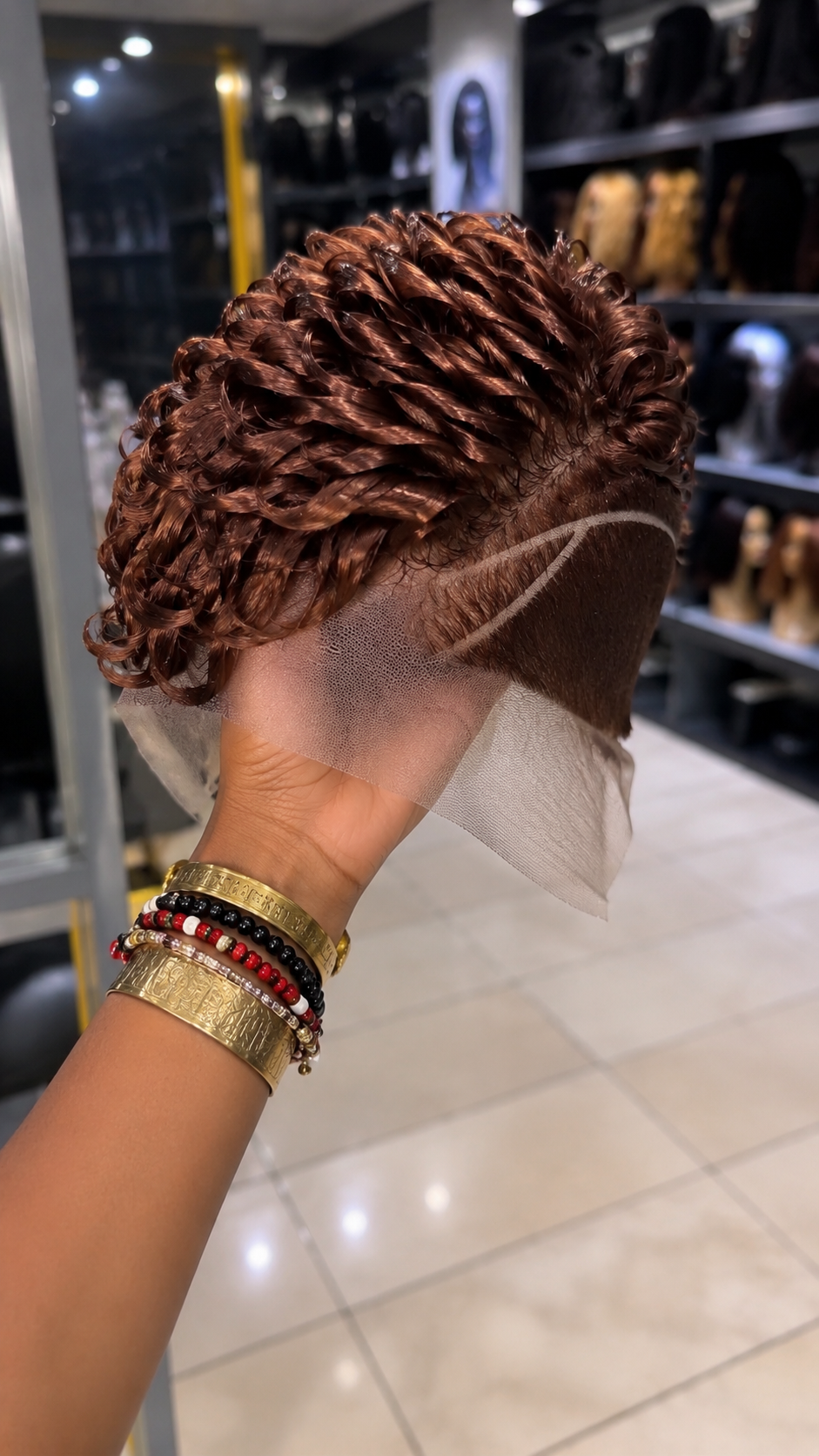
This is a deep auburn-copper curly pixie wig, photographed with the lace pulled to one side to expose a clean, straight part and the base beneath it. What sets it apart from other curly units in this category is the consistency of the curl itself — every coil across the crown holds the same tight diameter, wound in structured, almost helical rows rather than a looser, more varied spiral.
That level of uniformity is worth pausing on, because it cuts both ways. It can signal careful, deliberate craftsmanship. It can also signal a machine-set pattern designed to look consistent in a photo without holding up the same way through repeated wear. Knowing which one you are looking at changes what you should be asking before you buy.
Where To Buy This Uniform Spring-Coil Curly Pixie Wig
Custom makers can tell you directly whether a curl pattern this consistent was hand-wound curl by curl or set using a uniform rod size across the whole unit, which is worth asking before you assume either way.
Instagram and TikTok sellers favor tightly uniform curl patterns like this one because they photograph with crisp, repeatable definition, but a photo alone cannot tell you whether that uniformity survives a wash.
Etsy listings from smaller, independent makers sometimes describe the actual technique used to achieve a spring-coil pattern like this, which larger listings rarely bother to explain.
Marketplaces like Amazon, AliExpress, and Temu frequently use machine-set, uniform curl patterns specifically because they are easier to reproduce at scale than a hand-varied curl, and this look is common on mass-market listings for that reason.
Local beauty supply shops and salons let you stretch a single curl gently and watch how it springs back, which tells you more about the curl’s actual construction than examining a photo ever could.
Vendors and wholesalers direct are typically where this kind of uniform, rod-set curl pattern is produced at volume, before individual sellers list smaller batches under their own branding.
Regionally, deep auburn and copper spring-coil curly units in this density show up often through vendors in Lagos, Accra, Atlanta, London, and South African hair districts.
Vet the seller by asking whether the curl pattern is achieved with a permanent set, a temporary rod-set that will loosen with washing, or genuinely hand-wound strand by strand, since each answer implies a different level of durability.
Red flags include listings with no answer about how the curl was achieved, no willingness to show the pattern after a wash, and photos that only ever show the unit fresh and untouched.
When you order, send a note on your preferred curl tightness, since a uniform spring-coil pattern like this one is set at a fixed diameter and cannot easily be loosened or tightened once the unit is constructed.
Contact / order inquiries: WhatsApp [WhatsApp: +XX XXX XXX XX XX]
How Much It Costs
Tiered pricing for a deep auburn-copper unit with this level of tight, uniform curl construction runs $175–$440 for human hair, with hand-wound spring-coil work adding $40–$85 over a looser, more naturally varied curl pattern, since consistent tight coils across the whole head take more time to set individually. A good synthetic version runs $65–$155, and a basic synthetic falls between $28–$75.
What that includes and excludes typically covers the unit and its existing curl set, not a re-set service if the pattern loosens with wear, and not the specific curl-defining product needed to maintain that tight, uniform diameter over time.
Shipping and duty add $15–$60 depending on origin, with tightly curled units sometimes shipped in a rounded form to help the coils retain their shape rather than pressed flat.
Ongoing costs include a curl-refreshing spray or light gel to reactivate the spring pattern between washes, a diffuser or air-dry method that does not disturb the coil structure, and a satin cap to protect the pattern overnight.
First-year total, including the unit, upkeep products, and one professional curl reset if needed, tends to fall between $260 and $560 for a well-maintained human hair version.
Cost per wear on a $320 unit worn twice weekly over a year comes out to roughly $3.10 per wear, a figure worth weighing against the more labor-intensive construction behind a uniformly tight curl pattern.
What a very low price signals on a spring-coil pattern this consistent is usually a machine-set curl using a fixed rod size in bulk, which tends to loosen unevenly with wear rather than holding its uniform shape the way a hand-set curl often does.
Deposit structure for custom curl-work orders like this commonly runs 30–50% upfront, remainder due before shipment, kept on a payment method that allows a dispute if the delivered curl pattern does not match the tightness or consistency shown in photos.
Shipping, Delivery, And What To Expect After Ordering
A uniform, tightly wound spring-coil pattern takes real production time — expect 7–14 business days before a custom order ships, longer if each curl is individually set rather than processed in bulk with a fixed rod size. International delivery adds another 7–21 days.
What arrives should hold the same tight, consistent diameter shown in the listing photos, without noticeably looser or tighter sections scattered through the crown. If the curl pattern looks uneven or inconsistent compared to what was pictured, raise that with the seller before styling or washing the unit.
Photograph the curl pattern from directly above the day it arrives, before any product is applied. That overhead angle shows the actual consistency of the coils and becomes your reference if the pattern loosens or shifts with normal wear.
Reading Curl Uniformity As A Quality Signal
A curl pattern this consistent, where every coil across the crown holds the same tight diameter, is unusual compared to most curly units, which typically show some natural variation from section to section. That consistency can come from two very different sources, and they are not equally durable.
Hand-wound, strand-by-strand curl work tends to hold its shape through repeated washing because each curl was individually set with care, even when the diameters end up closely matched. A fixed-rod, machine-set pattern achieves the same visual uniformity faster and more cheaply, but the curl often loosens unevenly with wear, since the setting method did not account for natural variation in hair thickness across the head.
From a single photo, these two techniques can look identical. The only reliable way to tell them apart is to ask directly, or to see the pattern after a wash, since a hand-set curl generally reactivates closer to its original shape than a machine-set one does.
A Deep, Straight Side Part Beneath The Lift
Where the lace has been pulled aside, a clean, straight part runs back from the hairline, unremarkable in shape compared to the curved or off-center parts covered elsewhere in this category, but worth checking for the same basic reasons as any part: knot visibility, lace color match, and how closely the part follows your own natural part line.
A straightforward, simple part like this is generally the easiest to maintain day to day, requiring none of the extra care a curved or deep off-center part demands. It is a small point in this unit’s favor if low daily maintenance matters more to you than a more dramatic part shape.
Deep Auburn-Copper, One More Time In A Growing Family
The colour on this unit sits deeper and more brownish than the brighter copper tones covered elsewhere in this category, but it belongs to the same broad auburn-copper family that has come up several times now. That repetition is worth naming honestly: copper and auburn tones have appeared often enough in this series that colour alone is no longer a fresh angle on its own.
What keeps this unit worth covering is not the shade, but the curl construction underneath it — the uniform spring-coil pattern is a genuinely different technical question from anything asked about the copper or auburn units covered previously, whether those units featured two-tone placement, hand-painted highlights, or a curved part. If a future unit arrives in this same deep auburn-copper range without a distinct construction, cut, or technical detail attached to it, that will be the point to flag the colour family as fully saturated.
Before You Pay
- Has the seller explained whether the curl is hand-wound, rod-set, or machine-processed?
- Does the curl pattern hold the same tight diameter after a wash, based on any video or photo you have seen?
- Is a uniform, consistent curl what you actually want, or would a more naturally varied pattern suit you better?
- What happens if the curl loosens unevenly within the first few months of normal wear?
- Does the price reflect hand-set construction, or is it priced like a bulk, machine-set unit?
Trimming The Lace
Trim along the straight part and hairline in small, even sections, checking the fit against your own part line as you go — a simple, straight edge like this one is more forgiving of minor adjustments than a curved or deep part would be.
Leave a modest margin of lace beyond the last row of knots rather than cutting flush, since a straightforward part still benefits from the same careful handling as any other construction detail.
Search Terms
uniform spring coil curly pixie wig · deep auburn copper curly pixie · tight coil curly pixie wig human hair · hand set curl pattern wig · machine set curly pixie wig · consistent curl diameter pixie wig · straight part curly pixie wig lace front · rod set copper curly wig
Final Thoughts
Curl uniformity is one of those details that looks impressive in a photo and tells you almost nothing on its own about how the unit was actually made. The same tight, consistent spring-coil pattern can come from careful, hand-wound construction or from a fast, machine-set process, and only one of those tends to hold up the same way after repeated wear and washing.
Ask how the curl was set before you assume the more flattering explanation. A seller who can answer clearly, and who can show the pattern after a wash rather than only fresh out of the packaging, is giving you the information a single well-lit photo simply cannot.
The colour on this unit will not be the reason to remember it. The curl construction underneath is. That distinction — looking past the shade to the actual technique holding the pattern in place — is worth carrying into every curly unit you consider from here, copper or otherwise.
#WigBusiness
Önerilen Reels başlığı:

I very nice.i need it
How much