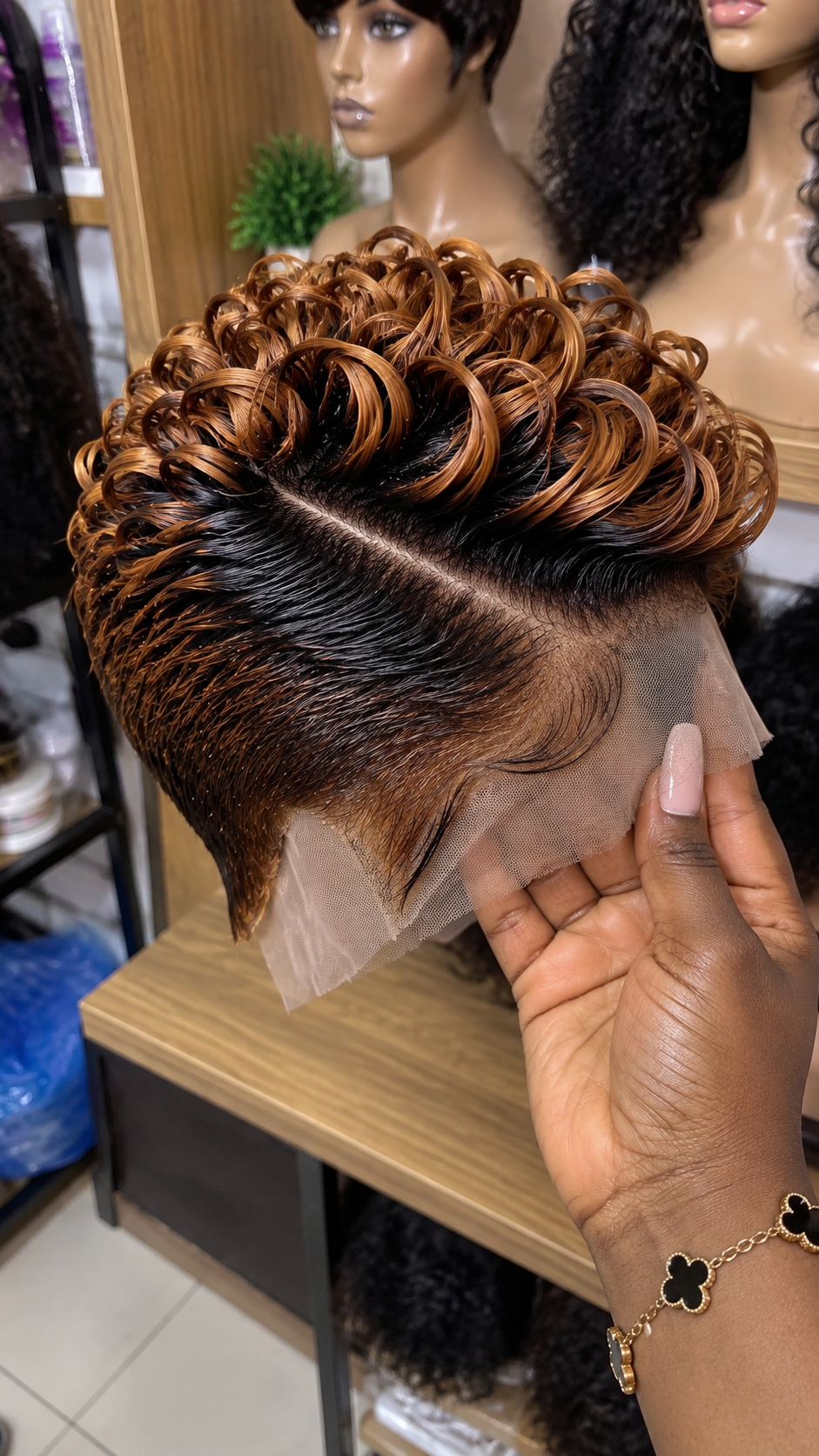
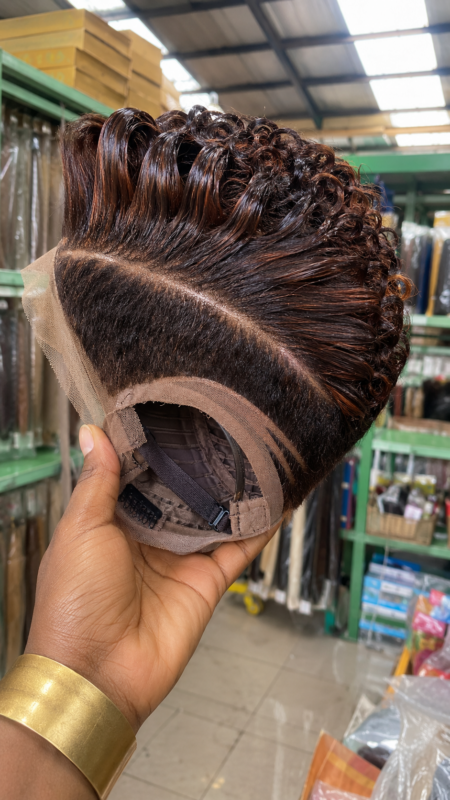
The appeal of this amber-caramel wig begins with an interesting contrast between height and direction. Across the crown, long strands rise from a deep espresso foundation and bend into broad, open ribbon curls. Beneath that elevated arrangement, the hair takes a completely different route: closely aligned strands sweep diagonally toward the lower side, gradually revealing warmer brown tones near their ends. A visible part separates these two styling areas, while a delicate curved strand near the front perimeter completes the composition.
This is not a conventional curly wig with randomly arranged ringlets. Its upper sections are deliberately lifted and folded, creating elongated arches with dark openings underneath. The lower hair remains comparatively flat and directional, allowing the crown to carry most of the volume. The result is a compact sculpted hairstyle that uses contrasting hair lengths and carefully positioned caramel tones instead of decorative shaved patterns.
The photograph shows the wig being held inside a hair retail store before installation. Untrimmed beige-toned lace extends beyond the front and side hair-bearing areas. The image clearly reveals the curl structure, diagonal part, color distribution and perimeter styling, but it does not establish the actual hair composition, commercial lace grade or complete cap construction. Those specifications must be confirmed with the supplier before purchasing.
The Crown Silhouette Is the First Detail Worth Reproducing
The upper sections create a noticeably elevated profile without becoming excessively full. Several caramel-colored ribbons rise almost vertically from the dark roots before bending backward into open arches. Their shapes differ from small circular finger coils because the individual loops are longer and more elongated.
This construction gives the crown movement even when the wig remains stationary. Some sections turn forward slightly, while others travel toward the rear, creating an overlapping arrangement that follows the rounded foundation.
When commissioning a similar wig, crown height should be discussed before curl diameter. The stylist needs to understand how far the front ribbons rise and where they begin leaning backward.
Increasing the elevation substantially would produce a taller hairstyle. Flattening the loops would make the result resemble ordinary backward-combed hair. Neither approach would accurately reproduce the reference.
Amber Caramel Is Concentrated Along the Raised Ribbons
The lighter hair appears primarily across the elongated loops. Its color ranges visually from amber caramel to warm copper-brown, with some golden reflections where the strands catch the shop lighting.
The dark foundation remains visible between the lifted sections. Rather than displaying one uniform caramel surface, the crown alternates between reflective upper ribbons and deeper recessed hair.
This placement makes the sculpted construction easier to recognize. Each lighter strand traces the direction of a loop, allowing the viewer to follow where the hair rises, curves and turns backward.
A custom colorist should consider the arrangement of the finished hairstyle before placing the warm tones. Traditional straight highlights may not produce the same appearance after the hair has been folded into broad curls.
The Espresso Foundation Provides More Than Color Contrast
Deep espresso and near-black hair dominate the roots and appear extensively through the side. This dark base visually anchors the brighter upper curls and creates shadow beneath their openings.
The foundation is especially important around the diagonal part, where black strands establish a clear difference between the raised crown and the flatter side.
For an accurate reproduction, the darker hair should remain substantial. Lightening the entire unit to caramel would remove the relationship between the upper loops and lower styling.
The photograph does not prove that several specific hair dye formulas were used. Reflected light can produce variations within a single warm-brown shade. Buyers should therefore obtain a neutral-light color photograph before approving custom processing.
The Diagonal Part Controls the Movement of Both Sections
A narrow scalp-toned division runs through the visible side beneath the crown. It begins near the forward upper area and travels diagonally backward, forming a distinct boundary between the raised loops and closely directed lower strands.
This part is essential to the structure. Above it, hair rises and folds into large caramel arches. Below it, strands travel more horizontally toward the back.
Moving the division significantly would change the apparent proportions. A lower part could make the elevated crown seem larger, while a higher position would leave more room for the flatter side.
For a custom wig, the parting should be established before the final curl setting. Its direction influences the placement of neighboring hair sections and should be included in the production brief.
The Lower Side Uses a Broad Directional Sweep
The side beneath the diagonal division has a quieter but equally deliberate arrangement. Long dark strands follow a backward path, gradually revealing warm brown and caramel tones toward the lower rear.
Unlike the crown, these strands do not form large open curls. They remain closer to the foundation, producing a series of elongated movements that support the upper hairstyle.
This contrast creates visual balance. The crown supplies height and open space, while the side provides lengthwise direction.
A stylist recreating the look should not automatically add carved barber lines or additional circular loops to the lower section. The reference depends on flowing strand placement rather than exposed decorative channels.
Warm Brown Ends Give the Side a Gradual Color Transition
The lower side becomes noticeably warmer as the strands extend backward and downward. Dark roots occupy the upper area, while caramel and chestnut-brown tones appear more strongly through the lower lengths.
This creates continuity with the brighter crown without requiring the entire side to become golden.
The change is particularly attractive because the warm color follows the direction of the strands. Instead of forming isolated patches, it appears as flowing ribbons extending through the side.
For custom coloring, the buyer should request a dark-root foundation with warm brown movement through the lower lengths. A hard horizontal color boundary would produce a different result.
The Small Perimeter Curl Provides a Finishing Accent
Near the lower front lace, a fine dark strand curves inward into a small circular flourish. Its size is modest compared with the large crown loops, but its position gives it visual importance.
This strand creates a decorative endpoint for the sweeping side hair. It also connects the dark front section with the warmer movement behind it.
The curl should be kept relatively delicate. Enlarging it substantially would create a stronger graphic element than the one visible in the photograph.
During installation, the stylist should examine this strand before trimming the lace or adjusting the perimeter. Removing it automatically would eliminate a recognizable detail.
Why This Design Does Not Need Carved Side Patterns
The photograph shows no prominent decorative razor channels across the visible side. The styling achieves its character through raised loops, diagonal separation, backward strand movement and selective color placement.
That distinction makes the wig suitable for buyers who appreciate sculpted hair but do not want elaborate side geometry.
It also changes the maintenance requirements. There are no intricate exposed channels that need to be preserved through repeated precision cutting.
The main responsibility is retaining the directional arrangement and avoiding unnecessary reduction of the lower hair density.
For made-to-order work, the customer should explicitly request the uninterrupted flowing side rather than allowing the maker to add popular barber-inspired details.
The Untrimmed Lace Needs Individual Fitting
Beige-toned mesh extends beyond the front and lower side. This indicates that the wig has not yet been trimmed to fit a particular wearer.
The excess lace gives the installer material to work with when establishing the final position. Because the crown and side have fixed directional styling, cap placement should be confirmed before cutting.
The apparent lace color may be influenced by surrounding lighting and the hand holding the wig. Its precise shade cannot be reliably determined from the photograph.
Buyers should ask the seller what lace material and colors are available. A visible fine mesh does not automatically establish HD lace or guarantee adhesive-free installation.
The Cap Should Be Evaluated Separately From the Hairstyle
The photograph emphasizes the exterior hair arrangement and lace perimeter, but the complete interior cap is not shown clearly enough to verify every component.
A buyer should request an underside photograph of the actual unit before ordering, particularly when attachment methods or cap sizing matter.
The seller should explain whether the wig includes adjustable straps, combs or other fastening components and whether those can be customized.
These practical specifications can affect installation and comfort without changing the appearance of the crown.
Choosing a Cap Size for a Directional Crown
The diagonal part and elevated front loops are fixed to the wig foundation. If the cap sits too far forward or backward, the hairstyle may appear positioned differently from the reference.
Accurate sizing is therefore important for maintaining the relationship between the crown and side.
Follow the manufacturer’s measurement chart and provide all requested dimensions. Depending on the construction, circumference, front-to-nape length and ear-to-ear width may be relevant.
A professional wig stylist can help collect these measurements before an expensive made-to-order unit is commissioned.
Finding a Professional Who Can Create Elongated Ribbon Loops
The upper construction requires different skills from ordinary loose-curl styling. A maker must lift individual hair sections, arrange them into elongated arches and maintain their separation across the rounded crown.
The lower side also requires directional setting so the hair follows a flowing backward route rather than forming more circular curls.
Custom lace-wig studios and stylists experienced with sculpted pixie crowns are practical places to begin.
When evaluating a portfolio, look for examples with long folded sections, dark root contrast and carefully arranged side hair. A maker specializing only in small corkscrew curls may not automatically reproduce this broader loop structure.
Where to Purchase a Similar Amber Caramel Wig
Specialist wig makers, hairpiece customization studios and wig retailers offering made-to-order styling can potentially supply comparable units.
A ready-made dark-root caramel wig may provide a suitable foundation, but the crown could still require professional shaping.
Before purchasing an unfinished unit, ask whether its hair length and density are sufficient for the elevated ribbon construction.
If a seller offers the completed appearance, request photographs of the actual available wig rather than relying solely on an earlier example.
Customers should also clarify whether the listed price includes finished styling, lace preparation and any fitting services.
A Precise Order Brief Should Follow the Hair’s Direction
The custom specification should begin with the crown: tall elongated caramel ribbons rising from dark roots, with open arches that progressively lean backward.
Next, describe the diagonal side part and its position beneath the raised hair.
The lower section should consist of closely aligned espresso strands flowing backward, with warmer chestnut-caramel tones becoming visible toward the ends.
Finally, identify the small curved perimeter strand and confirm that no decorative side carving should be added.
Cap measurements, available lace shades and installation preferences can then be discussed as separate practical requirements.
Approval Photographs Should Show the Loops From the Side
A direct side photograph is particularly useful for this design because it reveals the height and direction of the upper arches.
An elevated crown image should show whether neighboring loops remain separate and whether the caramel surfaces follow the intended arrangement.
A rear three-quarter view can confirm how the crown transitions into smaller curled sections.
A close photograph of the front lace and small perimeter curl can help the buyer approve the finer styling before shipping.
Where available, these images should show the actual commissioned unit rather than unrelated portfolio pieces.
Price Evaluation Should Begin With the Styling Work Included
A compact wig with broad ribbon curls may require considerable professional setting even though it does not contain elaborate carved lines.
The price can also reflect the amount of color processing, hair quality, cap construction and lace preparation.
For comparison purposes, the following categories offer illustrative budgeting ranges rather than confirmed retail quotations.
Estimated Pricing for an Amber Caramel Ribbon-Crown Wig
| Category |
Illustrative Price Range |
Potential Scope |
| Premium Custom |
$320–$575+ |
Higher-grade hair, individual cap measurements, tailored amber-caramel color placement, hand-arranged elongated loops, directional side setting and lace preparation. |
| Standard Custom |
$195–$345 |
Prepared caramel ribbon crown, dark-root foundation, diagonal side part and established lower directional styling. |
| Basic Human Hair |
$115–$210 |
A human-hair foundation potentially requiring additional coloring, crown construction, side setting and professional installation. |
| Premium Synthetic |
$75–$155 |
A pre-colored and pre-set option that may retain the loop arrangement with fewer professional styling appointments. |
| Basic Synthetic |
$35–$90 |
A budget interpretation with potentially simpler color placement, loop separation, directional styling or cap construction. |
Actual prices depend on the seller, location, hair or fiber, customization labor, cap material, shipping and fitting. The photograph does not verify the wig’s material or retail price.
When comparing quotations, ask whether the elongated crown and flowing side are already finished. A less expensive foundation requiring additional salon work may ultimately cost more than a completed custom piece.
Human Hair Can Offer Greater Freedom for Future Reshaping
A human-hair version may allow the ribbon loops to be professionally reset when they begin losing their shape, depending on the quality and condition of the strands.
Because the warm caramel sections may have undergone color processing, future heat should be selected carefully.
A professional stylist can potentially address individual displaced sections without rebuilding the entire crown.
This targeted approach may reduce unnecessary manipulation and help preserve the original directional arrangement.
Pre-Set Synthetic Hair May Be Practical for Shape Retention
A quality synthetic version can be suitable for buyers who prefer to retain the original sculpted appearance without frequent restyling.
Pre-set fibers may hold their folded sections well, although their response to heat and future adjustments varies.
Conventional permanent coloring methods should not be assumed suitable for synthetic fiber.
The exact material must be confirmed before heated tools or chemical processes are used.
The Upper Loops Require a Different Washing Approach From the Side
The crown contains raised arches with spaces between them, while the lower side relies on elongated strands arranged closer to the foundation.
During washing, avoid aggressive rubbing that mixes neighboring loop sections. Such friction can cause the open arches to collapse or become intertwined.
The side should be handled in the direction of its existing movement rather than brushed upward into the crown.
After drying, restore only the sections that have shifted. Photographs taken before the first wash can provide a valuable reference for the original styling.
Preserve the Small Perimeter Curl During Maintenance
The fine curled strand near the front is a small but recognizable design element. It should not be enlarged, removed or converted into a broader wave without a deliberate styling decision.
If the curl loses its inward-turning shape, a professional may be able to restore it using methods appropriate for the confirmed hair or fiber.
Avoid excessive holding product around the delicate strand because buildup can cause it to adhere to neighboring hair.
Preserving its original scale keeps the front consistent with the photographed reference.
Warm Color Maintenance Should Protect the Dark Root Areas
If a human-hair version eventually requires color refreshing, the darker espresso foundation should remain part of the plan.
The contrast between black roots and amber-caramel loops contributes to the crown’s dimensional appearance.
Applying one uniform light-brown formula throughout the entire wig could reduce that effect and alter the side’s darker directional movement.
A colorist should evaluate the existing shade placement before deciding which sections need refreshing.
Product Buildup Can Reduce the Ribbon Separation
The upper hair already has a reflective appearance. Excess oils or waxes may cause neighboring ribbons to stick together and obscure the open spaces between the arches.
Heavy residue can also make the caramel surfaces appear darker or less distinct from the foundation.
Use styling products sparingly and according to the confirmed material.
If buildup becomes noticeable, suitable cleansing may restore the appearance more effectively than adding additional shine product.
Professional Installation Should Preserve the Existing Crown Height
When the finished wig arrives, inspect the crown, diagonal part, side movement, lace and cap before permanent changes.
The installer should establish the cap position and check that the upright loops remain proportionate above the close side.
Only after the placement is approved should the excess lace be trimmed and optional styling adjustments considered.
If the loop construction has survived shipping intact, extensive restyling may be unnecessary.
Storage Should Support the Tall Arches
The elevated ribbon loops are vulnerable to compression. A suitable wig stand or mannequin head can help preserve their open construction between wears.
Avoid stacking objects over the crown or pressing the flowing side against hard surfaces.
The cap and lace should be fully dry before storage.
For travel, use packaging deep enough to prevent the upper arches from being flattened.
The Most Valuable Detail Is the Contrast in Hair Direction
This amber-caramel wig demonstrates how a sculpted crown can create a distinctive hairstyle without extensive side carving. Elevated caramel ribbons provide height and open movement above, while deep espresso roots connect them to a flatter side with warm brown lengths and a delicate perimeter curl.
For buyers, the essential checkpoints are loop height, spacing between the arches, caramel placement, dark root depth, the diagonal part, side direction, small front curl and available lace for fitting.
For wig businesses, a product listing should explain these characteristics through carefully chosen photographs rather than presenting the unit simply as a brown curly wig. A side profile reveals the crown’s construction, while elevated and rear views help customers assess the rest of the styling.
The strongest recreation will preserve the original directional relationship. Adding carved lines, excessive crown density or brighter blonde sections would produce a different hairstyle rather than a more accurate interpretation. The appeal comes from coordinated movement between the raised amber ribbons and the flowing espresso-brown side.
Search Terms
amber caramel ribbon curl wig · espresso root sculpted loops · diagonal part brown lace wig · copper brown elevated crown · flowing caramel side hairpiece · open arch ribbon wig · delicate perimeter swirl wig · untrimmed lace amber hairstyle