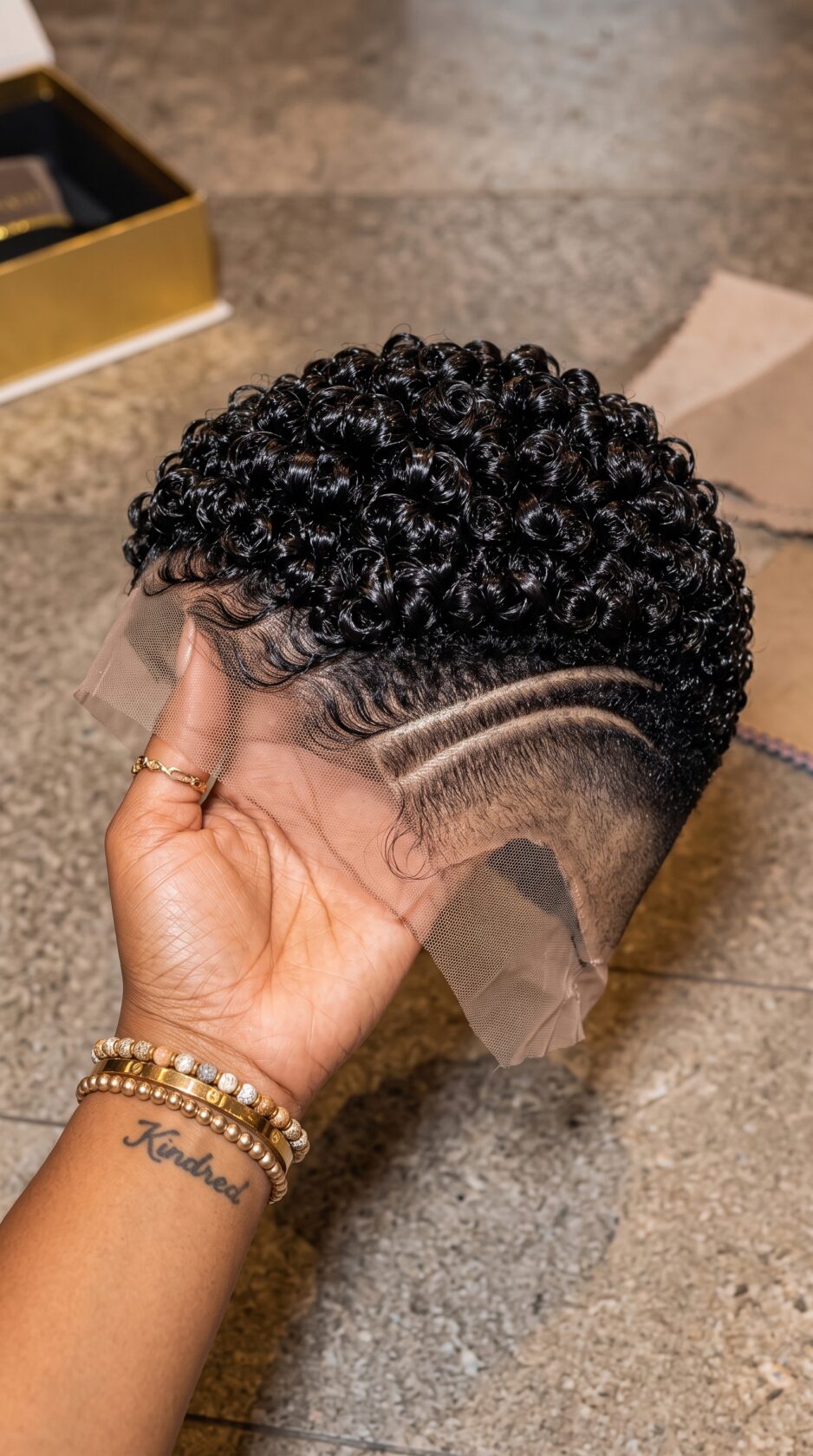
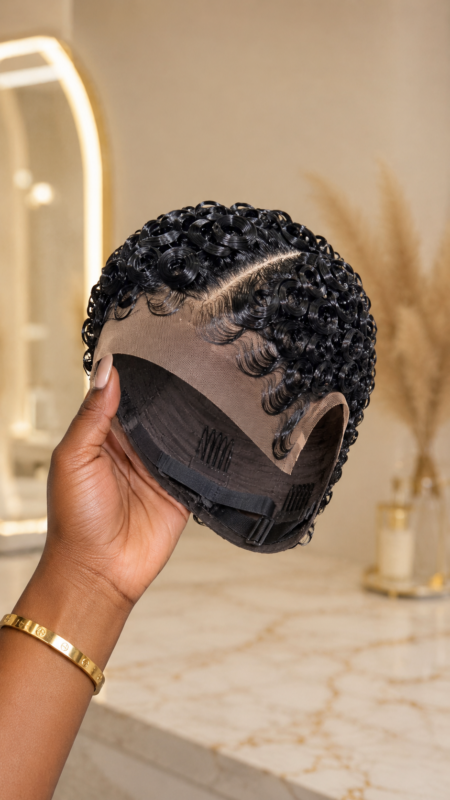
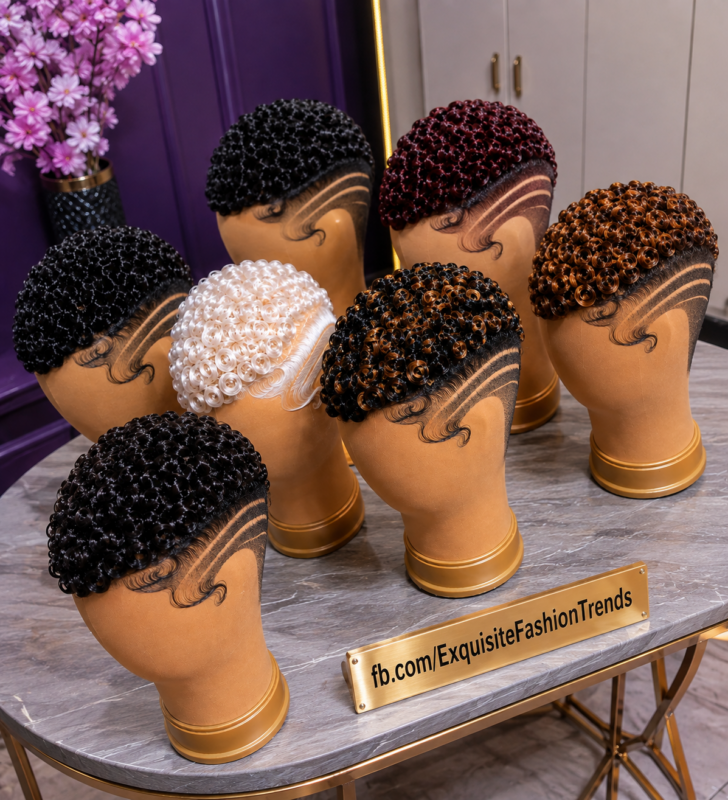
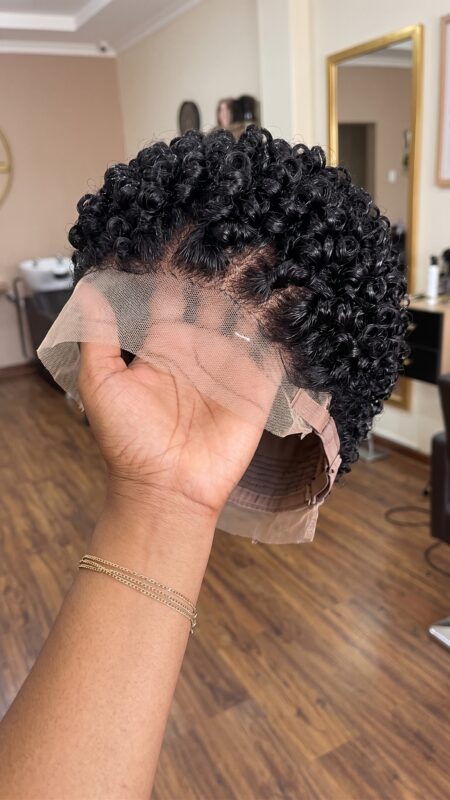
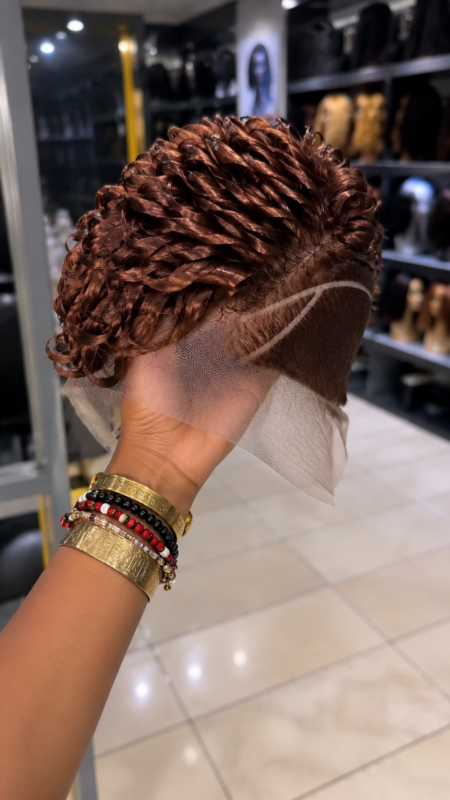
The most convincing part of this hairline is also the part with the shortest life. Look at the very front edge, where single fine hairs are knotted into the lace one at a time and thin out to almost nothing before the tulle takes over. That soft, sparse fringe is what makes the unit read as hair growing from skin rather than a wig sitting on top of one. It is the hardest thing on the whole cap to build, and it is the first thing that goes. Those wispy edge hairs break under a comb, shed in a wash, and snag on collars and pillowcases, and once they are gone almost nobody re-knots them. So the detail that sells this curly pixie wig is the detail with the shortest clock on it.
A real hairline is not a line at all, it is a gradient. Behind the fringe the density builds gradually, single knots giving way to fuller hair and finally the tight glossy coils on the crown. That graduation, sparse to dense, is the entire trick. A cheap unit skips it and knots the hair in a blunt wall right up to the edge, which is why a bad hairline looks like a hairline and a good one disappears. What the hand is holding here is the expensive version, the graded kind, photographed on its best day.
Which is the thing to understand before you pay: the pristine edge in this photo is the unit at its absolute peak. It will not look exactly like this in six months, not because the wig is bad, but because the finest hairs that make it perfect are the ones with the least staying power. Buy it knowing that, and you buy it right.
Where To Buy A Curly Pixie Wig With A Graded Hairline
Custom makers and lace studios are the only reliable source for a graded, hand-knotted hairline like this, because it is slow handwork that cannot be faked at scale. Ask directly whether the edge is knotted sparse-to-dense or blunt to the lace, and whether the fine hairs are single-knotted. A maker who grades hairlines will know exactly what you mean; a reseller will steer you back to the curls.
Instagram and TikTok sellers carry plenty of graded-hairline pixies, but you have to see the edge in motion. Ask for a close video of the front where light passes through the fringe, because a still photo can flatter a hairline that is thinner or blunter than it looks.
Etsy works with makers who show macro shots of the hairline and real buyer photos taken weeks in, where you can see how the edge held up. The risk is a listing photographed on day one, when every edge looks perfect. Read reviews for anyone mentioning how the front aged.
Marketplaces like Amazon, AliExpress, and Temu usually ship a blunt hairline knotted straight to the lace, not a graded one. That is acceptable if you plan to thin and lay the edge yourself, and a disappointment if you expected the graded fringe in the photo. Match your expectations to the price.
Local beauty supply shops and salons let you look at the edge under real light and up close, which is the only way to judge graduation honestly. You pay a premium in-store, but the hairline is exactly the thing a screen hides.
Vendors and wholesalers direct make sense across several units with a minimum, though hairline quality swings widely between pieces. For one unit with a graded front, a maker is the safer buy.
Regionally, finely graded hairlines on short units come strongest out of Lagos, Accra, Atlanta, London, and across South Africa, where knotters who grade edges by hand are easy to find on video.
Vet the seller the usual way: account age, real buyer photos over studio shots, a plain question timed for a genuine reply, and a close-up video of the hairline edge specifically. A seller who will not film the fringe up close is not confident in it.
Red flags: a hairline shown only from a flattering distance, a photo reused across listings, a price far under other graded units, and full payment demanded before shipping.
When you order, send a reference of your natural hairline, your measurements, and a note on how soft or defined you want the edge, because a graded fringe can be built denser to last longer or wispier to look more natural. Say which you value more.
On payment, thirty to fifty percent down with the balance before shipping is standard for custom hairline work. Use a method you can dispute, and ask for a close photo of the finished edge before releasing the last part.
Contact / Order Inquiries: WhatsApp [WhatsApp: +XX XXX XXX XX XX]
How Much It Costs
On a dark unit like this there is no colour premium, so almost the entire price sits in the hairline and the knotting. Understanding that keeps you from overpaying for curls and underpaying for the edge that actually matters.
Human hair, full build, glueless cap with bleached knots and a finely graded, single-knotted hairline on a fine lace: roughly $200 to $430. Human hair, mid build with a simpler graded edge: about $150 to $310. Human hair, basic cap with a blunt hairline: around $70 to $180. Good synthetic with defined curls: $60 to $140. Basic synthetic: $20 to $55.
The premiums here are all at the front. A fine HD lace that vanishes into skin runs another $20 to $50. Fully bleached knots so the edge does not read as dots add $15 to $40. A graded, single-knotted fringe is itself skilled time, often $25 to $60 above a blunt one, and it is the single add-on most worth paying for on a hairline you want to look real. Note that none of this is about the amount of hair; a graded edge uses fewer hairs at the front, not more.
Shipping and any customs charge sit outside all of it and change with where you live, so set a realistic band and check your own country’s import rate rather than trusting one flat figure.
Then the later costs, most of which protect or restore the edge. A canvas block and pins, a soft brush kept for the hairline only, a silk scarf for sleeping, and eventually a maker who can re-knot a thinned fringe if you can find one willing. First-year math, honestly: unit plus shipping plus any customs plus a small gentle-care kit plus maintenance tends to land between a low three-figure total and roughly double the sticker, with edge care being the ongoing part rather than a big lump.
Per wear it drops fast with regular use, but the edge sets the real lifespan of the natural look. A very low price on a graded-hairline unit almost always means the edge is blunt, the knots are unbleached, or the fringe is sparse in a way a distant photo hides. The close-up view tells you before the price does.
Deposits follow the custom pattern: thirty to fifty percent to start, balance before shipping, and a close photo of the finished hairline before the last payment clears.
Shipping, Delivery, And What To Expect After Ordering
The hairline is the fragile cargo here, so ask how the edge is protected in the box before it ships, since a crushed or tangled fringe is hard to recover. Choose a tracked service for custom hairline work, and confirm your own country’s import charge in advance so it does not surprise you. When it arrives, handle the edge as little as possible while you cut the lace and place the unit, because every extra touch on those fine hairs costs the edge some of its life. What you unbox is the hairline at its very best; your job is to slow how fast it leaves that state, not to expect it to stay there forever.
The Edge Is A Density Gradient, Not A Line
The reason this hairline looks real is that it fades from almost bare lace to full density over a small band, mimicking how hair actually thins at the edge of a scalp. A blunt hairline, knotted to the same density right up to the lace, always reads as a wig no matter how good the hair is. When you judge a unit, look for that graduation specifically. It is the difference between a hairline that disappears and one that announces itself.
The Finest Hairs Fail First And Nobody Replaces Them
The single knotted hairs at the very front are held by the smallest knots and carry the most stress from combing, washing, and daily friction, so they break and shed before anything else on the unit. Most makers will not re-knot an edge once it thins, and doing it well is rare and costly. This is why the honest lifespan of the natural look is set by the edge, not the curls, and why gentle handling of the fringe extends the whole unit’s convincing life.
The Curls Outlast The Hairline
The tight coils on the crown are durable and bounce back after washing, which means they will still look good long after the edge has softened. That mismatch matters: people often replace a unit like this not because the hair wore out but because the hairline did. Judge the curls for spring, but understand they are not what times the unit out.
Before You Pay
- Is the hairline graded from sparse to dense, or knotted blunt to the lace?
- Are the front hairs single-knotted, and are the knots bleached so they do not show?
- How fine is the lace at the very edge where it meets skin?
- Will the maker re-knot the fringe later, or is the edge a one-time build?
- Can I see a close, moving video of the hairline rather than a distant still?
Trimming The Lace
Cutting the lace on a graded hairline needs a lighter hand than usual, because the fine edge hairs sit right where your scissors go. Trim in small offset steps, leave a shallow margin instead of cutting flush, and keep well clear of the fringe itself so you do not lose the hairs that make the edge work. A jagged cut is unforgiving next to a delicate hairline, so if this is your first graded unit, let a stylist make the first pass and preserve the fringe as they do it. Once those edge hairs are cut or lost, they do not come back.
Search Terms
curly pixie wig · graded hairline pixie wig · single knotted edge wig · realistic hairline curly unit · bleached knots pixie wig · hd lace short curly wig · natural edge pixie unit · hand knotted hairline wig
Final Thoughts
This unit is a showcase of the one skill that separates a convincing wig from an obvious one: a hairline built as a gradient, single hairs knotted to fade from bare lace into full density. Photographed fresh, it looks like hair growing from skin, and that is worth real money. But the same fine hairs that make it perfect are the ones with the least staying power, and no amount of good hair on the crown changes that.
Buy it for the hairline, because that is what you are truly paying for, and judge it close up and in motion before you commit. Then wear it understanding that the edge in the photo is a peak, not a permanent state. Handle the fringe gently, sleep in silk, keep a soft brush for the front alone, and you stretch the convincing years out. Treat it like the durable curls behind it and the edge thins fast, and one day the hairline that sold you the unit is the reason you retire it. The curls were never the question. The edge always was.