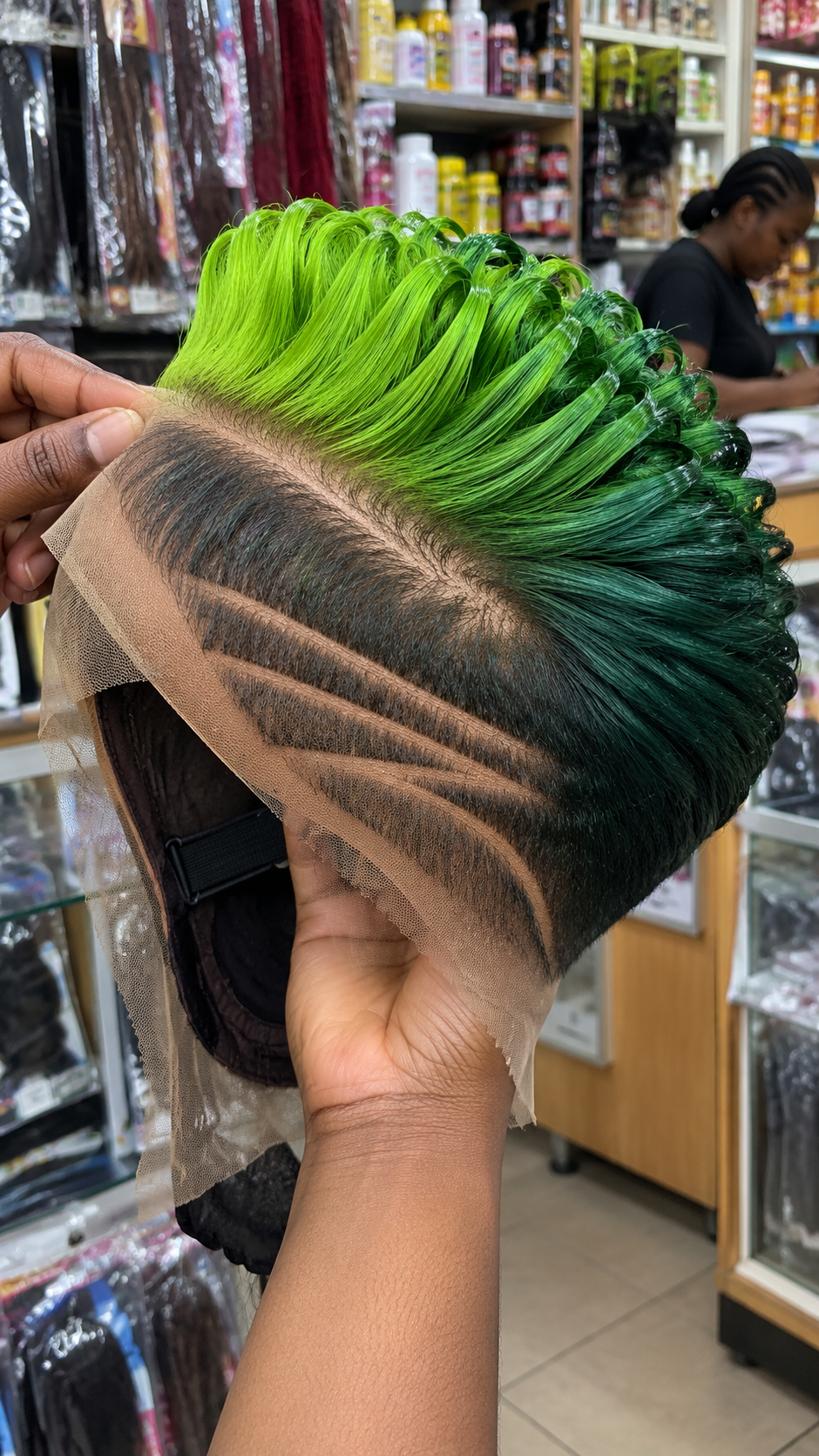
Some pixie wigs are designed to complement an outfit quietly. Others become the centerpiece of the entire appearance. This vivid green lace wig clearly belongs to the second category, combining an electric lime crown with deeper emerald and forest-green sections that sweep backward into raised ribbon curls. Beneath the colorful upper styling, a closely cropped charcoal-black side carries two long diagonal carved channels, creating a striking contrast between vivid color and barber-inspired precision.
The photograph captures the unit before installation, held open inside a hair supply shop. The untrimmed beige lace extends around the front and lower side, while part of the dark interior cap and an adjustment strap are visible. These details are especially valuable for shoppers because they allow the hairstyle to be assessed independently of a model’s face, makeup, or clothing.
Unlike a conventional curly pixie with a uniform spiral crown, this wig relies on elongated strands that rise from the front and curve backward. The transition from bright lime to darker green is closely associated with the direction of the hair. Its color placement, silhouette, and carved side pattern all need to be considered together when purchasing or commissioning a similar unit.
The Color Transition Is the Main Attraction
The most immediate visual characteristic is the brilliant neon lime green concentrated across the front and upper portion of the crown. The color is exceptionally bright, with yellow-green undertones that become particularly noticeable along the raised strands.
Moving toward the middle, the shade changes into a more saturated grass green. Farther backward, deeper emerald and forest-green tones become prominent, especially where the hair curves downward and approaches the rear of the visible hairstyle.
This is not a simple two-color wig with an abrupt dividing line. Several intermediate green tones appear along the swept strands, producing a gradual transition from lime through medium green into darker emerald.
The closely fitted side introduces a separate dark charcoal-black foundation. A subtle green cast is visible in some areas, but the side does not share the intense neon coloring of the upper crown.
Glossy reflections enhance the brighter strands, particularly near the front. However, photographic lighting and finishing products can influence the apparent intensity of the color. The exact dye formula or manufactured fiber shade cannot be established from the image.
Specifying the Direction of the Green Gradient
For a custom order, the color direction matters as much as the shades themselves. The brightest lime sections occupy the forward upper area, while deeper greens become increasingly visible toward the rear.
A wig with dark green roots and neon green tips could look very different if those colors were distributed vertically across every strand. Likewise, a uniformly fluorescent green unit would lose the darker rear contrast.
Ask the supplier to reproduce the visible front-to-back progression rather than describing the hairstyle only as a green ombre pixie.
Request photographs under daylight and neutral indoor lighting. Neon greens can appear more yellow, more blue-green, or less saturated depending on the camera and lighting conditions.
When ordering from a color chart, compare actual fiber samples where possible. Terms such as lime, electric green, emerald, and forest green can vary considerably between manufacturers.
Elongated Ribbon Curls Instead of a Circular Ringlet Crown
The upper hairstyle differs from wigs covered in small circular finger coils. Its front sections consist of elongated strands that rise upward and travel backward in a coordinated direction.
Several strands form broad ribbon-like curves. Their surfaces are relatively flat and glossy, allowing individual fibers to remain visible as they bend.
Near the upper middle, the hair begins forming larger arches and partially open loops. Toward the rear, the curves become more closely clustered, with several sections folding into compact circular formations.
This creates a directional hairstyle rather than a crown made from identical ringlets. The front appears more upright and elongated, while the rear contains a greater concentration of curved loops.
The silhouette remains compact, with the upper styling elevated above the closely fitted side. There is no long fringe hanging over the front lace.
Why the Front Elevation Must Be Controlled
The front strands rise noticeably, but their length remains proportionate to the overall wig. Excessive height would turn the design into a much larger pompadour, changing the balance between the crown and side.
Conversely, flattening the front would reduce the dramatic color transition and make the upper styling less recognizable.
When commissioning this hairstyle, request a side photograph showing the full height of the front section. A front-facing photograph alone may not reveal whether the strands rise at the intended angle.
Ask whether the hairstyle is designed to retain its shape after washing or whether professional resetting will be necessary. The answer depends on the fiber, construction, and styling method.
Two Diagonal Channels Across the Charcoal Side
The lower visible side contains two prominent carved channels that extend diagonally backward. They are positioned beneath a broad area of closely cropped dark hair.
The upper channel begins near the front side and continues toward the rear in a relatively straight, gently descending direction. The lower channel follows a similar path before curving more noticeably downward near its visible ending.
The exposed underlying surface appears lighter than the surrounding hair, making both separations easy to distinguish.
Between the channels, a narrow band of dark hair remains. Beneath the lower channel, another closely fitted section continues toward the lace perimeter.
The channels are not finger waves or colored highlights. They resemble barber-inspired carved separations formed through the dark side hair.
Evaluating the Side Pattern Before Custom Cutting
A buyer should not assume that an ordinary pixie wig can be converted into this design simply by cutting two lines. The feasibility depends on the density and placement of hair over the cap.
Removing too much hair can expose the underlying construction or create permanent gaps. A specialist familiar with lace wigs should evaluate the side before any cutting takes place.
Ask the supplier whether the channels are incorporated during manufacturing or created during final styling. The photograph shows the visible result but cannot establish the production method.
For accurate reproduction, provide a full side reference and specify the spacing, direction, and length of the two channels. Adding extra lines or changing their angles would alter the design.
The Exposed Diagonal Part Separates Two Hair Lengths
Another important structural detail is the diagonal separation between the colorful upper hair and the closely cropped side. This parting channel is visible beneath the green strands and runs backward across the upper side.
It creates a boundary between the longer, elevated ribbon curls and the darker hair below.
The part should not be confused with the two lower carved channels. Its position is higher, and its role is to separate the upper styling from the tapered side.
This distinction is important when describing the hairstyle to a wig maker. The design contains an upper parting separation and two lower diagonal decorative channels, not simply three identical razor stripes.
The upper separation also influences the available space for the green curls. Moving it too high or too low could change the proportions of the crown and side.
The Untrimmed Lace Reveals the Pre-Installation Structure
The wig is held with its interior partly facing the camera. Beige lace extends beyond the front hairline and continues around the lower visible side.
Fine dark strands are visible near the front boundary, while the green upper hair begins farther above the hairline.
Inside the cap, dark fabric construction and an adjustment strap can be seen. The strap appears to connect across part of the interior, indicating that the unit includes at least some adjustable hardware.
However, the photograph does not reveal every attachment point or establish the complete fastening system. Additional combs, clips, or security components should not be assumed without further evidence.
The lace appears fine in the photograph, but its exact grade cannot be confirmed. Buyers should request the manufacturer’s specifications rather than relying on visual appearance alone.
Does the Visible Strap Mean the Wig Is Glueless?
Not necessarily. An adjustment strap can help with cap fit, but it does not independently establish that a wig is designed for secure adhesive-free installation.
Ask the supplier whether the unit is specifically intended for glueless wear and which fastening components are included.
Cap circumference, hairline placement, and the wearer’s intended activities can influence the suitability of an installation method.
Request a complete underside photograph showing the cap opened fully. This should reveal the available adjustment hardware, internal seams, and any additional attachment components.
Who Should Consider a Neon Green Pixie Wig?
This hairstyle is especially suited to customers who enjoy expressive hair colors and carefully arranged sculpted cuts. The vivid green crown creates a strong visual statement, while the dark side prevents the entire hairstyle from appearing uniformly fluorescent.
The compact silhouette may appeal to someone who wants noticeable color without the length of a shoulder-length or long wig.
It can be considered for creative photography, celebrations, performance styling, themed events, or personal fashion choices where bright color is a central element.
For regular wear, the buyer should consider how frequently the hairstyle will need resetting and whether the cap provides sufficient comfort.
The color itself does not determine the wig’s durability. Fiber type, manufacturing quality, handling, and care methods are more relevant to long-term performance.
Finding a Wig Maker for Fluorescent Color Placement
A custom wig maker experienced in vivid colors and sculpted pixie styling is a sensible starting point. The supplier should be able to discuss both the green gradient and the raised ribbon-curl construction.
Local wig boutiques may be useful when buyers want to inspect color samples and cap materials in person. Online wig makers can provide additional customization options, but detailed product documentation becomes especially important.
When contacting a supplier, send the photograph and describe the lime-green front, medium-green upper sections, darker emerald rear, charcoal tapered side, diagonal part, and two carved channels.
Ask whether the wig will arrive fully styled or require additional salon work after delivery.
Approving the Color Before Production Is Complete
Bright green shades can vary substantially between samples. Ask the supplier to provide a photograph of the selected fibers or colored hair before the final styling stage.
Confirm whether the neon lime area will remain concentrated toward the front rather than spreading uniformly across the crown.
Request an image showing the transition into darker green at the rear.
Before shipment, obtain photographs from the front, visible side, opposite side, crown, and back. The current reference does not establish the complete rear styling or whether the opposite side contains the same carved pattern.
Clarify the revision policy before payment, particularly for custom coloring and irreversible cutting.
Ready-Made Green Pixies Versus Custom Color Work
A ready-made green pixie may be less expensive and faster to obtain, but its color placement and curl arrangement may differ from the photograph.
Some products may offer uniform neon green curls without the deeper emerald transition. Others may have a similar gradient but lack the raised ribbon styling or carved side channels.
A custom order can provide greater control over these details, although the result depends on the maker’s skill and the available materials.
If considering a ready-made base wig for modification, ask a professional whether the fiber can safely be restyled and whether the side contains enough hair coverage for the desired channels.
Do not assume that synthetic fibers can be recolored using conventional human-hair dye. Material compatibility must be established before any chemical treatment.
Illustrative Pricing for Neon Green Sculpted Pixie Wigs
The following USD amounts are illustrative budgeting ranges rather than verified current product prices. The photographed wig’s actual material, supplier, and selling price are unknown.
| Wig Category |
Illustrative USD Range |
Potential Cost Considerations |
| Premium Custom |
$360–$820+ |
Individual cap sizing, multi-stage green color placement, raised ribbon curls, diagonal parting, and precision twin-channel side work. |
| Standard Custom |
$195–$430 |
Selected cap options with custom green sections and coordinated sculpted styling. |
| Basic Human Hair |
$115–$290 |
A human-hair starting unit that may require specialist lightening, vivid coloring, cutting, and curl setting. |
| Premium Synthetic |
$80–$200 |
A manufactured green pixie with prearranged color placement and curls, depending on available designs. |
| Basic Synthetic |
$35–$100 |
A lower-cost green pixie alternative that may not reproduce the gradient or carved side accurately. |
Vivid green coloring can increase costs when the desired result requires multiple stages of processing or carefully selected colored fibers.
The raised ribbon curls may also require specialist styling, particularly when their direction must remain consistent from front to rear.
Side carving introduces another potential expense because the channels must be coordinated with the cap construction and surrounding hair density.
Additional charges may include lace customization, cap sizing, shipping, taxes, and salon installation.
Request an itemized quotation to distinguish the base wig price from coloring, styling, and fitting services.
Installing the Wig Without Disturbing the Green Sweep
The first fitting should begin with cap alignment. The diagonal part and carved side channels need to sit at the intended position relative to the wearer’s temple.
A professional wig stylist can assess cap comfort, hairline placement, and the suitability of the intended fastening method.
The excess lace should not be trimmed until the correct wearing position has been established. Cutting too close to the fine hairline may damage strands or reduce the available fitting margin.
Once the cap is positioned, the stylist should inspect the raised green strands for compression or displacement caused by shipping.
Any restoration method should be selected according to the confirmed fiber type and manufacturer instructions.
Heat styling should not be applied automatically, especially when the material and color-processing history are unknown.
Protecting the Lime-to-Emerald Color Transition
The vivid green color is a major part of the hairstyle’s identity, so maintenance should focus on preserving both its intensity and its placement.
If the wig contains colored human hair, ask the supplier about its processing history and recommended color-care products. Bright shades may require particular attention to washing frequency, product selection, and exposure to sunlight.
If the wig contains synthetic fibers, conventional recoloring may be unsuitable. Follow the manufacturer’s instructions before attempting any color adjustments.
Regardless of material, avoid excessive handling that mixes the lighter front strands with the darker rear sections. The color transition is most recognizable when the directional styling remains intact.
Maintaining the Ribbon Curls and Carved Channels
The upper strands should be handled carefully to preserve their elongated curves. Repeated brushing can disturb the coordinated backward movement and alter the raised silhouette.
The closely fitted side requires a different approach. Brushing across the carved channels may move hair into the exposed spaces and reduce their visibility.
If the side pattern becomes irregular, consult a stylist familiar with wig construction before attempting additional cutting.
When storing the wig, use an appropriately sized stand that supports the cap without flattening the crown. Avoid pressing objects against the carved side.
For transport, provide enough space for the raised curls and protect the lace from unnecessary folding or snagging.
Evaluating the Design Beyond Its Bright Color
The neon lime crown is undoubtedly the first element most viewers will notice, but the hairstyle’s construction deserves equal attention.
The elongated green strands create movement from front to rear, while the deeper emerald sections introduce tonal depth. The diagonal part separates the colorful crown from the dark tapered side, and the two carved channels add a controlled geometric accent.
These relationships make the design more specific than an ordinary green curly pixie wig.
Before purchasing, verify the fiber, cap measurements, lace specifications, fastening method, and whether the hairstyle is delivered fully finished.
Request complete product photographs and establish whether the supplier can reproduce the color progression and side geometry accurately.
A successful reproduction will preserve the fluorescent lime front, darker emerald rear, elongated backward ribbon curls, charcoal tapered side, upper diagonal part, and two carved channels. Those visible characteristics provide a practical checklist for comparing products and commissioning a custom wig.
Search Terms
Neon lime green swept pixie lace wig · Emerald rear ribbon curl hairstyle · Electric green crown charcoal tapered side · Double diagonal razor stripe green wig · Lime to forest green sculpted pixie · Beige lace front green gradient wig · Raised green ribbon loops with side part · Adjustable strap neon green lace unit