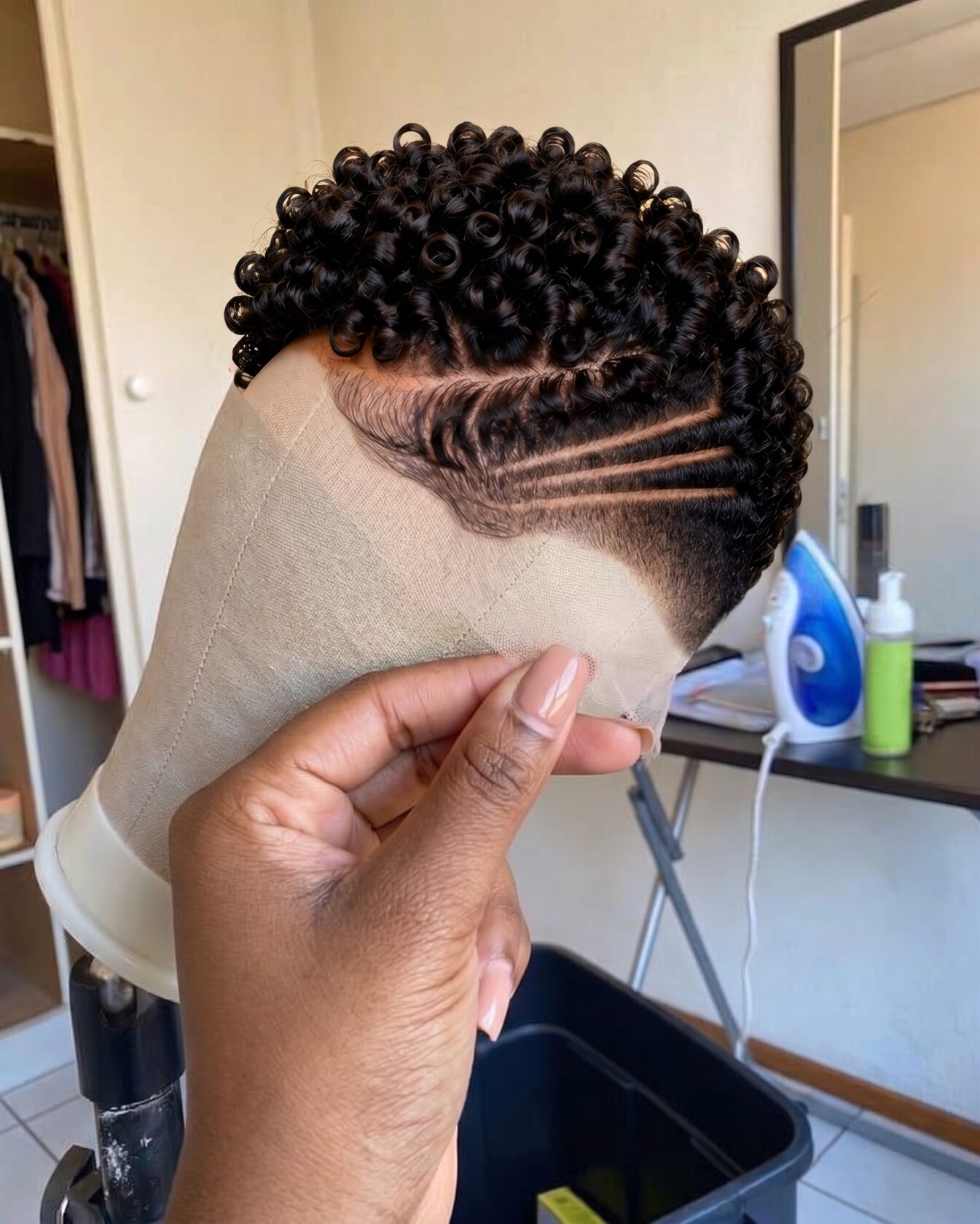
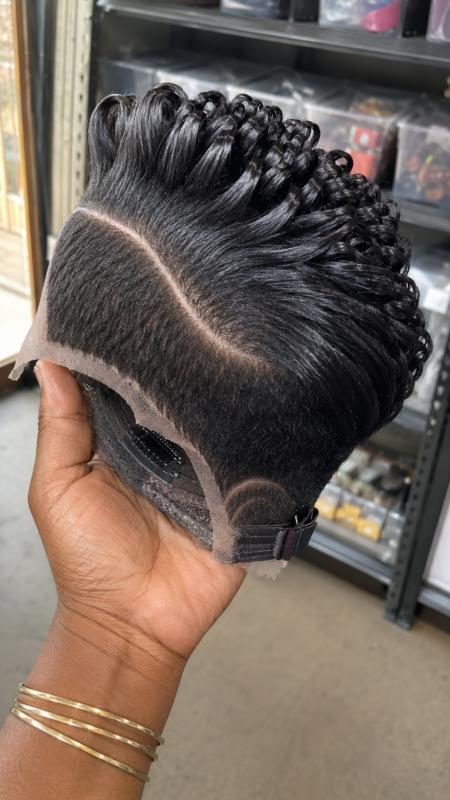
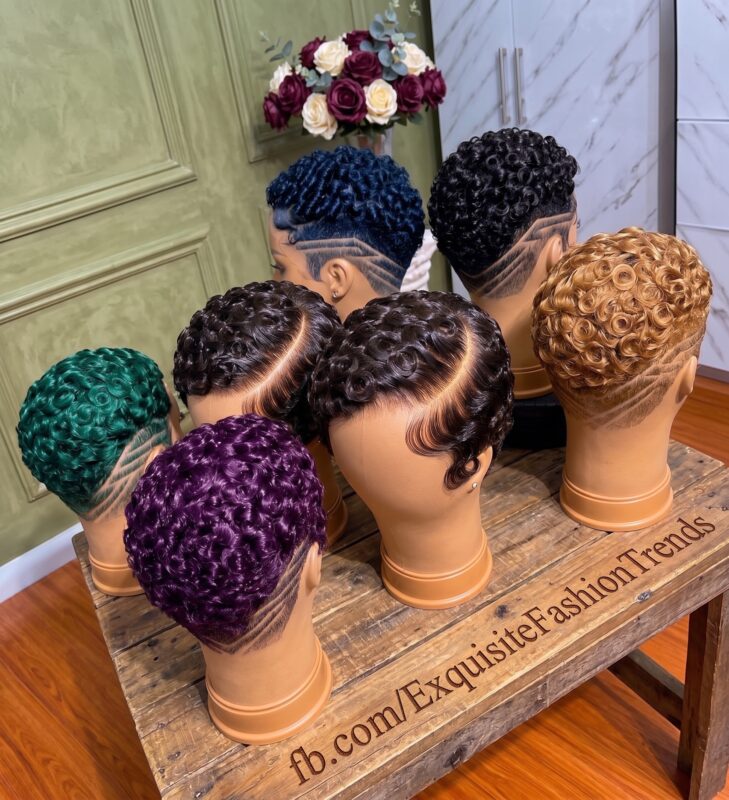
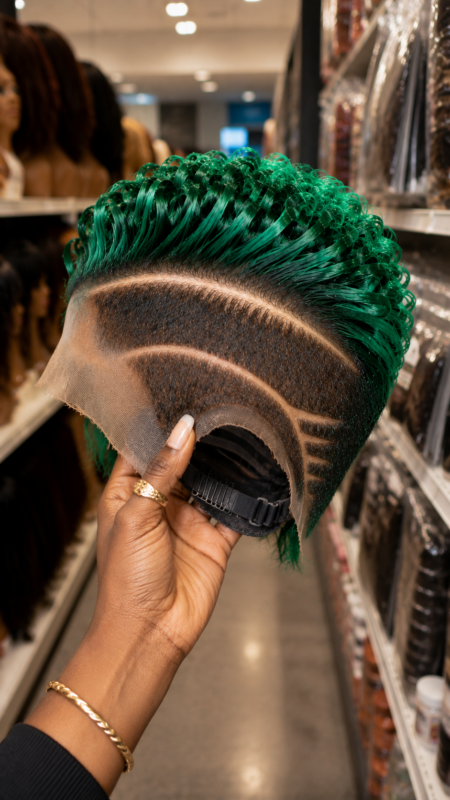
Most buyers see a wide panel of bare lace and assume it means more wig. It means the opposite of what they think. The lace held up in this photo is not the product, it is the mounting surface, and almost all of it gets cut away before the unit is ever worn. What you keep is a thin strip past the hairline, maybe an inch, sometimes less. The rest is scrap the moment the unit meets your own head. So the size of the lace tells you very little about what you are buying, and a seller who leans on how much lace there is may be leaning on the part you are about to throw away.
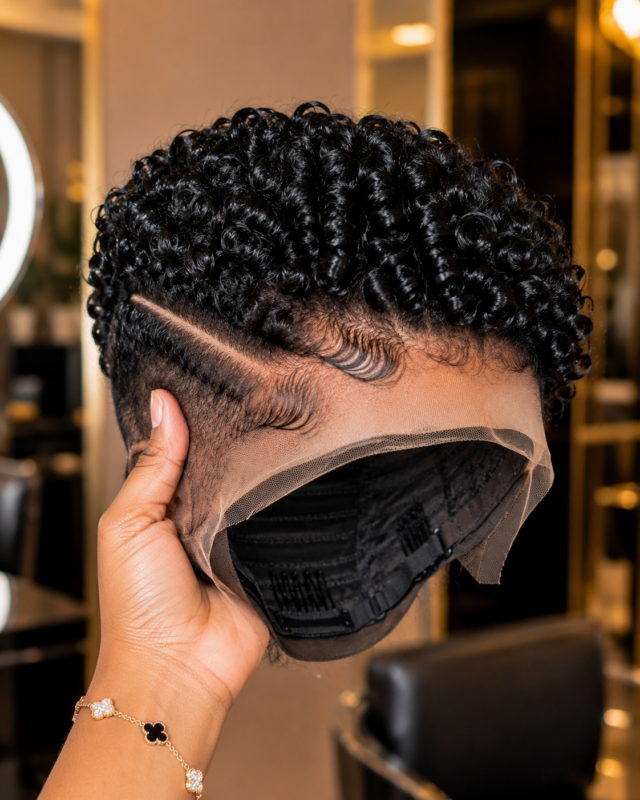
Look at what is actually on that lace. Along the front there is a hand-laid hairline, fine baby hairs and small swept edges set into a soft fade, and above it a crown of tight rod-set curls. That hairline work and those knots are the real product. The acreage of tulle underneath them is working margin, room for you or your stylist to place the hairline where it suits your face and cut to your own shape. Useful, yes. But it is not more hair, more colour, or more curl. It is more to remove.
This is what a lace unit honestly looks like before it is finished, and the gap between this raw photo and the styled result is the whole job. Judge a curly pixie wig on the knotting and the hairline, not on the sheet of lace a hand is holding up.
Where To Buy A Curly Pixie Wig With A Laid Hairline
Custom makers and lace studios are the right call when the hairline is pre-laid like this, because the value is in that handwork and it needs to suit your face, not a stranger’s. Ask whether the edges are set with product for the photo or knotted to last, and whether they will lay the hairline to a reference of your own forehead. A maker who does the hairline by hand will talk you through it; a reseller will change the subject to the lace size.
Instagram and TikTok sellers carry most laid-hairline pixies, and the underside is what you want to see. Ask for a video of the unit turned inside out so you can see the knots and how dense the hairline is. A pretty front means little if the knots behind it are sparse.
Etsy works with makers who post real finished photos, not just raw-unit shots like this one. The risk is a listing that shows a beautifully laid hairline on the display unit and ships you a plain lace you have to lay yourself. Read reviews for whether the edges arrived done.
Marketplaces like Amazon, AliExpress, and Temu tend to ship exactly this: a lot of raw lace and a plain hairline you finish entirely on your own. That is fine if you or your stylist can lay edges and cut lace. It is a poor buy if you expected the laid hairline in the photo to be included.
Local beauty supply shops and salons let you see the knots and the hairline up close before paying, which matters far more than lace size. You pay a premium in-store, but the hairline is the thing you cannot judge from a screen.
Vendors and wholesalers direct make sense across several units with a minimum order, though hairline quality varies unit to unit. For one piece with a laid front, a maker beats raw stock.
Regionally, hand-laid hairlines on short units come strongest out of Lagos, Accra, Atlanta, London, and across South Africa, where stylists who lay edges and cut lace by hand are easy to find on video.
Vet the seller the usual way: account age, real buyer photos over studio shots, a plain question timed for a real reply, and a request for an inside-out video of the cap. A seller who shows only the front and never the knots is hiding the part you actually pay for.
Red flags: a photo reused across listings, no willingness to show the underside, a price far under comparable laid-hairline units, and full payment demanded before anything ships.
When you order, send a reference photo of your own hairline, your head measurements, and a note on how far back you want the hairline to sit, since the excess lace exists precisely so it can be placed to you. Say if you want the edges laid or left plain.
On payment, thirty to fifty percent down with the balance before shipping is standard for custom hairline work. Use a method you can dispute, and ask for an inside-out photo of the finished knots before releasing the last part.
Contact / Order Inquiries: WhatsApp [WhatsApp: +XX XXX XXX XX XX]
How Much It Costs
The price of a curly pixie wig like this sits in the knotting and the hairline, not the lace, so knowing where the money goes protects you from paying for tulle.
Human hair, full build, glueless cap with bleached knots, a laid and knotted hairline, and a fine lace: roughly $200 to $430. Human hair, mid build with a simpler hairline you may need to finish: about $150 to $310. Human hair, basic cap with a plain lace and no laid edges: around $70 to $180. Good synthetic with defined curls: $60 to $140. Basic synthetic: $20 to $55.
The add-ons that matter here are all about the front. A fine HD lace that melts into skin rather than sitting visible runs another $20 to $50. Fully bleached knots so the hairline does not read as dots add $15 to $40. A hand-laid, pre-knotted hairline with set edges is itself a premium, often $20 to $50 on top, because it is skilled time. None of that is the lace acreage. You could pay for a huge lace and still get a cheap hairline, which is exactly the trap.
Shipping and any customs charge sit outside all of it and shift with where you live, so budget a realistic band and look your own country’s import rate up rather than trusting a flat quote.
Then the later costs, most of which are hairline upkeep. A canvas block and pins, edge control and a scarf to relay the baby hairs, product to redefine the curls after a wash, and a professional cut to trim the lace to your head the first time if you are unsure. First-year math, honestly: unit plus shipping plus any customs plus a small kit plus one professional lace cut plus maintenance tends to land between a low three-figure total and roughly double the sticker, driven mostly by whether you finish the hairline yourself or pay for it.
Per wear it comes down quickly with regular use, but the hairline keeps asking for small upkeep. A very low price on a laid-hairline unit usually means the edges are set only for the photo, the knots are unbleached, or the hairline is sparse behind a good front shot. On the underside you can see all three, which is why the inside-out view matters more than the price.
Deposits follow the custom pattern: thirty to fifty percent to start, balance before shipping, and an inside-out photo of the finished knots before the last payment clears.
Shipping, Delivery, And What To Expect After Ordering
A lace unit travels flat and arrives with the excess lace still on, so do not be alarmed by how much tulle is in the box; that is normal and most of it is meant to go. Ask how the hairline is protected in transit, since crushed edges have to be relaid. Insist on tracked delivery for custom hairline work, and check your own country’s import charge ahead of time so nothing surprises you on arrival. What you unbox is a unit that still needs its lace cut to your head and, if the edges are set for the photo, its hairline relaid to your face. That finishing is the difference between the raw photo and the look you are picturing.
The Lace Is Margin, Not Product
The wide panel exists so the hairline can be placed and cut to you, which is a feature, not a bonus you paid extra for. More lace gives you more room to work and nothing else. It does not add hair, density, or curl, and it should never be the reason a unit costs more. When you compare two units, set the lace size aside entirely and compare the knots and the hairline. That is where the price is honest.
Pre-Laid Edges Are Laid To Someone Else’s Face
Those swept baby hairs and small waves along the front look finished, and they are, but they were laid to the shape of a display, not your forehead. They are also set with product, so the first wash relaxes them and you relay them to your own hairline. Treat a pre-laid hairline as a preview of what the unit can do, not as a permanent feature. The knots underneath are what last; the styling on top is yours to redo.
Judge The Knots, Not The Front Shot
A styled front is easy to photograph and a sparse hairline is easy to hide behind it, so the underside is where the truth is. On the inside you can see how densely the hairline is knotted, whether the knots are bleached, and how fine the lace is. A dense, evenly knotted hairline on a fine lace is worth paying for. A thin hairline on a huge lace is a front shot doing the selling.
Before You Pay
- Are the laid edges knotted to last, or set with product only for the photo?
- How densely is the hairline knotted, and can I see the unit inside out?
- Are the knots bleached so the hairline will not read as dots on my skin?
- How fine is the lace, given most of it will be cut off anyway?
- Will you lay the hairline to a reference of my own forehead, or is it a generic shape?
Trimming The Lace
This is the unit where trimming is the whole point, because nearly all of that panel comes off. Work slowly, cutting in small uneven steps and leaving a shallow margin past the hairline rather than going flush, so the lace can still melt into your skin. Do it on your own head or a block shaped to you, not to the generic cut it arrives with, since the excess exists so you can place the line where it flatters your face. If it is your first lace cut, have a stylist make the first pass and keep the shape they leave as your template, because once the lace is cut it does not grow back.
Search Terms
curly pixie wig · laid hairline pixie wig · glueless lace pixie · rod set curl pixie unit · bleached knots pixie wig · hd lace short wig · pre laid edges pixie · knotted hairline curly wig
Final Thoughts
This photo is more honest than most listings, because it shows the unit raw, before the lace is cut and while the hairline is still fresh from the maker. What it teaches, if you read it right, is that the lace is not the wig. The wide panel in the hand is mostly margin you will remove, and the value is the small band of hand-laid, knotted hairline and the curls above it. That is what you keep, and that is what you should price.
Buy it for the knots and the hairline work, judged from the inside out, not for how much lace a hand can hold up. A curly pixie wig with a dense, well-laid hairline on a fine lace is worth real money and looks like your own hair when it is cut to you. A thin hairline hidden behind a big front shot is not, no matter how much tulle comes with it. Learn to look past the lace and you will stop paying for the part that ends up in the bin.