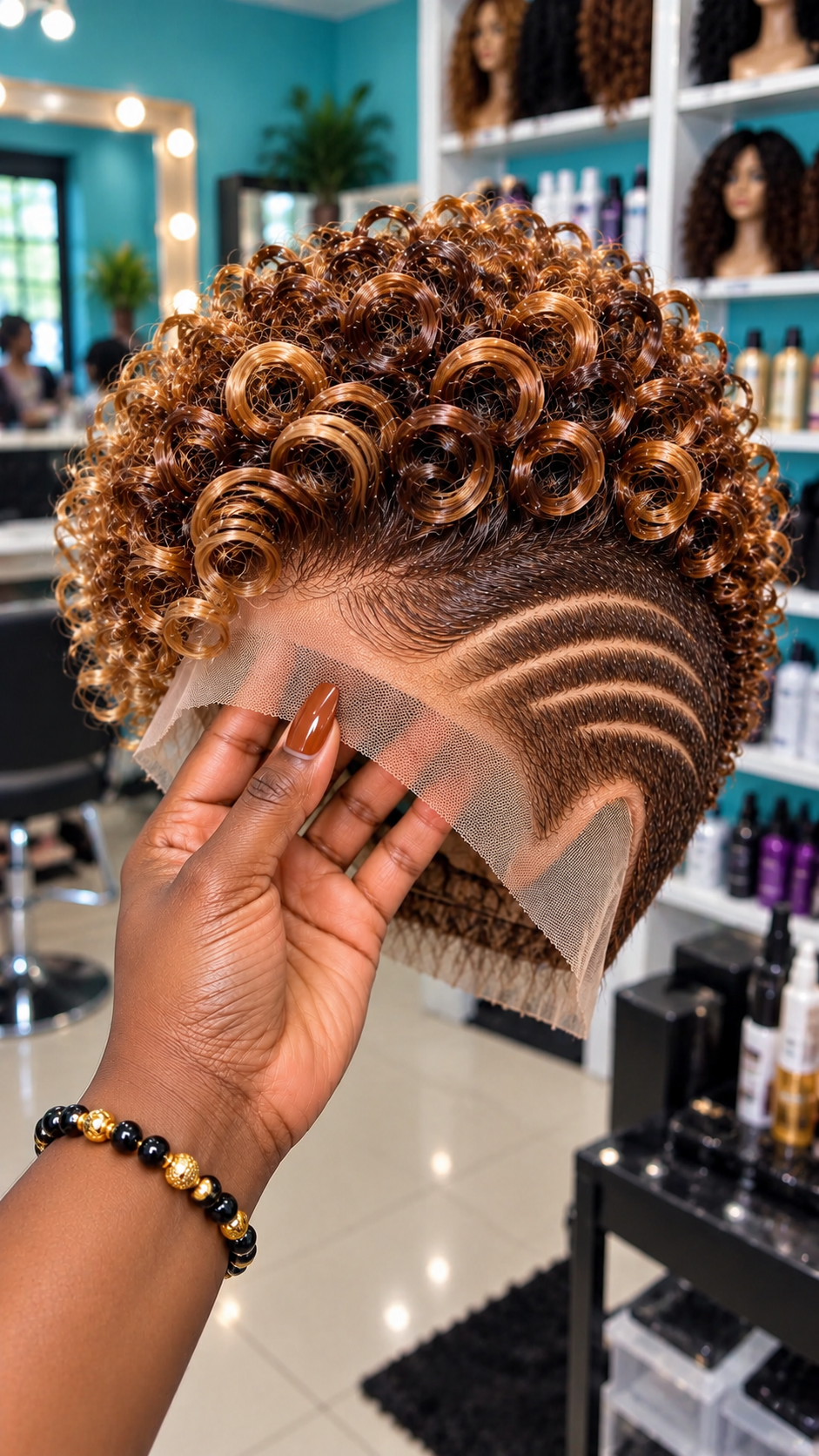
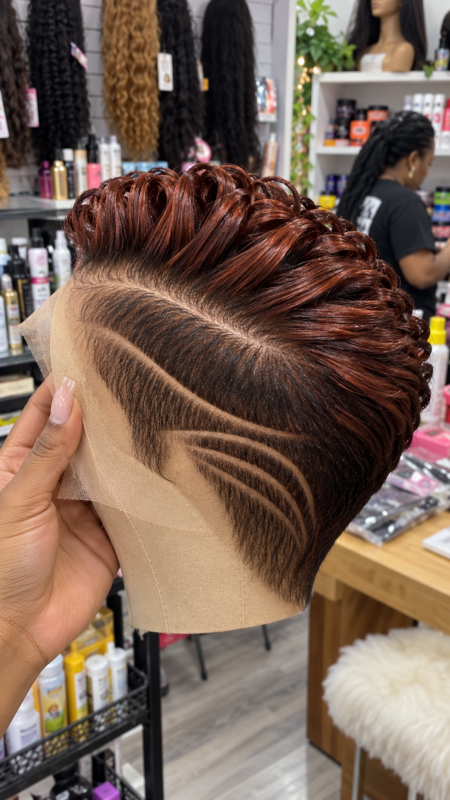
A carefully arranged wig can communicate its craftsmanship before anyone puts it on. The caramel bronze pixie lace wig in this photograph is a compelling example because its design is visible at three distinct levels: a rounded collection of open spiral ringlets, a directional band of closely arranged hair beneath the curls, and a temple panel decorated with three sweeping curved channels. The copper-brown coloring links these elements together, allowing the hairstyle to stand out through its construction rather than through an extreme contrast between unrelated colors.
The unit is displayed in one hand inside a turquoise-walled hair salon, with its beige lace extending beyond the forehead and temple area. It has not yet been installed. This presentation provides a useful opportunity to examine the curl arrangement, exposed hairline, and side pattern before the lace is trimmed or the cap is fitted to a wearer.
The most important purchasing consideration is the accuracy of the ringlet construction. A seller may advertise a caramel curly pixie wig, but the photographed hairstyle is more specific than that description suggests. Its upper curls form recognizable circular openings, while the lower side contains carefully spaced arcs that must be reproduced with precision.
A Ringlet Crown With a Distinctive Circular Rhythm
The upper hairstyle is composed of numerous compact spiral ringlets, many arranged as nearly complete circles. Their openings are clearly visible, especially across the front and middle of the crown, where several curls face outward toward the camera.
Some ringlets appear larger and more open, while others are smaller and positioned behind neighboring loops. This variation creates a layered appearance without requiring the hair to extend far beyond the compact pixie silhouette.
The front section contains several prominent circular formations that sit above the fine hairline. Moving toward the center, the loops become more closely grouped, with overlapping strands creating deeper areas of shadow.
At the visible rear edge, smaller curls continue around the upper perimeter. The photograph does not provide a complete back view, so the exact arrangement behind the crown remains unverified.
The circular formations have a glossy surface that catches the salon lighting. Reflections follow the curves of the strands, emphasizing the spiral construction and the warm caramel coloring.
Why the Ringlet Openings Matter to the Finished Appearance
Open circular ringlets create a different visual effect from ordinary loose curls. Their hollow centers allow the viewer to distinguish individual formations even when the crown contains a considerable amount of hair.
A wig with very small spring coils would appear more tightly packed. A unit with loose, downward-hanging curls would create a softer silhouette with less emphasis on circular openings.
Neither alternative would reproduce the exact character of the photographed design.
For custom orders, buyers should request a close-up photograph of the ringlets before shipment. The supplier should demonstrate that the circular arrangement extends beyond the most visible front section.
A top-view photograph is particularly useful because it reveals whether the curls are distributed across the crown or concentrated along one edge.
Caramel Bronze Coloring Across the Upper Spirals
The visible hair displays a warm mixture of caramel, copper-brown, and deeper bronze tones. The brighter strands appear golden in some reflections, while shaded areas show richer brown coloring.
The crown is not uniformly pale blonde. Instead, the ringlets contain a combination of medium warm brown and lighter caramel reflections, with darker sections remaining visible between the curls.
The color appears broadly coordinated across the upper hairstyle. There is no clearly established platinum, silver, burgundy, or blue coloring.
Near the base of the crown, the hair appears darker, creating additional depth beneath the raised loops. This darker foundation continues into the closely arranged hair above the temple design.
The photograph was taken under bright salon lighting, which may intensify the golden appearance of certain strands. Buyers should therefore compare color samples under more than one lighting condition.
Choosing Between Caramel, Bronze, and Copper Brown
These color descriptions often overlap in online wig catalogs, but they are not interchangeable. Caramel may suggest a more golden brown, while copper brown generally contains stronger reddish warmth. Bronze can describe a deeper brown with metallic-looking reflections.
The photographed wig combines characteristics of all three, with the overall appearance remaining warm and medium brown rather than bright orange.
When ordering, provide the image and request an actual photograph of the supplier’s closest available shade. Avoid relying exclusively on a color name or digital swatch.
If the wig is custom-colored human hair, ask about the processing required to achieve the desired shade. If it is synthetic, confirm whether the selected color is manufactured into the fibers.
The photograph alone cannot establish the material or coloring method.
Three Sweeping Temple Arcs Create the Side Identity
The most recognizable lower detail is the arrangement of three curved channels along the visible temple. These separations travel backward in a layered formation, following the contour of the side rather than forming straight diagonal lines.
The upper channel begins beneath the directional hair at the crown boundary. A second curved separation follows below it, and a third lower channel bends more sharply toward the temple area.
The channels expose a lighter underlying surface, creating visible contrast against the copper-brown hair surrounding them.
The lower curve is especially distinctive because it changes direction more noticeably than the upper arcs. This gives the side pattern a flowing appearance rather than a rigid geometric arrangement.
The hair between the channels remains closely fitted, allowing the pattern to be visible without additional color accents.
Reproducing the Arcs Without Altering Their Proportions
A custom wig maker should be given a clear side photograph showing the entire pattern. Simply requesting three curved lines may result in a design with different spacing or direction.
The upper arc should remain connected visually to the hair beneath the crown, while the lower curve should retain its more pronounced bend near the temple.
The width of the exposed channels also matters. Very broad separations may overpower the closely fitted hair, while extremely narrow lines may become difficult to distinguish after installation.
Before approving permanent cutting or hair removal, ask the wig maker how the channels are constructed. The photograph shows their appearance but does not establish the exact production technique.
Removing too much hair from a finished wig can expose the cap or create permanent gaps. Precision work should be performed by someone experienced with wig construction rather than relying solely on ordinary barbering techniques.
The Directional Hair Above the Temple Connects the Design
Between the raised ringlets and the curved side channels, the hair lies relatively close to the underlying cap. The strands are directed backward in a coordinated arrangement, creating a flatter transition beneath the crown.
This area is important because it prevents the circular curls from appearing disconnected from the lower hairstyle.
The darker copper-brown foundation becomes more visible here, while the raised ringlets above catch stronger reflections.
Near the front, fine strands curve along the hairline before joining the directional upper-side section. Their placement contributes to the hairstyle’s controlled appearance.
The transition also influences the overall silhouette. Without the flatter band beneath the ringlets, the upper hairstyle could appear excessively full or extend too far toward the temple.
The Lace Front Remains Ready for Custom Fitting
A broad section of beige lace extends beyond the front hairline and lower temple area. The lace has not yet been trimmed to the final wearing shape.
Fine hair strands are visible near the forehead, with the copper-brown styling continuing toward the lace boundary.
The mesh appears relatively fine in the photograph, but its exact grade cannot be confirmed. Buyers should request the manufacturer’s lace specifications rather than assuming a particular category.
The lower portion of the image shows some interior material through the open cap, but the complete construction is not visible.
Specific attachment combs, adjustable straps, elastic bands, or other fastening components cannot be reliably identified from this view alone.
Questions to Ask About the Cap Before Ordering
Request a photograph showing the entire underside of the wig. The seller should identify the cap materials, available adjustment hardware, and intended installation method.
Confirm the available cap sizes and provide the measurements requested by the wig maker. A cap that does not fit correctly may shift the temple arcs away from their intended position.
If adhesive-free wear is important, ask whether the unit is specifically designed for that method. The presence of a lace front does not establish glueless compatibility.
Also ask whether the temple pattern can be positioned on the preferred side. The photograph shows one decorated side but does not reveal the opposite side.
Finding a Supplier Who Can Produce This Specific Curl Arrangement
Customers seeking this hairstyle should look for wig makers experienced in sculpted pixie units, circular ringlet styling, and barber-inspired side patterns.
A general retailer may offer caramel curly wigs, but the precise crown arrangement and three curved temple channels may require specialist customization.
Local wig boutiques can be useful when buyers want to inspect the cap and color in person. Independent wig makers may provide more control over the ringlet placement and side geometry.
Online suppliers can also be considered, provided they offer genuine product photographs and clear construction information.
Preparing a Detailed Custom Order Request
Send the original photograph and identify the warm caramel bronze color, open circular ringlets, compact crown silhouette, closely arranged upper-side hair, and three sweeping temple channels.
Ask whether the supplier can reproduce the hairstyle as a finished unit or whether additional salon work will be required after delivery.
Provide the cap measurements requested by the maker and confirm the preferred side for the decorative pattern.
Request information about the fiber, lace dimensions, cap construction, and expected production timeline.
Before payment, clarify the revision policy and whether photographs of the completed wig will be supplied for approval.
Why a Ready-Made Curly Pixie May Not Be Enough
A ready-made caramel curly pixie may offer a similar color and general silhouette, but it may not include the same circular ringlet construction.
Many standard curly units contain loose spirals or smaller coils rather than the open loops visible in this photograph.
The temple pattern introduces another challenge. A ready-made wig with a plain side may not have sufficient hair coverage or suitable construction for additional carving.
Before purchasing a base unit for customization, ask a professional whether the desired changes are feasible.
Custom construction may offer greater control over the final appearance, particularly when the ringlet arrangement and curved side channels are essential.
Illustrative Pricing for Caramel Bronze Ringlet Pixie Wigs
The following USD ranges are illustrative budgeting estimates rather than verified current product prices. The photographed wig’s actual material, supplier, and selling price are unknown.
| Wig Category |
Illustrative USD Range |
Potential Cost Considerations |
| Premium Custom |
$345–$780+ |
Personalized cap measurements, carefully arranged circular ringlets, coordinated caramel coloring, and precision triple-arc temple styling. |
| Standard Custom |
$185–$395 |
Selected cap options with customized ringlets and a simplified or individually arranged curved side pattern. |
| Basic Human Hair |
$105–$270 |
A human-hair starting unit that may require additional coloring, curl setting, and professional side detailing. |
| Premium Synthetic |
$75–$185 |
A manufactured caramel curly pixie with preformed loops and possible decorative temple styling. |
| Basic Synthetic |
$30–$90 |
A lower-cost curly pixie alternative that may not reproduce the circular openings or triple curved channels accurately. |
The price of a custom unit may be influenced by the amount of work required to arrange the ringlets. Individual circular formations can demand more precise styling than ordinary loose curls.
The curved temple channels may also increase labor costs because their placement must be coordinated with the underlying cap and surrounding hair.
Color processing, lace customization, cap sizing, and finishing work can further affect the quotation.
Ask whether the quoted price includes the fully styled wig, shipping, taxes, and any installation services. Comparing complete costs is more useful than comparing base wig prices alone.
Booking a Wig Stylist for the First Installation
The first fitting should begin with cap placement and hairline alignment. The three curved temple channels must sit at the intended angle relative to the wearer’s forehead and side of the head.
A professional wig stylist can assess cap comfort, lace placement, and whether the decorative pattern follows the desired contour.
The excess lace should remain intact until the correct wearing position has been established. Trimming too close to the hairline may damage fine strands or reduce the available fitting margin.
The stylist should also inspect the ringlets for compression caused by shipping or packaging.
If the curls require restoration, the appropriate method should be determined according to the confirmed fiber type and manufacturer instructions.
Heat styling should not be applied automatically because different materials have different tolerances.
Keeping the Circular Ringlets Distinct Between Wears
The upper curls depend on retaining their open circular shape. Repeated brushing or pulling through the crown can stretch individual loops and disturb their arrangement.
Handle the ringlets carefully and avoid unnecessary separation of neighboring curls.
If the wig contains human hair, a professional stylist may be able to reset displaced curls using suitable techniques. Any prior coloring or chemical processing should be considered.
If the wig contains synthetic fibers, conventional heated tools may be unsuitable. Follow the manufacturer’s care instructions before attempting restyling.
Heavy styling products can collect between the loops, reducing the visibility of their circular openings.
Protecting the Temple Arcs During Cleaning and Storage
The closely fitted side should be handled separately from the raised crown. Brushing across the curved channels may move hair into the exposed spaces and make the pattern less distinct.
If the arcs become irregular, consult a stylist familiar with the wig’s construction before attempting corrective cutting.
When storing the unit, support it on an appropriately sized stand that preserves the crown shape without pressing against the temple design.
For travel, use protective packaging that provides enough room for the raised ringlets and prevents the lace from snagging or folding.
Choosing the Design for Its Craftsmanship Rather Than Color Alone
This caramel bronze pixie offers a distinctive combination of warm coloring, circular ringlets, and a carefully arranged temple pattern.
The raised crown creates visual interest through numerous open loops, while the flatter side provides contrast in both elevation and styling direction.
The three curved channels add a decorative element that distinguishes the hairstyle from ordinary curly pixie wigs.
Its suitability for everyday wear or occasional use will depend on cap comfort, installation requirements, and the maintenance needed to preserve the ringlets.
Before purchasing, verify the fiber, lace specifications, cap measurements, and fastening method. Request complete product photographs and confirm whether the finished styling is included in the price.
A successful reproduction should preserve the warm caramel bronze color, open circular ringlets, compact crown proportions, directional upper-side hair, and three sweeping temple arcs. These visible details provide a practical foundation for comparing suppliers, approving a custom order, and planning a professional installation.
Search Terms
Caramel bronze circular ringlet pixie wig · Triple sweeping temple arc lace wig · Copper brown hollow spiral crown · Warm caramel sculpted loop hairstyle · Three curved side channels pixie unit · Beige untrimmed lace bronze curl wig · Golden brown ringlet crown with temple arcs · Compact copper caramel spiral lace hairstyle