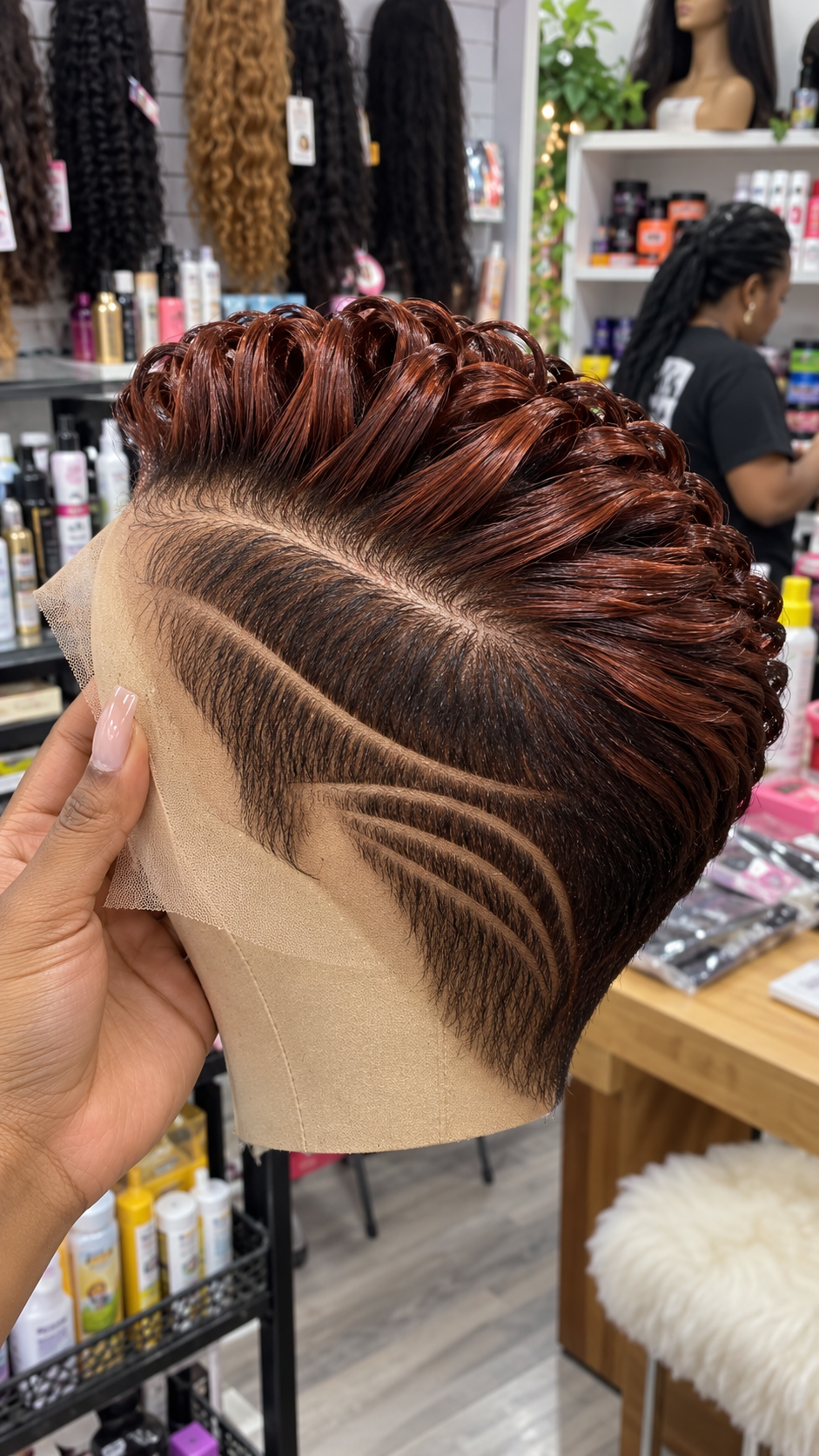
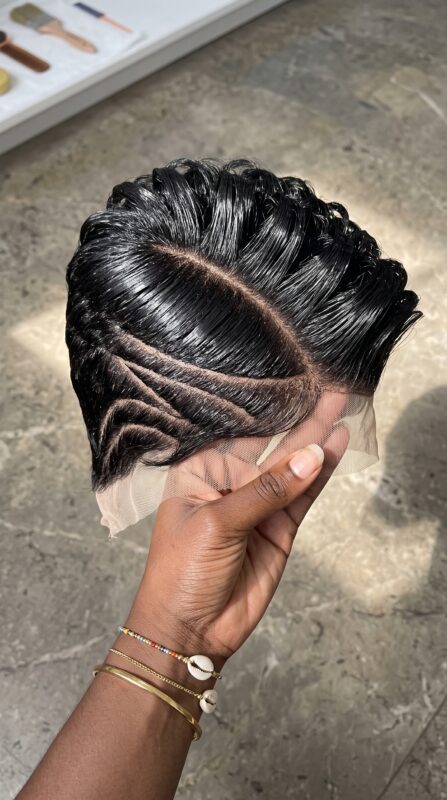
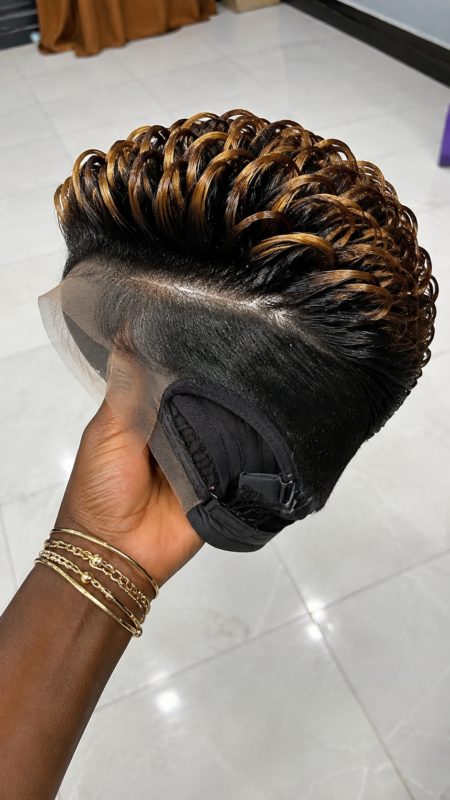
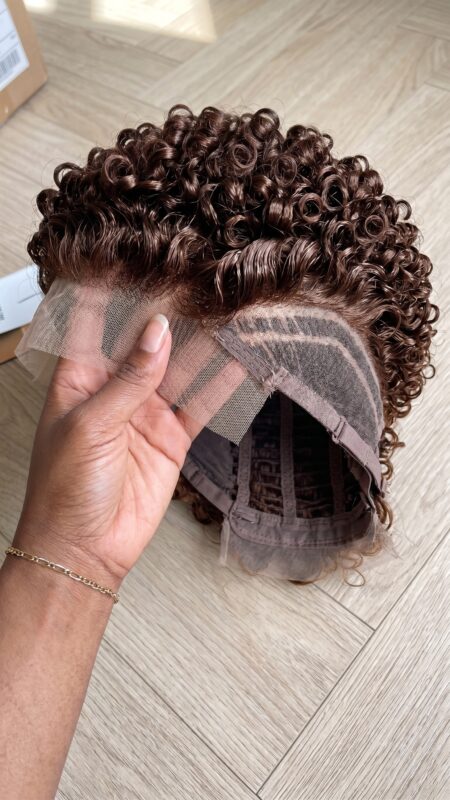
The most remarkable part of this auburn copper wig is not the height of its upper curls or even its warm reddish-brown color. It is the intricate arrangement of the lower side, where several narrow channels bend into a nested pattern beneath a broad diagonal parting. The hairstyle brings together two contrasting forms: elevated, backward-directed ribbon curls across the upper portion and closely arranged dark hair that creates a striking decorative profile.
Displayed on a beige support form inside a beauty supply shop, the wig is photographed from an elevated side angle. This perspective reveals the relationship between the upper curl structure, the main diagonal separation, and the smaller curved divisions near the lower temple. It also shows an extended beige lace section around the front and side, indicating that the hairpiece is being presented before final installation.
Unlike a conventional curly pixie, this design relies heavily on hair direction. The upper sections rise and bend backward, while the lower strands follow the contour of the side. The copper tones are strongest along the upper curls, with darker brown and nearly black areas visible beneath them. These contrasts give the wig a distinctive appearance that would be difficult to reproduce accurately through a generic hairstyle description.
For buyers considering a custom sculpted pixie wig, the photograph offers an opportunity to examine which details deserve priority during ordering, how to assess the quality of the side arrangement, and what information must be confirmed before choosing a supplier or booking installation.
The Nested Side Curves Are the Design’s Most Demanding Element
The lower side contains a series of narrow, curved separation channels arranged beneath a broader diagonal parting. The main upper channel travels across the visible side, dividing the raised copper hairstyle from the darker, close-fitting panel below.
Farther down, smaller curved divisions appear within the lower section. These channels bend toward the rearward side, creating a layered pattern with several closely spaced arcs. Their arrangement resembles nested curves rather than straight parallel stripes.
The lower curves are particularly noticeable because the hair between them remains dark and closely arranged. The pale channels contrast with the surrounding strands, making their shapes visible even without bright coloring in the side section.
The channels do not all begin at the same point. Some are shorter and sit within the broader side arrangement, while others extend farther across the visible panel. This variation gives the design a more elaborate appearance than a simple double-line parting.
Although the pattern resembles decorative barber work, the photograph does not establish that it was produced with a razor or clippers. The visible effect could involve deliberate separation and positioning of hair on the wig base. Buyers should describe the geometry rather than assume a particular manufacturing method.
Why the Spacing Between Curves Matters
The narrow hair sections between the channels are essential to the appearance. If these sections are too wide, the design may lose its intricate character. If they are too narrow, the individual curves may become difficult to distinguish or the underlying cap may become excessively exposed.
The photograph shows a combination of broader upper spacing and tighter lower divisions. This creates a gradual transition from the main diagonal parting into the more detailed nested pattern.
A custom wig maker should study the entire side arrangement rather than reproduce each curve independently. The relationship between the channels determines whether the finished design resembles the reference.
For buyers, a close side photograph is more useful than a general front-facing image when evaluating this particular detail.
How the Copper Upper Hair Changes Direction
Above the main parting, the hairstyle rises into a collection of elongated ribbon-like curls. The front sections stand relatively upright before bending backward, while the rearward sections become more closely arranged and less elevated.
The curls do not resemble small circular ringlets distributed evenly across the crown. Instead, many form elongated arches with visible openings between the strands.
Several larger loops appear near the upper front, creating a raised profile. Toward the back, the hair transitions into overlapping curved sections that follow a more horizontal direction.
This progression creates movement without requiring long hair to fall over the forehead or shoulders. The hairstyle remains compact, with its upper volume concentrated near the crown.
The loops appear glossy and carefully positioned, but the photograph does not establish the exact setting method. A stylist may use different techniques depending on the material and construction of the wig.
Preserving the Upper Shape During Custom Production
A reproduction should maintain the distinction between the upright front arches and the more backward-directed rear sections.
If the front curls are made too long, they may extend farther above the head and change the intended silhouette. If they are made too compact, the hairstyle may lose the elongated loop openings visible in the reference.
The upper arrangement also depends on the direction of the strands. Randomly placed curls could create a similar amount of volume while producing a completely different appearance.
When communicating with a wig maker, ask for elongated backward-bending loops rather than ordinary loose curls. Provide the side photograph and request confirmation that the maker understands the intended height and direction.
Auburn Copper Coloring With a Darker Understructure
The upper hair displays warm auburn, copper, and reddish chestnut tones. The brightest reflections appear along the outer surfaces of the raised curls, where the strands catch the shop lighting.
Between the copper sections, darker brown and nearly black strands remain visible. This gives the upper hairstyle depth and helps separate neighboring loops.
The lower side is considerably darker overall, although warm brown reflections can be seen through parts of the closely arranged hair.
This relationship between the brighter upper sections and the darker side is central to the design. A uniformly copper-colored wig would not reproduce the same contrast.
The photograph cannot establish the exact color formula or whether all tonal differences result from deliberate processing. Indoor lighting and reflective styling products may influence the recorded appearance.
Before ordering, request a photograph under neutral daylight. Ask whether the supplier offers a dark-rooted auburn copper shade or a custom color arrangement that preserves the deeper foundation.
The Main Diagonal Parting Connects Both Styling Zones
The broad upper separation channel acts as a boundary between the elevated copper curls and the flatter side hair. It travels diagonally across the visible side and narrows as it approaches the rearward area.
Above the channel, the hair rises toward the crown. Below it, the strands are directed downward and backward along the side.
This contrast creates a strong visual division without requiring the entire side to be shaved.
The main parting also helps organize the smaller nested curves beneath it. Together, the channels produce a layered appearance that is more intricate than a single decorative stripe.
For a custom order, the main diagonal parting should be established before the smaller curves are arranged. If its position changes significantly, the available space for the lower pattern may also change.
Buyers should therefore evaluate the upper and lower channels as one connected design rather than separate decorative elements.
The Close-Fitting Lower Hair Retains Visible Coverage
The lower side contains closely arranged dark hair that follows the contour of the wig. The strands are not completely removed, and the photographed area does not resemble an exposed skin fade.
Instead, the hair remains visible between the decorative channels, creating dark panels that emphasize the pale separations.
Near the lower front, the hair becomes finer and follows a curved direction toward the lace edge. This creates a tapered-looking finish without proving that the area was cut using a particular barber technique.
The compact side provides a visual counterbalance to the elevated copper loops above.
If the side were made substantially fuller, the nested channels might become less noticeable. If it were cut too closely, the design could expose more of the supporting material than intended.
Customers should therefore request a close photograph of the lower side when comparing ready-made products or approving a custom reproduction.
Understanding the Beige Lace Around the Front and Temple
A broad beige-toned lace section extends beyond the front and visible side of the wig. The mesh remains untrimmed, indicating that the unit has not yet undergone final fitting.
The lace is especially noticeable where it extends below the lower side pattern. Its pale appearance contrasts with the dark hair and the beige support form beneath it.
The photograph does not establish whether the lace is HD lace, Swiss lace, transparent lace, or another commercial category. Those details require confirmation from the supplier.
The image also does not show the complete underside of the wig. It cannot confirm the total number of comb attachments, adjustable straps, or other securing components.
Before purchasing, request a full interior photograph and written specifications for the cap and lace.
Why the Side Pattern Must Be Considered During Fitting
The decorative curves sit close to the temple area, so their position may change visually when the wig is placed on a head.
If the cap sits too far forward, the lower channels may extend into an unintended area near the face. If it sits too far backward, the pattern may become less prominent.
A stylist should first position the wig and evaluate the relationship between the hairline, main diagonal parting, and lower curves.
Only after confirming the fit should excess lace be trimmed where necessary.
Removing too much lace before fitting can reduce adjustment flexibility and may permanently affect the front edge.
Finding a Wig Maker With Precision Side-Styling Experience
This hairstyle is not an ideal project for a supplier who only produces conventional curly wigs. The nested side curves require careful planning, and the upper ribbon loops must retain a specific backward direction.
Look for custom wig makers or salon stylists experienced in sculpted pixie hairstyles, directional curl setting, and detailed side arrangements.
When reviewing portfolios, pay attention to whether the maker can reproduce narrow curved channels with consistent spacing.
Ask for examples of completed wigs that combine elevated upper curls with close-fitting side sections.
For a custom order, provide the reference photograph and identify the nested lower curves as a priority. Explain that the design should retain visible hair between the channels rather than becoming a completely shaved side.
Also specify the auburn copper upper color, darker foundation, and elongated loop arrangement.
Ready-Made Shopping Versus Commissioning a Custom Unit
A ready-made wig may be suitable if the buyer finds a product with comparable upper curls, color distribution, and side geometry.
However, the nested curve pattern may be difficult to locate in a standard catalog. Many curly pixie wigs include one or two decorative lines, but fewer reproduce several closely spaced curves with the same proportions.
Custom production provides greater control over the design, although it may require additional time and labor.
Before placing a deposit, ask the maker whether the side pattern can be reproduced accurately on the proposed cap construction.
Request written confirmation of the hair material, cap size, lace specifications, color target, and styling expectations.
If possible, ask for a progress photograph before the final styling is completed. This can help identify differences in the side geometry while adjustments may still be feasible.
Booking a Salon for Installation and Detail Preservation
Once the wig arrives, inspect the upper curls and lower side channels before making any adjustments.
Check whether the auburn copper color matches the agreed reference and whether the elongated loops retain their intended shape.
At the salon, the stylist should position the cap and evaluate the decorative side pattern relative to the wearer’s temple.
Ask whether the salon has experience installing sculpted pixie wigs and maintaining detailed side arrangements.
Any cutting near the lower channels should be approached cautiously. A wig may contain lace or cap material immediately beneath the visible hair.
If the upper loops become disturbed during shipping, a stylist experienced in structured curl setting may be able to advise on appropriate restoration methods.
The safest approach depends on the confirmed hair material and the original styling technique.
Illustrative Pricing for an Auburn Copper Precision-Side Wig
The cost of reproducing this design may be influenced by the complexity of the nested curves, the arrangement of the upper loops, color processing, lace coverage, and cap construction.
The photograph does not establish the actual manufacturer, fiber composition, or selling price.
The following US dollar amounts are illustrative planning estimates rather than verified current product prices.
| Wig Category |
Illustrative USD Range |
Potential Cost Considerations |
| Premium Custom |
$360–$820+ |
Individual cap sizing, intricate nested side channels, elongated copper loop setting, and specialist finishing. |
| Standard Custom |
$190–$430 |
Selected cap adjustments, customized auburn color, and detailed side-pattern styling. |
| Basic Human Hair |
$110–$285 |
A human-hair base unit that may require additional coloring and professional sculpting. |
| Premium Synthetic |
$75–$210 |
A higher-grade synthetic option with potentially prearranged loops and decorative side sections. |
| Basic Synthetic |
$30–$110 |
A budget alternative where exact curve placement and upper-loop direction may be limited. |
These categories describe possible purchasing approaches and do not identify the material of the photographed wig.
Ask whether the quoted price includes installation, shipping, lace preparation, color customization, and future restyling.
The nested side pattern may require additional specialist labor. A ready-made unit that already matches the reference could offer better value than a cheaper wig requiring extensive corrections.
Maintaining the Side Curves Without Disturbing Their Shape
The lower decorative channels are among the most delicate visual elements of this hairstyle. Their appearance depends on the neighboring hair remaining arranged in the intended direction.
Brushing across the channels may move strands into the exposed areas and reduce the visibility of the pattern.
Before attempting maintenance, ask the supplier which products and techniques were used to position the hair.
The upper copper loops require separate attention. Their elongated arches may lose their shape if compressed or brushed aggressively.
If the wig contains synthetic fibers, avoid heat tools unless the manufacturer confirms the permitted temperature.
If the unit contains human hair, professional resetting may be possible, but the appropriate method depends on previous processing and the original styling technique.
The auburn copper color may also change with repeated washing or sunlight exposure if the hair has been color-treated. The extent of any change depends on the material and products used.
Ask whether the hairstyle is intended to survive washing without complete restyling and how the wig should be stored between uses.
Photographs That Can Confirm the Finished Design
The reference provides a strong view of the upper hair and one side, but it does not show the complete rear or opposite temple.
Before final payment, request a direct front photograph to evaluate the hairline and upper-loop distribution.
An opposite-side view will establish whether the nested curves are repeated or whether the other side has a different arrangement.
A rear photograph will show how the elongated loops transition toward the nape.
A complete underside photograph is necessary to verify the cap construction and attachment components.
A brief video under neutral lighting can also help establish the actual auburn copper color and the overall proportions.
These additional views are especially important for custom orders because they allow the buyer to evaluate the finished product before shipping.
The Value of Preserving the Original Side Geometry
This wig demonstrates how an intricate side arrangement can become the defining element of a sculpted pixie hairstyle. The auburn copper upper loops provide warmth and elevation, while the darker lower sections create a foundation for the nested curved channels.
The main diagonal parting connects the upper and lower styling zones, and the smaller curves add a distinctive decorative rhythm.
The untrimmed lace confirms that the hairpiece is being presented before installation, although the exact lace grade, fiber material, and complete cap construction remain unverified.
For buyers seeking a comparable design, the strongest approach is to prioritize the accuracy of the side curves, the direction of the upper loops, and the contrast between the copper and dark hair.
A successful reproduction should preserve these elements without adding unrelated decorative lines or changing the hairstyle into an ordinary curly pixie.
With careful supplier selection, clear custom-order instructions, and appropriate professional fitting, the design can provide a distinctive option for women who appreciate detailed sculpted hairstyles.
Search Terms
Auburn copper nested curve pixie wig · Reddish brown ribbon loop lace hairpiece · Multiple curved side channel wig · Copper swept back sculpted crown · Dark side panel auburn pixie hairstyle · Beige untrimmed lace temple wig · Layered curved parting copper wig · Chestnut auburn elongated loop hairpiece