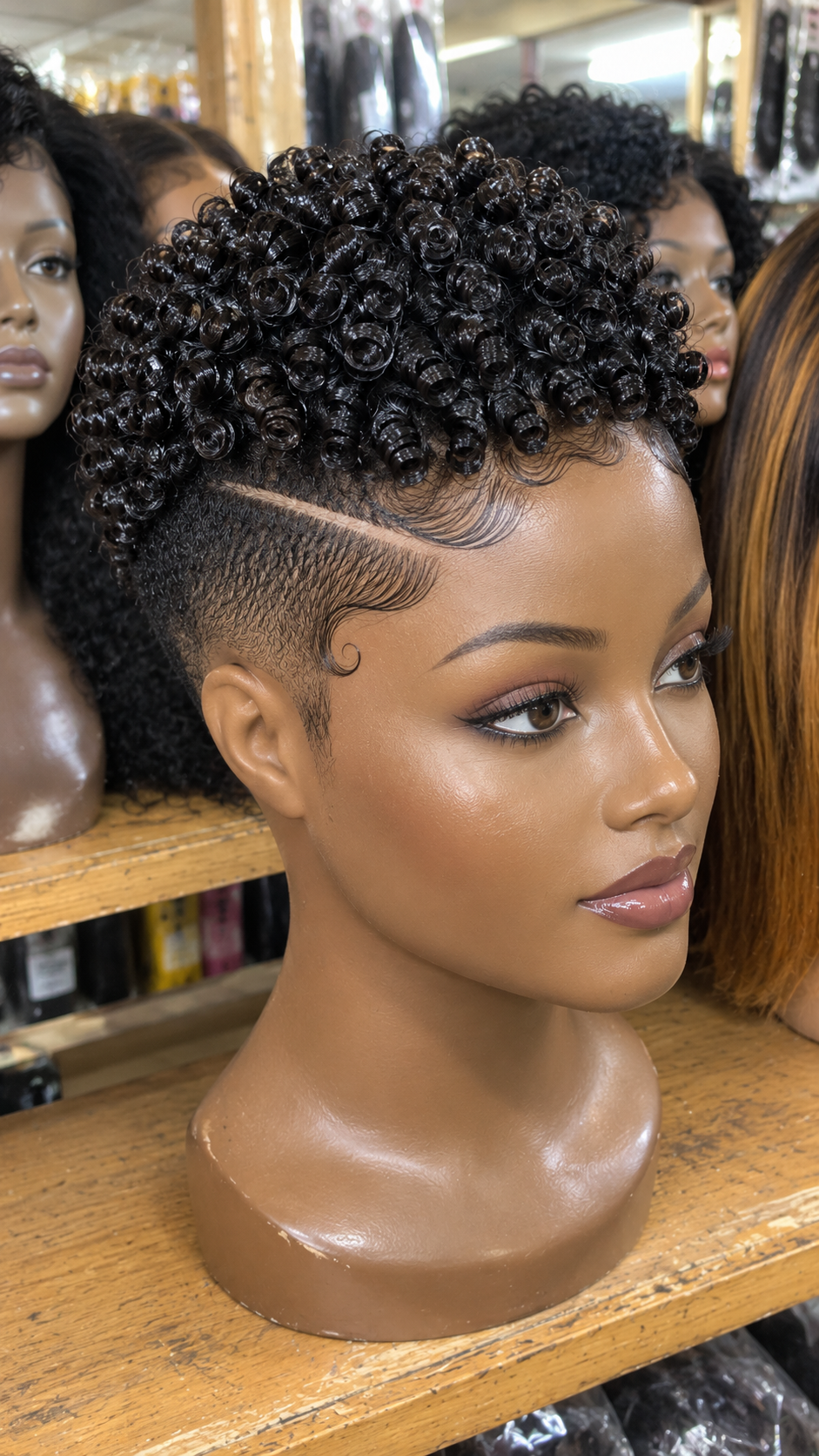
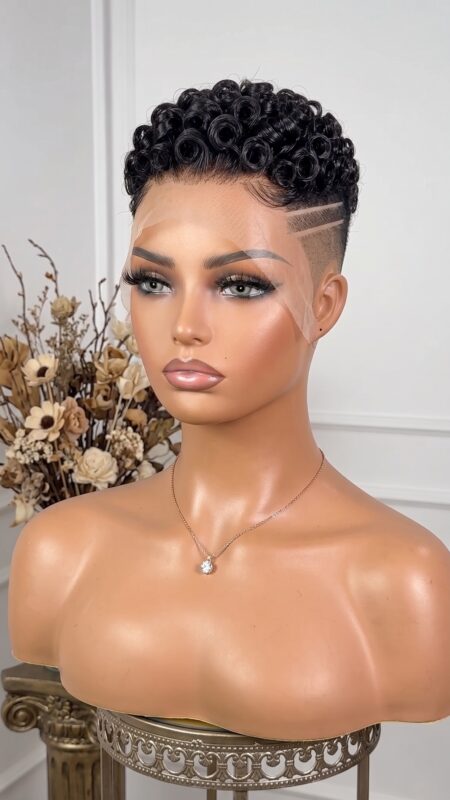
Not every striking pixie wig needs multiple hair colors or elaborate shaved patterns. The jet-black hairstyle displayed on this salon mannequin makes its impression through a densely arranged crown of glossy corkscrew coils, a long diagonal side part and one beautifully curved strand near the temple. The relationship between these elements creates a compact hairstyle with substantial crown detail and a comparatively restrained lower section.
Unlike the larger circular ringlets seen on many sculpted wigs, this particular crown contains smaller, more tightly wound tubular curls. Numerous spirals stand close together, with several arranged almost vertically and others following the rounded shape of the head. The side uses closely cropped-looking hair with fine directional strands rather than a series of decorative carved channels. A narrow part separates the dense upper curls from the lower area, while an individual curled strand near the temple gives the face-framing design its finishing accent.
The wig is displayed on a realistic female mannequin inside a beauty supply store. Its fitted appearance shows how the crown and temple details can frame a face, but the photograph does not expose the cap interior, lace construction or attachment system. Consequently, the image cannot confirm whether the unit uses human hair, synthetic fiber, HD lace or a particular installation method. Those specifications should be verified with the seller before purchase.
The Crown Has a Different Character From Oversized Ringlet Wigs
The most obvious structural characteristic is the size of the spirals. The crown contains numerous compact corkscrew formations with rounded openings and tightly wound strands. Their diameter is generally smaller than the broad hollow rings used in some sculpted finger-coil designs.
This creates a more concentrated upper surface. Instead of relying on a few especially large circles, the wig develops its shape through many individual coils positioned closely together.
Several spirals around the forward crown have visible openings, while smaller curls fill the spaces between them. Toward the upper rear, the curl arrangement becomes denser and follows the natural roundness of the cap.
A customer requesting this construction should specify compact tubular finger coils rather than loose spiral curls or oversized rolled ringlets. The difference is important because ordinary curly wigs may have a similar overall length while producing a completely different crown appearance.
The Glossy Black Finish Reveals the Individual Coils
The hair appears predominantly jet black, with narrow reflected highlights across the curved strands. Some surfaces look slightly charcoal under the store lighting, but there is no clear evidence of an intentionally applied second hair color.
The glossy surface emphasizes the circular construction. Light travels across the outer ribbons, while the inside of each coil remains dark.
This creates depth without requiring blonde, brown or copper highlighting. The styling itself provides the visual contrast.
For customers who prefer a monochromatic wig, this is an important advantage. The hairstyle remains detailed through its curl arrangement rather than depending on color changes to create interest.
When ordering, request deep jet-black hair and confirm the actual shade under neutral light. Extremely blue-black fiber may appear different from the more natural glossy black shown in the photograph.
Dense Spiral Placement Creates a Rounded Crown
The curls are concentrated across the top and upper sides, forming a rounded elevated silhouette. Their distribution appears substantial, but the overall hairstyle remains compact.
Rather than extending into long curls, the strands are rolled into relatively close formations. This allows the wig to carry considerable detail without introducing excessive length around the neck or shoulders.
The larger front spirals establish visual interest near the hairline, while the smaller surrounding sections create continuity through the crown.
A professional recreation should preserve this distribution. Making every curl identical could produce a mechanical appearance, while increasing the volume excessively might change the balance between the crown and lower side.
The Deep Side Part Creates the Hairstyle’s Asymmetry
A narrow exposed part begins near the front and travels diagonally backward through the side. It separates the dense upper spiral field from the closely arranged lower hair.
The parting has a clear structural purpose. It establishes where the crown curls stop and where the flatter side styling begins.
Its diagonal direction also creates asymmetry. The larger curled field appears concentrated above the part, while the lower side remains comparatively quiet.
A custom stylist should establish this division before completing the surrounding curls. Changing the parting after the crown has been fully arranged could require significant restyling.
For remote orders, a direct side photograph can help confirm that the part follows the same diagonal route rather than becoming a straight horizontal line.
The Lower Side Has a Closely Cropped Appearance
Beneath the diagonal part, the hair becomes much smaller in scale and lies close to the head. Fine dark strands create a tapered-looking side that contrasts with the raised corkscrew crown.
This lower section is not covered with the same large coils as the top. Its comparatively restrained surface allows the upper curls to remain the focal point.
The visible hair also provides a dark background for the individual temple curl.
A maker should avoid automatically adding decorative razor lines to this area. The photograph shows one principal side division and delicate perimeter styling rather than several carved geometric patterns.
Preserving that simplicity is part of reproducing the reference accurately.
The Temple Curl Gives the Side Its Signature
Near the temple, one fine strand curves downward and then turns inward into a small circular flourish. This detail stands apart from both the compact side hair and the dense crown spirals.
Although it uses relatively little hair, its position makes it visually important. The curl sits close to the face and adds a carefully arranged accent without overpowering the overall hairstyle.
The spiral should remain modest in size. Enlarging it substantially would create a more dramatic pattern than the one shown, while removing it would eliminate one of the clearest identifying details.
For custom production, ask the stylist to preserve a single curved temple strand with an inward-turning endpoint.
The Forehead Strands Create a Fine Directional Transition
Along the front, several fine black strands travel in gentle arcs beneath the first row of crown spirals. These strands are flatter and more elongated than the circular curls above them.
Their function is to create a gradual visual transition between the forehead and the denser upper hairstyle.
The directional front does not cover the entire forehead. Instead, it follows the natural outline of the hairline while keeping the compact pixie silhouette intact.
When commissioning a similar wig, the buyer should provide a close front reference. The arrangement of these strands can significantly affect the final face-framing appearance.
The Hair Around the Ear Remains Relatively Compact
The mannequin’s ear is visible, allowing the relationship between the upper curls, side part and lower perimeter to be evaluated.
The hair does not hang heavily over the ear. Instead, the compact lower section leaves the ear area relatively open, while the small temple curl provides the main decorative accent.
This creates a practical visual distinction from longer curly wigs that cover much of the side of the face.
For a custom fitting, the stylist should check that the wig’s side position allows the intended relationship with the ear and temple. Cap size and placement can influence how the side appears on an individual wearer.
The Back Should Continue the Compact Curl Distribution
The photograph mainly presents the front and one side. While some of the rear crown is visible, the entire back cannot be inspected from this angle.
For that reason, a buyer should request a rear photograph rather than assuming that every section follows the exact same coil map.
A suitable rear design would need to remain consistent with the chosen reference and the wig maker’s approved construction plan.
When ordering a custom piece, ask how the spirals transition toward the lower back and whether the density decreases gradually.
This information helps prevent a wig from appearing carefully styled only on the front and side.
Why This Wig May Appeal to Buyers Seeking Compact Styling
The hairstyle offers a rounded upper silhouette without long hanging curls. That can be useful for customers who prefer a compact wig while still wanting visible texture and dimensional styling.
The close side also prevents the overall appearance from becoming excessively full.
However, compact length should not automatically be confused with low maintenance. The individually arranged spirals and delicate temple curl still require appropriate care to preserve their shape.
A buyer should consider whether the desired routine involves occasional professional curl resetting or a pre-set fiber that retains its construction with limited intervention.
The Mannequin Display Does Not Confirm Lace Specifications
The wig is shown fitted to a mannequin, so the underside and complete hairline construction are concealed.
Although the front appears closely arranged, that alone is not evidence of HD lace or any other particular lace grade.
Some wigs use lace fronts, while others rely on different cap or perimeter constructions. The exact specification should be obtained from the seller.
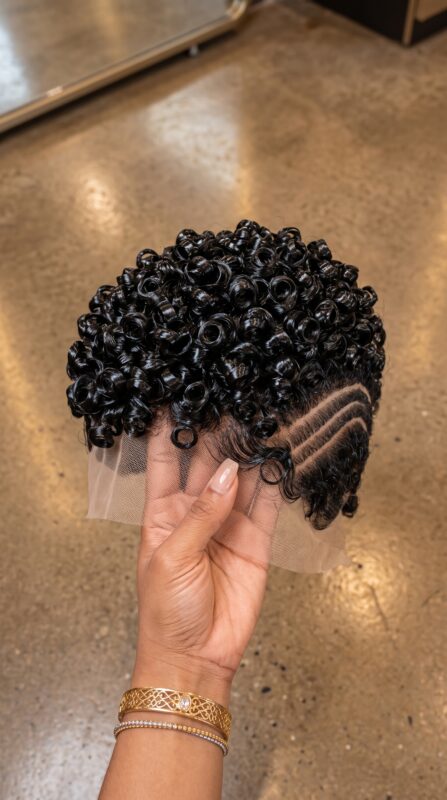
Before purchasing, request a photograph showing the unit removed from the mannequin, including the interior cap and front foundation.
This allows the buyer to assess the construction independently from the attractive exterior styling.
Cap Size Can Change the Side Part’s Position
The side division and temple curl are part of the wig’s finished arrangement. Their location depends on how the unit sits on the wearer.
If the cap is positioned too far forward, the parting may approach the forehead differently from the reference. A cap sitting too far backward can shift the temple curl away from its intended position.
For made-to-order wigs, follow the manufacturer’s measurement instructions and confirm the available sizes.
Depending on the construction, circumference, front-to-nape and ear-to-ear measurements may be relevant.
A professional wig stylist can assist with sizing before a custom order is placed.
Choosing Between Human Hair and Synthetic Fiber
The photographed wig’s material cannot be verified visually, but the buyer’s choice will influence maintenance and future styling flexibility.
A human-hair version may allow individual corkscrew curls to be professionally reset when they relax, depending on the hair’s quality and condition.
A premium synthetic version may retain a pre-set spiral pattern with less frequent reconstruction, although heat tolerance and future modification options vary.
Neither category is automatically the better purchase. The customer should compare the intended wearing routine, professional maintenance availability and budget.
Finding a Salon Experienced With Compact Corkscrew Coils
Custom wig studios, lace-wig specialists and salons offering sculpted finger-coil hairstyles are useful places to begin searching.
The maker should have experience arranging numerous small tubular curls while maintaining a rounded crown and flatter lower side.
When evaluating a portfolio, look for close photographs of similar coil constructions. Large loose curls are not sufficient evidence that the stylist can reproduce this tighter arrangement.
Experience with fine directional hairline styling is also valuable because the temple curl and front strands need a different technique from the crown.
Where to Buy a Similar Jet Black Spiral Pixie Wig
Beauty supply retailers and specialist wig sellers may offer compact black curly units, but the exact corkscrew crown and temple flourish could require professional customization.
When contacting a seller, provide the photograph and describe the desired elements separately: glossy black tubular coils, a deep diagonal side part, compact lower hair and one delicate temple curl.
Ask whether the unit is ready-made or produced after ordering.
If the seller offers custom work, request current photographs of the actual finished wig before shipment rather than relying solely on a portfolio image.
Booking a Professional Installation or Styling Appointment
The appropriate salon appointment depends on whether the wig arrives fully arranged.
A finished unit may require fitting and minor corrections. An unfinished foundation may need extensive coil setting, side shaping and front-strand styling.
When booking, tell the stylist whether the corkscrew crown is already complete and whether the temple curl needs to be created or simply preserved.
This allows the salon to estimate appointment time and assign a professional familiar with the necessary techniques.
Build the Custom Order Around Curl Size and Side Simplicity
The crown specification should identify densely arranged small tubular spiral coils with occasional larger openings and a rounded compact silhouette.
The color should remain deep jet black without obvious contrasting highlights.
The side requirement should include a diagonal exposed part, close dark hair and one fine curled temple flourish, avoiding unrelated decorative carving.
After these visual details are agreed upon, cap measurements, material, available lace options and installation preferences can be discussed separately.
This helps prevent a generic black curly wig from being substituted for the sculpted reference.
Approval Photographs Should Include the Hairline
A close frontal photograph should show the fine directional strands beneath the crown and the placement of the first spiral curls.
A side view should reveal the diagonal part and temple flourish.
An elevated crown image can confirm the density, size and distribution of the tubular coils.
A rear photograph should establish the continuity of the curls around the back.
If construction matters, ask for a separate underside photograph showing the actual cap and attachment system.
Pricing Should Reflect the Number of Individually Arranged Coils
Although this wig has a compact length and a single dark color, its crown contains numerous detailed spiral formations. Producing those curls consistently can require substantial labor.
The side part, fine temple styling and cap preparation may also influence the quotation.
Estimated Price Ranges for Jet Black Corkscrew Pixie Wigs
| Category |
Illustrative Price Range |
Potential Scope |
| Premium Custom |
$315–$565+ |
Higher-grade hair, individual sizing, hand-arranged corkscrew crown, diagonal part refinement, delicate temple styling and selected cap preparation. |
| Standard Custom |
$190–$335 |
Prepared black coil crown, close side construction and established hairline styling with standardized cap sizing. |
| Basic Human Hair |
$110–$205 |
A human-hair foundation requiring additional spiral setting, side shaping and professional fitting. |
| Premium Synthetic |
$75–$150 |
A quality pre-set interpretation that may preserve compact spirals with reduced professional resetting. |
| Basic Synthetic |
$35–$85 |
A budget alternative where coil consistency, front detail, side shaping or cap construction may be simpler. |
These figures are illustrative budgeting references rather than confirmed prices for the wig on the mannequin. Actual costs depend on material, seller location, customization, cap construction, shipping and installation.
Before purchasing, ask whether the price includes the finished corkscrew crown and delicate temple styling. A lower-cost base may still require significant professional work.
Daily Care Should Preserve the Compact Spiral Arrangement
The crown’s individual coils can become less recognizable when neighboring strands are repeatedly brushed together.
Before the first wash, take an overhead photograph of the original arrangement. This can help a stylist restore displaced sections later.
During cleansing, follow the care instructions for the confirmed material and avoid aggressive rubbing between neighboring curls.
After drying, adjust only the sections that have moved rather than rebuilding the entire crown unnecessarily.
The Temple Curl Deserves Individual Attention
The small side flourish is particularly visible because it sits close to the face. If it loses its circular ending, the front profile may appear noticeably different.
A stylist should restore its original direction rather than enlarge it or replace it with several additional curls.
Heavy product may cause the fine strand to stick to neighboring hair, reducing its distinct appearance.
Use appropriate styling methods sparingly and preserve the original scale of the flourish.
Maintain the Diagonal Part Without Widening It
The exposed side part already creates a clear separation between the upper spirals and lower hair.
It does not need to become wider through repeated trimming.
If fine strands move across the part, repositioning may restore its appearance without cutting.
This conservative approach helps preserve the closely arranged dark hair that supports the crown.
Avoid Product Buildup in the Tubular Curls
The black coils already have a reflective surface. Excessive oils, waxes or holding products can cause strands to adhere together and reduce the visible spiral openings.
Product buildup may also make the crown appear heavily coated rather than individually sculpted.
Use only products compatible with the confirmed hair or fiber.
When residue becomes noticeable, suitable cleansing may restore separation more effectively than applying additional shine product.
Storage Should Preserve the Rounded Upper Silhouette
A suitable wig stand or mannequin head can help maintain the raised spiral crown between wears.
The side should remain clear of hard surfaces so the fine temple curl is not flattened.
Store the unit only when the hair and cap are fully dry.
For travel, choose packaging with enough space to protect the spiral openings without compressing the upper crown.
The Strongest Recreation Keeps the Styling Compact and Precise
This jet-black wig demonstrates how a carefully arranged curl crown can create substantial visual interest without multiple colors or elaborate shaved artwork. Dense corkscrew spirals provide the upper structure, a diagonal part establishes asymmetry, and one delicate curled strand completes the temple.
For buyers, the main quality checks are spiral diameter, crown density, glossy black color, parting direction, compact lower hair, temple-curl placement and verified cap construction.
For wig businesses, showing a styled mannequin from the front and side can help communicate the hairstyle’s character. Additional overhead, rear and underside photographs would make the product listing more informative and allow customers to evaluate the actual construction before ordering.
A successful custom version should preserve the relative simplicity of the side and the dense precision of the crown. Increasing volume, adding highlights or introducing extra carved lines would change the reference rather than reproduce it accurately.
Search Terms
jet black corkscrew coil wig · compact tubular spiral pixie · diagonal part black curly wig · single temple curl hairstyle · glossy black sculpted crown · close tapered side wig · fine forehead finger waves · black salon mannequin wig
“`