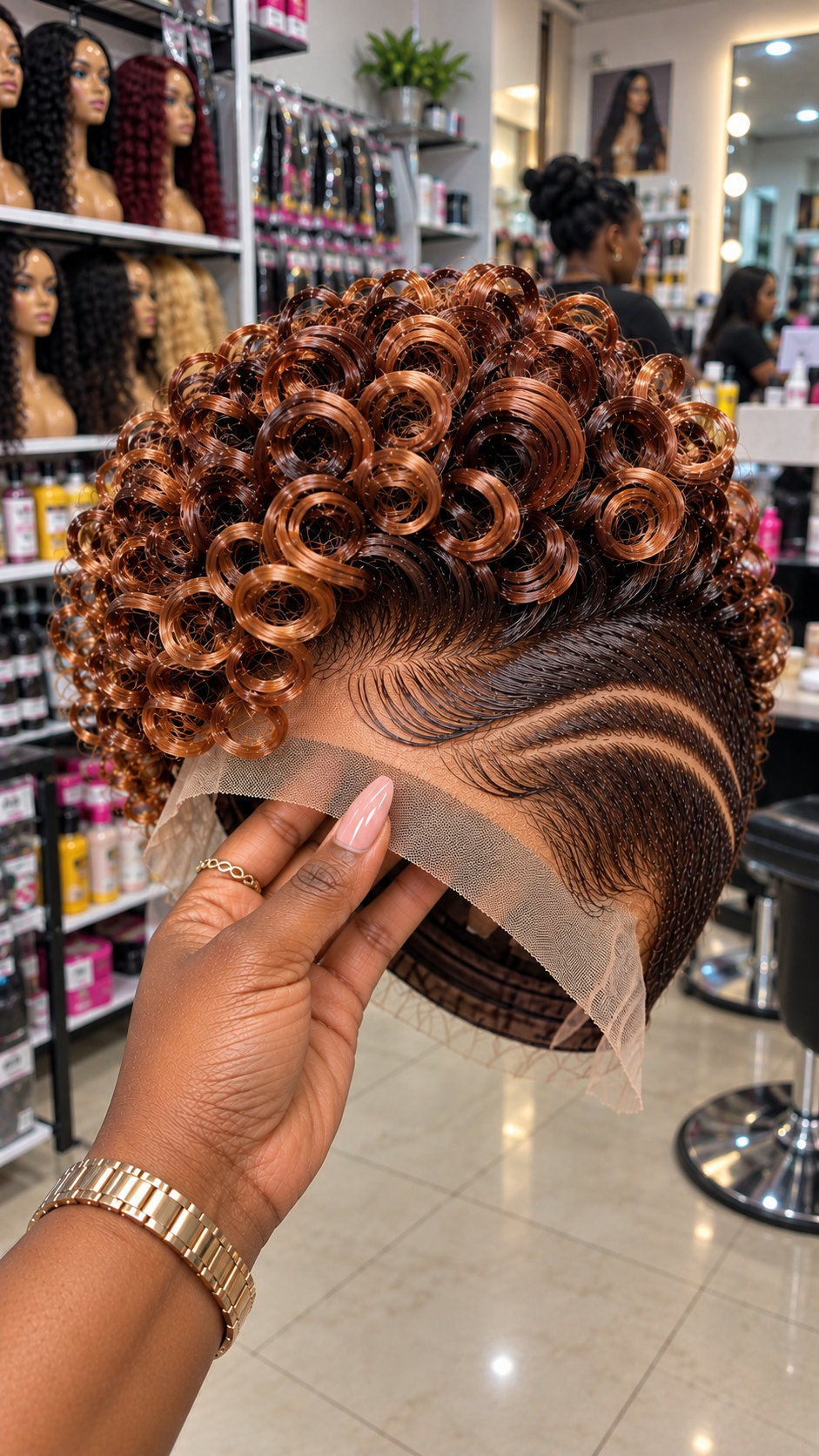
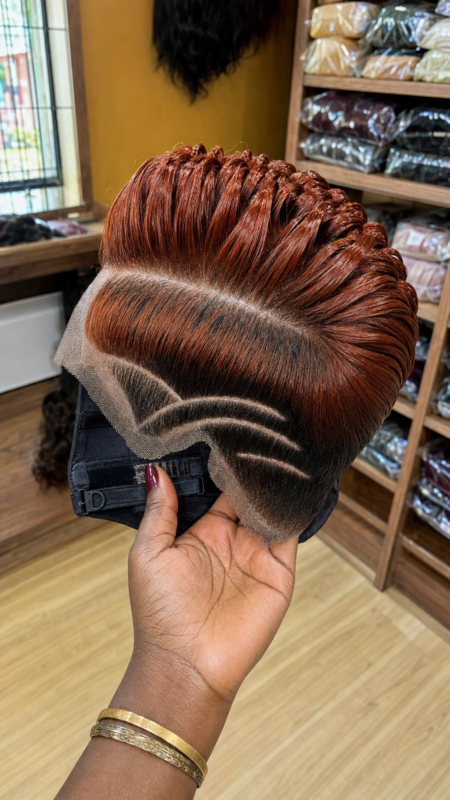
The difference between an ordinary copper curly wig and this sculpted pixie becomes apparent when the hair is examined from the side. A dense collection of circular auburn ringlets occupies the upper head, while two prominent curved separations organize the darker temple into carefully directed sections. Between these areas, a broad finger-wave-inspired panel creates a graceful transition from the raised curls to the closely fitted lower hair.
The photograph captures a lace wig before installation, supported by one hand inside a busy hair retail salon. Its crown contains numerous glossy, hollow-centered ringlets in warm copper, reddish auburn, and deeper chocolate-brown tones. The front hairline has fine strands arranged into flowing curves, and the visible side displays two elongated separation channels. Untrimmed beige lace extends beyond the forehead and temple, while part of the dark interior cap is visible through the lower opening.
What makes this particular hairstyle worth examining is the relationship between its color and construction. The copper tones emphasize the circular formations, while the darker side gives the waves greater visual contrast. A buyer seeking a close reproduction should therefore evaluate the placement of the color, the dimensions of the ringlets, and the shape of the temple channels as connected decisions rather than independent styling requests.
A Copper Color Story Built Around Chocolate-Brown Depth
The upper hair contains a rich combination of warm copper and auburn shades. Some ringlets appear bright reddish copper where the light catches their outer curves, while others display deeper chestnut-brown and chocolate tones. The darker areas are particularly noticeable inside the circular openings and near the roots.
This variation prevents the crown from appearing uniformly orange or red. Instead, the different shades create depth across the rounded loops, allowing individual curls to remain distinguishable even where they overlap.
The lower temple is noticeably darker than many of the upper ringlets. Its appearance is closer to deep chocolate brown with subtle warm reflections. This darker foundation connects the upper coloring to the sculpted side without introducing an unrelated black panel.
The photograph does not establish whether the copper tones were achieved through coloring, blending differently colored hair, or another production method. The exact fiber composition is also unknown.
Choosing Copper Without Losing the Brown Foundation
A customer describing this hairstyle simply as copper red may receive a wig that is considerably brighter than the reference. The photographed unit contains a substantial amount of brown depth beneath and among the copper ringlets.
A more precise color request would specify warm copper-auburn circular curls with chocolate-brown roots and a predominantly darker temple section.
Ask the maker for photographs under natural daylight and neutral indoor lighting. Copper can appear more orange under warm lights and more reddish brown in different surroundings.
For human-hair options, any proposed lightening or coloring should be discussed with a qualified colorist. For synthetic options, the desired combination must be available in compatible manufactured fibers. The photograph alone cannot establish which material was used.
The Circular Ringlets Create a Sculptural Upper Silhouette
The crown contains numerous tightly arranged circular formations. Several ringlets face outward toward the camera, revealing hollow centers, while others tilt diagonally or overlap adjacent curls.
The loops vary slightly in diameter. Larger formations appear across the central upper section, while smaller ringlets fill the surrounding spaces and extend toward the visible sides.
This variation creates a richly layered appearance without requiring long hanging curls. The ringlets remain concentrated near the upper head, producing a rounded pixie silhouette.
Some of the copper strands form nearly complete circles, while others bend into partial loops. Their different orientations give the crown a sense of movement despite the carefully arranged styling.
The darker hair beneath the ringlets contributes to the appearance by creating shadowed spaces between the brighter copper surfaces. These shadows make the individual formations easier to recognize.
Why the Ringlet Openings Matter
The hollow centers are a major part of the hairstyle’s identity. If the curls are made too tightly, their openings may become difficult to see. If they are too loose, the crown may lose its compact circular arrangement.
When commissioning a similar wig, ask the stylist to reproduce the approximate loop diameter and spacing rather than simply requesting curly hair.
A close photograph from slightly above the front-side angle can help confirm whether the ringlets retain their circular structure across the crown.
The maker should also consider the overall height. Excessive additional volume could change the relationship between the raised copper curls and the closely fitted temple.
The Front Hairline Connects Copper Curls to Dark Waves
Beneath the front ringlets, fine dark strands follow a curved direction across the hairline. Their arrangement creates a gradual transition from the raised crown to the flatter temple styling.
The front wave sweeps toward the visible side, where it joins a broader section of closely directed hair. This movement is important because it prevents the crown and temple from appearing like two unrelated designs.
The hairline contains delicate curved strands rather than a heavy straight fringe. Their placement contributes to the overall appearance without competing with the circular ringlets above.
During installation, the stylist should assess how these strands sit once the wig is positioned on the wearer. Excessive reshaping could change the intended relationship between the front curls and the side waves.
Two Sweeping Channels Give the Temple Its Structure
The visible temple contains two prominent curved separation paths. The upper channel follows a long arc beneath the broad side wave, while the lower channel curves around a smaller section of closely directed hair.
The two separations are not perfectly parallel. Their different curvature creates a layered appearance that follows the contour of the side.
Between the channels, the dark hair is arranged in coordinated strands that sweep backward and downward. The lower section follows the temple toward the ear-side perimeter.
These channels resemble carved barber designs, but the photograph does not establish whether they were created by shaving, controlled parting, or exposed foundation areas. On a constructed wig, similar visual effects may require different techniques from those used on natural hair.
Keeping the Curves Proportional
The width and direction of the two channels influence the entire side design. If the upper separation becomes too wide, it may visually disconnect the broad wave panel from the lower hair.
If the lower curve is made too narrow or too shallow, the compact temple section may lose its distinctive boundary.
A custom maker should preserve the general spacing and curvature visible in the reference. Adding extra decorative lines would change the original arrangement.
Before approving a custom order, request a close photograph of the temple with the hair positioned as it will be worn.
The Dark Temple Balances the Warm Crown
The lower side appears predominantly deep brown, with closely directed strands that follow the contour of the cap. This darker area provides visual contrast against the brighter copper ringlets above.
The hair is arranged relatively flat, creating a controlled surface beneath the raised crown. Its direction follows the sweeping channels and the natural curve of the temple.
The difference in volume is particularly important. The upper curls are raised and circular, while the lower hair remains compact and directional.
If the side were made equally full, the hairstyle could lose its distinctive pixie proportions. Conversely, reducing the side too aggressively might create an abrupt transition that differs from the photograph.
The complete rear is not visible, so buyers should request additional photographs before assuming that the same taper and color distribution continue around the back.
The Lace Perimeter Shows the Wig Before Installation
Beige lace extends beyond the front hairline and continues around the visible temple. Its edges remain untrimmed, indicating that the unit has not yet received final wearer-specific lace finishing.
The mesh is clearly visible beneath the front wave and along the lower side. Its appearance confirms the presence of lace but does not establish a particular commercial grade.
The wig should not be described as having HD lace without product-specific verification.
Before purchasing, ask the seller to identify the lace material, coverage area, and available color options.
During installation, the unit should be positioned on the wearer before the excess lace is removed. The appropriate trimming boundary depends on the forehead shape, cap position, and intended securing method.
Particular care is needed near the temple because the decorative channels extend close to the lace perimeter.
What the Interior Opening Reveals
The lower opening exposes part of a dark interior cap. Fabric construction and stitched sections are visible beneath the lace.
However, the photograph does not provide a complete underside view. The number of internal combs, adjustment components, elastic elements, and exact lace coverage cannot be confirmed.
Buyers should request a full underside photograph before purchasing. Ask the seller for the cap circumference, available sizes, and intended attachment method.
If the unit is advertised as glueless, request confirmation of its actual securing system and fitting requirements. The presence of lace and an interior cap does not independently establish adhesive-free suitability.
A stable fit is particularly important for this hairstyle because the curved temple pattern depends on precise positioning.
Finding a Wig Maker for Copper Circular Ringlets
Customers seeking this design should look for wig makers experienced in compact circular ringlets, sculpted pixie styling, and detailed temple waves.
Ordinary copper curly wigs may contain loose spirals or evenly distributed curls rather than the hollow circular formations visible here.
When contacting a salon, provide the reference photograph and explain that the desired hairstyle includes copper-auburn circular ringlets, chocolate-brown depth, a broad front wave, and two sweeping temple channels.
Ask to see examples of previous work involving similar curl structures and side detailing.
Local wig salons may offer opportunities to discuss color samples and cap fit in person. Online custom makers can also be considered if they provide accurate specifications and photographs of completed work.
Before paying a deposit, confirm whether the maker can reproduce the temple geometry without damaging the wig foundation.
Preparing a Reference-Based Custom Order
The first priority should be the crown arrangement. Confirm that the maker understands the desired hollow circular ringlets and rounded upper silhouette.
Next, discuss the color distribution. The copper and auburn shades should remain balanced with darker chocolate-brown depth.
The temple design should then be reviewed separately. Specify the broad upper wave and the two prominent curved separation paths.
Once these visual details are agreed upon, discuss the fiber composition, cap construction, lace coverage, and installation requirements.
For a custom cap, the maker may request head circumference, front-to-nape distance, and ear-to-ear measurements. Follow the supplier’s measuring instructions.
Before shipment, request photographs of the completed unit from the front, visible side, opposite side, above, and rear. An underside photograph should also be included.
Confirm the production timeline, payment terms, shipping arrangements, and whether styling adjustments are included.
Ready-Made Alternatives and Their Limitations
A ready-made copper curly pixie may provide a faster purchasing option, but its ringlets may not have the same circular structure as the reference.
Some ready-made wigs contain loose spirals, spring-shaped coils, or uniformly distributed curls. Their temple sections may also lack the two sweeping channels.
Customers should compare the crown arrangement and side geometry before purchasing. A similar copper color alone does not guarantee a close match.
Custom production offers greater control over curl diameter, color placement, and temple styling, but it may require additional labor and a longer production timeline.
If considering restyling an existing wig, ask a qualified stylist to assess the material and construction first. Cutting or removing hair to create decorative channels can be irreversible.
Illustrative Pricing for Copper Auburn Ringlet Pixie Wigs
The following USD ranges are illustrative planning estimates rather than verified current prices or quotations for the photographed wig. Actual costs depend on fiber composition, color processing, cap construction, styling complexity, seller location, and included services.
| Wig Category |
Illustrative USD Range |
Potential Purchase Scope |
| Premium Custom |
$325–$760+ |
Personalized cap planning, detailed copper color placement, circular ringlet styling, and twin temple wave construction. |
| Standard Custom |
$175–$395 |
Reference-based crown styling and curved temple customization with selected color options. |
| Basic Human Hair |
$105–$255 |
A human-hair pixie base that may require separate coloring, circular curl setting, and side styling. |
| Premium Synthetic |
$80–$195 |
A manufactured-fiber alternative with prearranged curls or copper-brown color blending, depending on availability. |
| Basic Synthetic |
$30–$100 |
An entry-level copper curly pixie option that may approximate the silhouette without reproducing the detailed ringlet and temple arrangement. |
These categories represent possible purchasing options. The photograph does not establish whether the displayed wig contains human hair, synthetic fibers, or a blend.
The most significant labor costs may arise from arranging the numerous circular ringlets, balancing the copper shades, and reproducing the curved temple channels.
Ask whether the quotation includes the finished wig, lace trimming, installation, shipping, taxes, and future adjustments.
Comparing complete service packages is more useful than comparing base prices alone.
Maintaining the Copper Circular Ringlets
The upper curls require careful handling because their appearance depends on preserving the individual circular openings.
Aggressive brushing can separate the strands and change the arrangement of the loops.
Before cleaning, ask the maker how the curls were formed and secured. The appropriate maintenance method depends on the fiber composition and any styling products used during construction.
Do not apply high heat until the material and permitted temperature range are confirmed. Synthetic fibers may have strict limitations, while human hair can also be damaged by excessive styling.
If individual ringlets begin to flatten, professional resetting may be preferable to repeated home attempts.
Preserving the Copper and Chocolate Contrast
Warm copper shades may change in appearance over time depending on the coloring method and care routine. Product buildup can also reduce the visible distinction between neighboring curls.
Use products suitable for the confirmed fiber composition and coloring history.
For processed human hair, ask the stylist about appropriate color-safe products and whether future color maintenance may be necessary.
For synthetic hair, follow the manufacturer’s instructions and avoid unverified dyeing or heat treatments.
Protecting the Sweeping Temple Waves
The lower side requires a different maintenance approach from the crown. Its appearance depends on the exposed channels remaining visible and the surrounding strands retaining their intended direction.
Repeated friction, rough combing, or pressure from tight headwear may disturb the styling.
When removing the wig, avoid pulling directly on the decorative temple or delicate lace perimeter.
If the channels become less distinct, consult a stylist before attempting to widen them. Cutting into the hair or foundation could permanently alter the design.
For storage, use a support that maintains the cap shape while leaving sufficient space around the raised ringlets.
Planning the Final Installation
After receiving the wig, inspect the copper ringlets, temple geometry, lace perimeter, and cap construction before making permanent changes.
Book a stylist experienced in lace-front wigs and sculpted pixie hairstyles. Explain that the goal is to preserve the circular crown and twin sweeping temple channels.
The stylist should first assess the cap fit and hairline position. Once the unit sits appropriately, the excess lace can be trimmed according to the wearer’s needs.
Minor adjustments to the front curls may be appropriate after fitting, but excessive reshaping could change the original silhouette.
Before completing the appointment, inspect the hairstyle from the front, side, and above. These angles reveal whether the ringlets retain their circular structure and whether the temple waves remain distinct.
Evaluating the Finished Copper Pixie Wig
The distinctive character of this wig comes from the combination of warm copper-auburn circular ringlets and a carefully organized dark temple. The two sweeping channels create a layered side pattern, while the broad front wave connects the raised curls to the lower section.
The color arrangement contributes to the design by emphasizing the individual loops without overwhelming the darker foundation.
For buyers seeking a faithful reproduction, the priorities should be the compact circular ringlets, copper and chocolate color balance, twin curved temple geometry, and appropriate lace and cap fitting.
A reliable supplier should be able to confirm the material, provide additional photographs, explain the construction, and clarify the services included in the purchase.
With those details established, this photograph can serve as a practical reference for selecting or commissioning a copper-auburn sculpted pixie wig that preserves the relationship between its richly colored crown and carefully directed temple waves.
Search Terms
Copper auburn hollow ringlet lace wig · Chocolate root circular curl pixie · Twin sweeping temple wave hairstyle · Warm copper sculpted crown wig · Brown finger wave side lace pixie · Beige untrimmed lace auburn ringlets · Copper chocolate two tone curly pixie · Glossy auburn loop crown temple waves