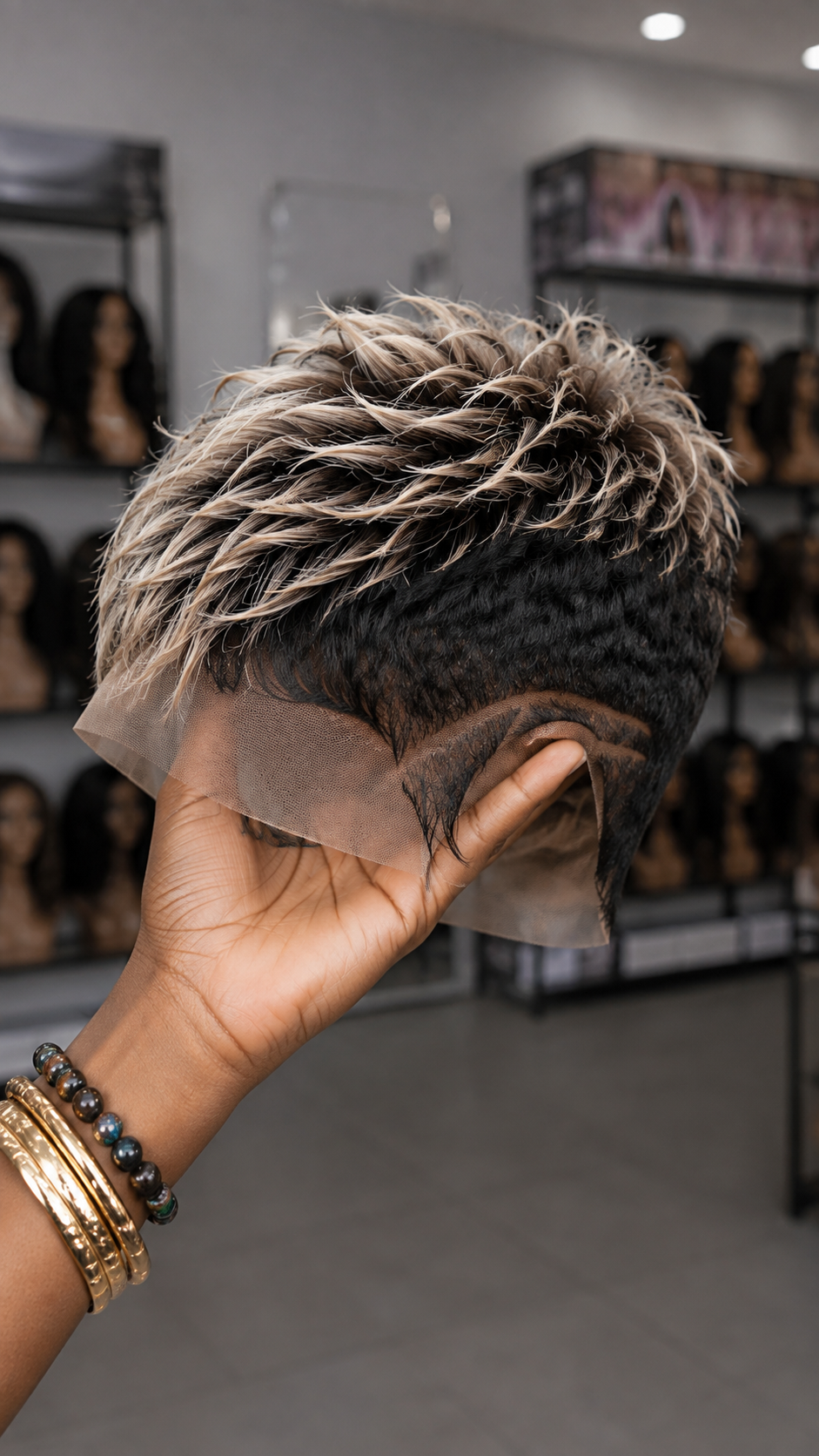
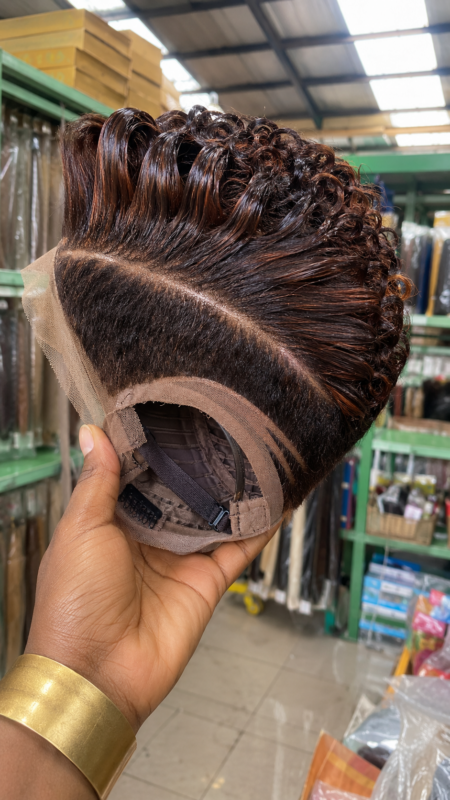
After a long run of curls, spirals, and crimps, this unit does something different: razored, piecey strands with sharp, tapered ends and a tousled, spiky finish, achieved through cutting technique rather than any curling tool. No rod touched this hair, no crimping iron pressed it into zigzags, the texture comes from how it was cut, razored at angles that create separated, feathered pieces rather than a smooth, blunt edge. This is a genuinely different way of building texture into short hair, and it behaves nothing like the curled units that dominate most pixie collections.
Because the texture is cut in rather than set in, it does not relax, drop, or frizz the way a curl does. There is no round or coiled shape to loosen over time, so this piecey, spiky look does not soften into something else the way a curl fades toward a looser wave. Instead, the texture holds structurally, through the cut itself, and what changes day to day is simply how you style it, pushed up and separated for volume, or smoothed down for something calmer. This makes it fundamentally lower-maintenance in one specific way: there is no re-setting required, ever, since there was never a set to begin with.
The dark root melting into a platinum blonde adds another layer here, but the real story of this unit is the cut. Sharp, tapered ends catch light differently from a round curl, giving a more graphic, editorial edge rather than a soft, bouncy one. If you have been comparing curl units on curl size, definition, and how they relax, none of that vocabulary quite applies here, because a razored, piecey texture is playing an entirely different game, one of cut and structure rather than curl and set.
Where To Buy A Razored, Piecey-Texture Pixie Wig
Custom makers who cut and texturise rather than curl can create genuinely sharp, separated pieces, so ask specifically about the cutting technique used to create the spiky, piecey finish. A maker who understands texturising will describe razoring or point-cutting; one who only curls or crimps may not offer this texture at all.
Instagram and TikTok sellers who show razored pixie units display the piecey, tousled finish clearly, so look at how sharp and separated the ends are rather than judging by curl definition, since this style has none. A razored pixie wig succeeds on the crispness of its cut, not on any curl pattern.
Etsy works with makers who can describe their cutting technique for textured pixie styles. The risk is confusing a loosely curled or crimped style with a genuinely razored one. Read listings and reviews carefully for mentions of texturising, razoring, or piecey cutting specifically.
Marketplaces like Amazon, AliExpress, and Temu carry textured pixie units, and this style suits synthetic hair particularly well, since the shape is structural rather than curl-dependent, so a good synthetic razored pixie can look just as sharp as human hair with far less upkeep. Judge the sharpness and separation of the piecey ends in photos.
Local beauty supply shops and salons let you see and feel how a razored texture differs from a curled one, and a stylist can show you how the piecey finish is styled and maintained. You pay a premium in-store, but this hands-on comparison is useful if you are used to curl units and want to understand this different texture.
Vendors and wholesalers direct ship standard textured styles, so confirm the technique is genuine razoring or point-cutting rather than a loosely set curl marketed as texture.
Regionally, razored and texturised pixie cuts are a real specialty skill found across Lagos, Accra, Atlanta, London, and South Africa, distinct from the curl-setting skills used for spiral or barrel styles.
Vet the seller the usual way: check the account age, look for real buyer photos, time a plain question for a genuine reply, and ask directly about the cutting technique used to create the texture. A seller who can explain razoring or point-cutting specifically understands this style is different from a curl set.
Red flags: a loosely curled or lightly crimped unit marketed as a razored texture, blunt rather than tapered ends in close photos, and no clarity on the actual cutting method used.
When you order, send your measurements and ask specifically for a razored, piecey texture with tapered, separated ends rather than a curl or crimp. That gets you the cut-based texture you are after, not a different technique mislabelled.
Contact / order inquiries: WhatsApp [WhatsApp: +XX XXX XXX XX XX].
How Much It Costs
A razored, piecey pixie is priced similarly to other short units, and the real value lies in the precision of the cut itself rather than any colour or curl work layered on top.
Tiered pricing. Human hair, full build with a razored, piecey texture and a dark-root platinum melt, glueless with a fine lace: roughly $210 to $450, with the colour work adding to the base price. Human hair, mid build: about $160 to $340. Human hair, basic cap: around $100 to $220. Good synthetic with a well-textured cut: $60 to $150, and synthetic often suits this style particularly well since the texture is structural. Basic synthetic: $25 to $60.
What that includes and excludes. The price covers the unit and its cut as textured. It excludes shipping, any customs, and the styling paste or wax used to define the piecey finish day to day.
Shipping and duty. These sit outside the price and change with where you live, so plan a realistic band and confirm your own country’s import rate.
Ongoing costs. This style needs no re-setting product or heat tools at all, just a light texturising paste or wax to separate and define the pieces each time you style it, and a purple product for the platinum sections to stay bright. This is meaningfully less ongoing effort than any curled or crimped unit in this shop’s range.
First-year total. A human razored-texture unit plus shipping plus any customs plus light styling product and toning tends to land between a low three-figure sum and roughly double the sticker, with upkeep being some of the lowest of any style covered so far.
Cost per wear. Because there is no curl to relax or crimp to soften, this texture looks essentially the same from the first wear to the fiftieth, provided the cut stays intact, which makes its cost per wear excellent for anyone who wants consistency without daily styling effort.
What a very low price signals. A very cheap unit sold as razored or piecey may actually have blunt, unfinished ends rather than genuinely tapered ones, so check close photos for the actual cut quality rather than trusting the description.
Deposit structure. For custom work, thirty to fifty percent down with the balance before shipping is standard, and use a method you can dispute.
Shipping, Delivery, And What To Expect After Ordering
A razored pixie unit arrives with its cut already finished, and unlike a curl or crimp, that cut does not need reviving from being packed flat, since the texture is structural rather than set. Ask that it ship protected, choose a tracked service, and confirm your country’s import charge before it lands. When it arrives, work a small amount of texturising paste through the ends to separate and define the piecey finish. What you unbox is a texture that holds its character from day one without any re-setting required.
The Texture Comes From The Cut, Not A Tool
Every curled or crimped unit in this collection relies on a set that eventually relaxes, but this piece relies entirely on how it was cut, tapered and razored to create separated, feathered pieces rather than a blunt edge. That structural difference is why it does not behave like any curl unit, since there is nothing to loosen, only a cut that holds until it grows out or needs a trim.
It Never Needs Re-Setting
Because the texture is not a curl or a crimp, there is no re-setting to think about, ever. What you do day to day is purely styling, working product through to separate the pieces, not restoring a shape that has relaxed. This is a genuine, ongoing time saving compared to any set curl, and it is worth knowing if you are drawn to low-maintenance styles.
Sharp Ends Catch Light Differently Than A Curl
The tapered, razored ends of this texture read as more graphic and editorial than a round curl’s soft shine, catching light in sharp, defined lines rather than glossy loops. This gives the style a different mood entirely, less bouncy and romantic, more sharp and modern, which is worth considering if you have been choosing between units based on curl definition alone.
Before You Pay
- Is this a genuinely razored, piecey cut, or a loose curl marketed that way?
- Are the ends visibly tapered and separated, not blunt?
- Do I want a texture I never have to re-set, styling only with product?
- Does the sharp, editorial look suit me better than a soft curl?
- Is the colour placement, if any, clean and well-blended at the root?
Trimming The Lace
The lace comes off the front the usual way, and with a razored texture the front pieces can be cut to blend seamlessly into the lace trim, since both are about precise cutting rather than curl placement. Trim in small offset steps and leave a shallow margin rather than cutting flush, in daylight. If this is your first razored unit, let a stylist make the first pass, since achieving genuinely sharp, tapered pieces at the hairline takes real cutting skill.
Search Terms
razored pixie wig · piecey texture short wig · platinum root pixie unit · textured spiky pixie lace · dark root blonde razor cut wig · tapered ends short pixie · editorial pixie wig texture · glueless razored short wig
Final Thoughts
After a long run of curls and crimps, this unit’s texture comes from an entirely different source, the cut itself, razored into sharp, separated pieces rather than set into any curl or zigzag. That structural difference means it never relaxes, never needs re-setting, and holds its character from the first wear onward, asking only for a little styling paste to define the piecey finish each time.
Buy it understanding you are choosing cut over curl, a sharp, editorial texture over a soft, bouncy one, with meaningfully less ongoing upkeep than any set style. A razored, piecey pixie wig with a dark-root platinum melt gives you a completely different silhouette and maintenance rhythm from a curled unit, and once you know the difference is in the cutting technique, not a curling tool, you know exactly what you are buying and how little it will ask of you afterward.