Not every elaborate curly wig relies on shaved lines, dramatic color transitions, or decorative forehead waves. Some designs achieve their character through a deliberate difference in hair length and arrangement. This chocolate espresso wig presents a striking example: a dense upper collection of glossy circular ringlets sits above a closely cropped side panel, creating a dramatic contrast between elevated curls and compact hair.
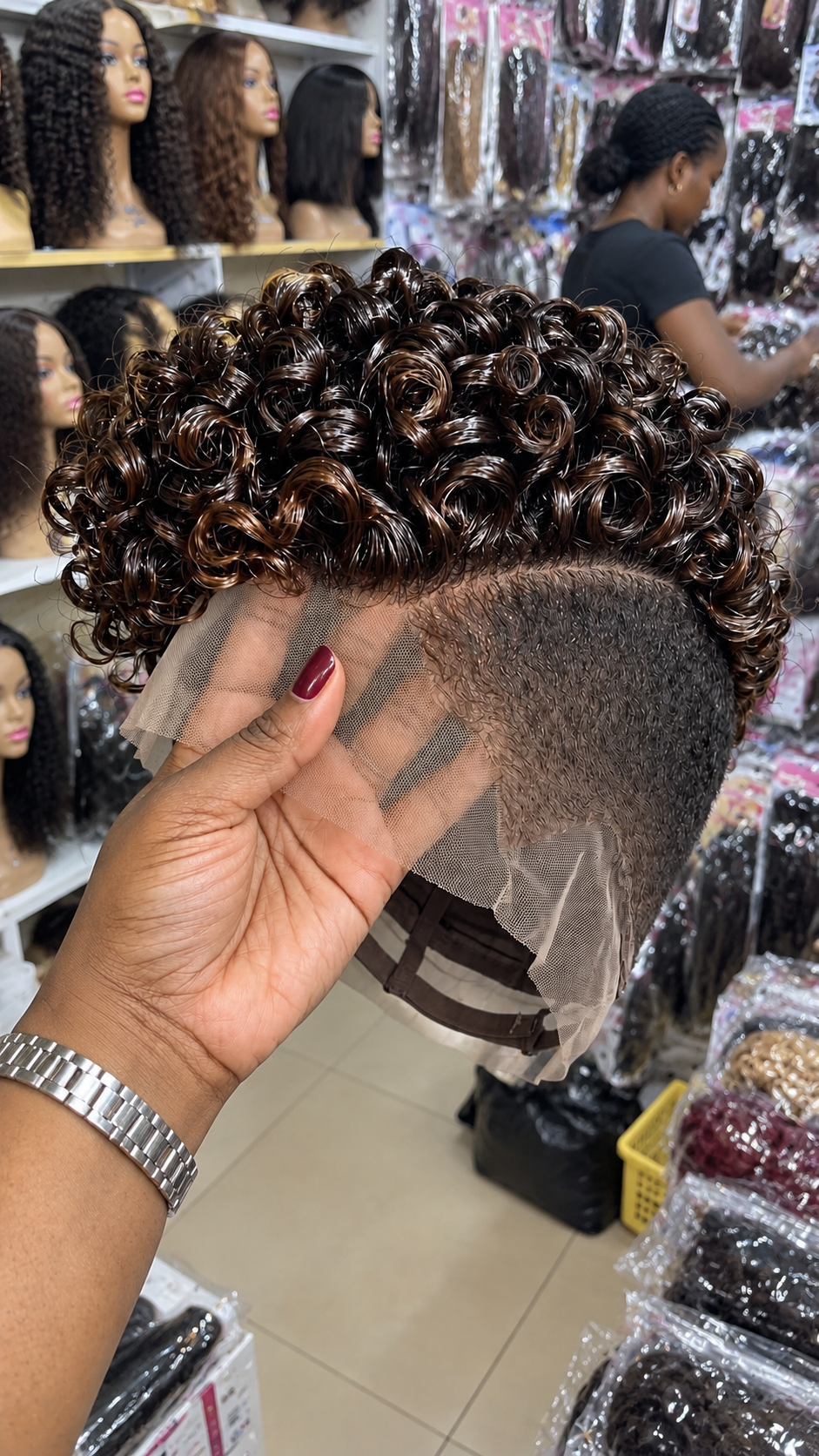
Photographed inside a busy hair supply shop, the wig is held in one hand with its untrimmed lace facing the camera. The angle reveals the circular curl structure, the darker roots beneath the glossy upper hair, and a large lower panel containing very closely arranged, fine curls. Part of the interior cap is also visible beneath the lace.
The absence of carved side artwork is particularly important. Unlike wigs with sweeping channels or geometric designs, this unit relies on the contrast between the raised ringlets and the closely cropped lower section. The side appears uninterrupted by obvious shaved lines, allowing the hair’s natural-looking density and directional transition to become the main attraction.
For buyers seeking a similar appearance, the central challenge is reproducing this balance. A wig with the correct chocolate-brown color but loose hanging curls will not resemble the reference. Likewise, a unit with a raised curly crown but an excessively thin lower section may lose the compact, full-bodied character of the design.
A Side Panel That Changes the Way the Entire Wig Is Perceived
The most revealing area of the photograph is the broad, closely cropped panel beneath the ringlets. This section contains numerous fine, tightly arranged curls that lie relatively close to the underlying cap. The strands appear much smaller and less elevated than those forming the upper hairstyle.
The panel occupies a substantial portion of the visible side, extending downward from the ringlet boundary toward the lower lace area. Its surface appears predominantly dark brown with muted gray-brown reflections, partly influenced by the salon lighting and the fine structure of the hair.
Unlike a conventional tapered haircut, the photograph does not establish whether the lower section was produced through cutting, specialized ventilation, or another wig-making method. What can be observed is a deliberate difference in apparent length and curl scale.
The transition between the upper and lower areas is relatively direct. The large circular ringlets end above the compact panel, creating a noticeable boundary without a pale carved channel separating them.
This is a useful design choice for customers who appreciate elaborate curls but prefer not to have geometric side artwork. The lower section provides contrast through hair length and arrangement rather than decorative lines.
Why the Lower Hair Should Not Be Made Too Sparse
When commissioning a similar wig, ask the maker to preserve the visible density of the lower panel. Although the hair is closely arranged, it does not appear completely shaved to the underlying cap.
A lower section with insufficient hair may expose construction material and produce a different appearance. Conversely, excessive length or fullness could blur the distinction between the compact side and the raised ringlets.
The ideal balance depends on the cap construction and the wearer’s head measurements. A professional should evaluate whether the desired lower density can be achieved without compromising the integrity of the wig.
Customers should request a close side photograph before final approval. This is especially important because a frontal image may conceal the lower panel almost entirely.
Chocolate Brown Highlights Within a Dark Espresso Foundation
The upper ringlets display a rich mixture of chocolate brown and deep espresso tones. Some strands appear warm brown where they reflect the shop lighting, while others remain nearly black in the shadowed areas.
The color variation is subtle rather than dramatic. There are no clearly visible blonde, copper-orange, burgundy, or silver sections. Instead, the curls contain warm brown reflections that emphasize their circular shapes.
The darker foundation is especially noticeable near the base of the ringlets and throughout the lower panel. This creates continuity between the two styling areas, even though their curl structures are very different.
Several upper loops appear slightly lighter along their outer surfaces, where the curved strands catch the light. Their centers remain darker, producing depth without requiring strongly contrasting highlights.
When ordering, describe the desired appearance as deep chocolate espresso with warm brown reflections rather than requesting a brightly highlighted wig.
Distinguishing Actual Color From Salon Reflections
Glossy dark hair can appear considerably lighter under overhead lighting. The photograph contains several bright reflective bands, but these should not automatically be interpreted as intentionally colored highlights.
Before purchasing, ask the seller for photographs taken under natural daylight. This can help determine whether the hair contains separate brown-highlighted strands or whether the lighter appearance comes primarily from reflections.
If ordering a custom unit, confirm the desired balance between espresso and chocolate tones. A uniformly jet-black wig may appear darker than the reference, while a light chestnut version could reduce the contrast between the upper ringlets and the lower panel.
The maker should also explain whether the proposed color is available in the chosen fiber and whether any additional coloring would be required.
The Upper Ringlets Are Dense Without Being Uniform
The upper hairstyle contains numerous glossy circular curls arranged into a rounded, elevated formation. Several loops near the center form recognizable circular openings, while others overlap or bend in different directions.
The ringlets vary in apparent size. Some are relatively broad and open, while smaller curls occupy the spaces between them. This variation creates a layered appearance rather than a perfectly repeated pattern.
The curls are concentrated near the upper surface, with several extending toward the visible front and side. Their arrangement gives the wig considerable decorative detail without requiring long hanging strands.
The glossy chocolate-brown surfaces reflect light along their curves, making the circular structure especially noticeable. Dark openings remain visible inside many of the loops, emphasizing their three-dimensional arrangement.
Near the boundary with the lower panel, the curls become more compact and closely grouped. This helps the upper section transition into the shorter hair beneath it.
Controlling the Upper Volume During Production
A wig maker attempting to reproduce this hairstyle must consider the relationship between curl size, density, and overall height.
If the ringlets are too large, the upper section may become excessively bulky. If they are too small or tightly compressed, the distinctive circular openings may disappear.
The reference shows a relatively full upper arrangement, but the curls remain individually recognizable. This balance is important for maintaining the hairstyle’s character.
Customers should request photographs from the front, side, and slightly above the crown. These angles reveal whether the ringlets are distributed consistently and whether the upper silhouette remains proportional to the lower panel.
The maker should also explain how the curls are formed and whether they require professional resetting after washing. The photograph cannot establish the actual fiber or styling technique.
The Transition Between Large Ringlets and Fine Side Curls
One of the most interesting aspects of the hairstyle is the dramatic change in curl scale. The upper section contains broad, polished loops, while the lower panel is composed of much finer curls.
This contrast creates visual movement without relying on carved lines or multiple colors. The eye naturally moves from the circular openings above to the compact surface below.
The boundary between the two sections is not perfectly straight. Several ringlets extend slightly downward, creating an irregular but controlled transition.
The lower hair also appears less reflective than the upper curls. This difference may result from the shorter strands, their arrangement, and the lighting angle.
For a custom order, ask the stylist to preserve the distinction between the two curl scales. A lower section with loose curls would reduce the contrast, while an entirely bare side would create a much sharper effect than the reference.
What the Exposed Lace Reveals Before Installation
A broad section of beige-brown lace extends beyond the visible front and side of the wig. The mesh is held between the fingers, making its fine structure easy to examine against the hand and shop background.
The lace remains untrimmed, indicating that the unit is being presented before final fitting. Its extended edge provides material that may be adjusted during installation.
The lower side panel approaches the lace boundary, making careful trimming particularly important. Removing too much mesh could interfere with the intended hairline or expose unwanted construction details.
The photograph does not establish the exact lace classification. It would be inaccurate to identify the material as HD lace without reliable product information.
The image also does not prove that the wig can be worn securely without adhesive. The appropriate installation method depends on cap fit, attachment options, and the wearer’s needs.
Before purchasing, ask the seller to confirm the lace specifications, available cap sizes, and recommended fitting procedure.
A Partial Interior View Raises Useful Questions
The lower portion of the photograph reveals part of the wig’s interior. A dark brown cap structure with stitched bands and fabric sections is visible beneath the lace.
The cap appears to contain a structured perimeter, but the image does not clearly show the complete fastening system. Additional combs, clips, straps, or adjustment mechanisms should not be assumed to be present.
A buyer should request a photograph of the entire underside, including the front lace area, rear perimeter, and any securing components included with the actual unit.
Cap measurements are especially important because the lower panel occupies a substantial portion of the visible side. If the cap sits incorrectly, the transition between the ringlets and compact hair may appear misplaced.
Ask the maker which measurements are required. These commonly include head circumference, front-to-nape distance, ear-to-ear measurements, and temple placement.
If ordering online, confirm whether the seller offers multiple cap sizes or individual adjustments. A standard-size unit may not provide the same fit for every wearer.
Finding a Stylist Who Understands Contrasting Curl Lengths
This design requires expertise in arranging circular curls and creating a closely fitted lower section. A stylist experienced only with loose curly wigs may not be familiar with the controlled ringlet formation or the compact side construction.
Look for wig makers who specialize in sculpted pixie units, spiral curl styling, and custom lace wig fitting.
When contacting a salon, send the reference photograph and explain that the upper ringlets should remain elevated above a closely cropped panel of fine curls.
Emphasize that the visible side does not contain decorative shaved lines. Adding geometric artwork would change the hairstyle rather than reproduce it.
Ask whether the maker can create the lower panel using a method suitable for the chosen cap and hair density.
Review previous examples of similar work. Photographs showing compact curly wigs with contrasting hair lengths are more relevant than a general portfolio of long wigs.
For local purchases, a fitting appointment can help establish whether the proportions suit the wearer’s head shape. Online buyers should request photographs of the actual finished unit before shipping.
Building a Custom Order Around the Side Panel
The ordering process should begin with the overall silhouette. Confirm the intended height of the ringlets, the width of the compact lower panel, and the location of the transition between them.
Next, discuss the color. The maker should understand that the hairstyle is predominantly dark espresso with chocolate-brown reflections rather than a strongly highlighted design.
Provide accurate head measurements according to the maker’s instructions. The lower panel needs to align with the wearer’s temple and side of the head.
Once the base is prepared, request a side photograph showing the compact panel before the upper curls are fully arranged. This makes it easier to evaluate the density and shape of the lower section.
After the ringlets are completed, request front, side, and rear photographs. The reference does not fully reveal the back, so additional views are necessary to establish how the hairstyle continues around the head.
Before delivery, confirm the hair material, cap construction, lace specifications, and any included securing components.
Also clarify whether the quoted amount includes installation, lace preparation, shipping, and future styling adjustments. These services may be charged separately.
Illustrative Prices for Chocolate Espresso Ringlet Pixie Wigs
The combination of dense circular ringlets and a closely arranged lower panel may influence the amount of labor required to produce a similar wig. The following USD figures are illustrative planning ranges, not verified live prices or quotations for the photographed unit.
| Wig Category |
Illustrative USD Range |
Possible Purchase Characteristics |
| Premium Custom |
$290–$690+ |
Individual cap sizing, advanced circular ringlet styling, carefully arranged compact side panel, and personalized lace preparation. |
| Standard Custom |
$155–$345 |
Customized chocolate-brown curls, dark foundation, and professionally shaped lower side section. |
| Basic Human Hair |
$95–$240 |
A human-hair pixie base that may require additional curl formation and side customization. |
| Premium Synthetic |
$65–$175 |
Higher-priced synthetic options with dark brown coloring and prearranged curls, subject to manufacturer specifications. |
| Basic Synthetic |
$25–$90 |
Budget curly pixie alternatives that may resemble the color and silhouette without reproducing the detailed ringlet arrangement. |
The main cost variable may be the time required to arrange the upper curls into recognizable circular loops. A wig with ordinary loose curls may require less styling labor.
The lower panel may also involve specialist work, depending on how the fine curls are arranged and how the cap is constructed.
Color preparation is likely to be less elaborate than a strongly contrasting blonde or copper design, but the final cost still depends on the chosen material and supplier.
Customers should compare complete quotations that include the wig, customization, shipping, installation, and any necessary adjustments.
The photograph does not establish whether the displayed wig is human hair, synthetic, or a blend. The table describes possible purchasing categories rather than confirmed product characteristics.
Preserving the Upper Ringlets Without Disturbing the Lower Panel
The upper curls and lower panel may require different handling because their structures are noticeably different.
The circular ringlets depend on controlled strand placement. Aggressive brushing may separate the loops or cause neighboring curls to merge, reducing their distinctive appearance.
The lower panel contains much finer curls that lie close to the cap. Excessive manipulation could disturb their compact arrangement or expose the underlying construction.
Before washing, confirm the fiber type and obtain the maker’s recommended care procedure.
If the wig is human hair, repeated washing and heat styling may gradually affect the ringlet arrangement. If it is synthetic, heat compatibility must be confirmed before using heated tools.
Avoid applying excessive heavy products to the upper curls. Product buildup can reduce strand separation and make the circular openings less visible.
When handling the wig, support the cap rather than pulling on individual ringlets or the fine lower hair.
Keeping the Compact Side Looking Consistent
The lower panel should be maintained without unnecessary cutting or aggressive combing. Its appearance depends on retaining the closely arranged fine curls.
If the panel begins looking uneven, consult a stylist familiar with the wig’s construction. Do not attempt to shave or trim the area without professional assessment.
Depending on the cap and hair placement, additional cutting could expose underlying material or permanently alter the design.
During storage, place the wig on a suitable stand that supports the cap without compressing the upper ringlets. Avoid pressing the lower panel against rough surfaces that could disturb the fine curls.
A Dark Curly Pixie That Relies on Shape Rather Than Artwork
This chocolate espresso wig offers a distinctive alternative to curly pixie designs with shaved lines or elaborate temple patterns. Its visual impact comes from the contrast between large, glossy circular ringlets and a closely arranged panel of much finer curls.
The dark color gives the hairstyle a cohesive appearance, while warm chocolate reflections emphasize the individual loops without introducing dramatic highlights.
Its strongest quality is the balance between upper volume and lower compactness. The ringlets remain prominent, but the side panel prevents the silhouette from becoming excessively wide.
Customers seeking a similar unit should prioritize accurate curl arrangement, suitable cap construction, and careful fitting rather than relying exclusively on color descriptions.
With appropriate customization and material-specific maintenance, this design can provide an elegant, sculptural pixie appearance that remains distinctive without decorative carved lines or contrasting bright colors.
Search Terms
Chocolate espresso circular ringlet pixie wig · Dark brown compact side panel lace wig · Glossy chocolate loop curl crown · Fine micro curl side pixie hairstyle · Untrimmed beige lace espresso ringlet wig · Dark root sculpted circular curls · Closely cropped side chocolate curly wig · Brown interior cap spiral pixie unit