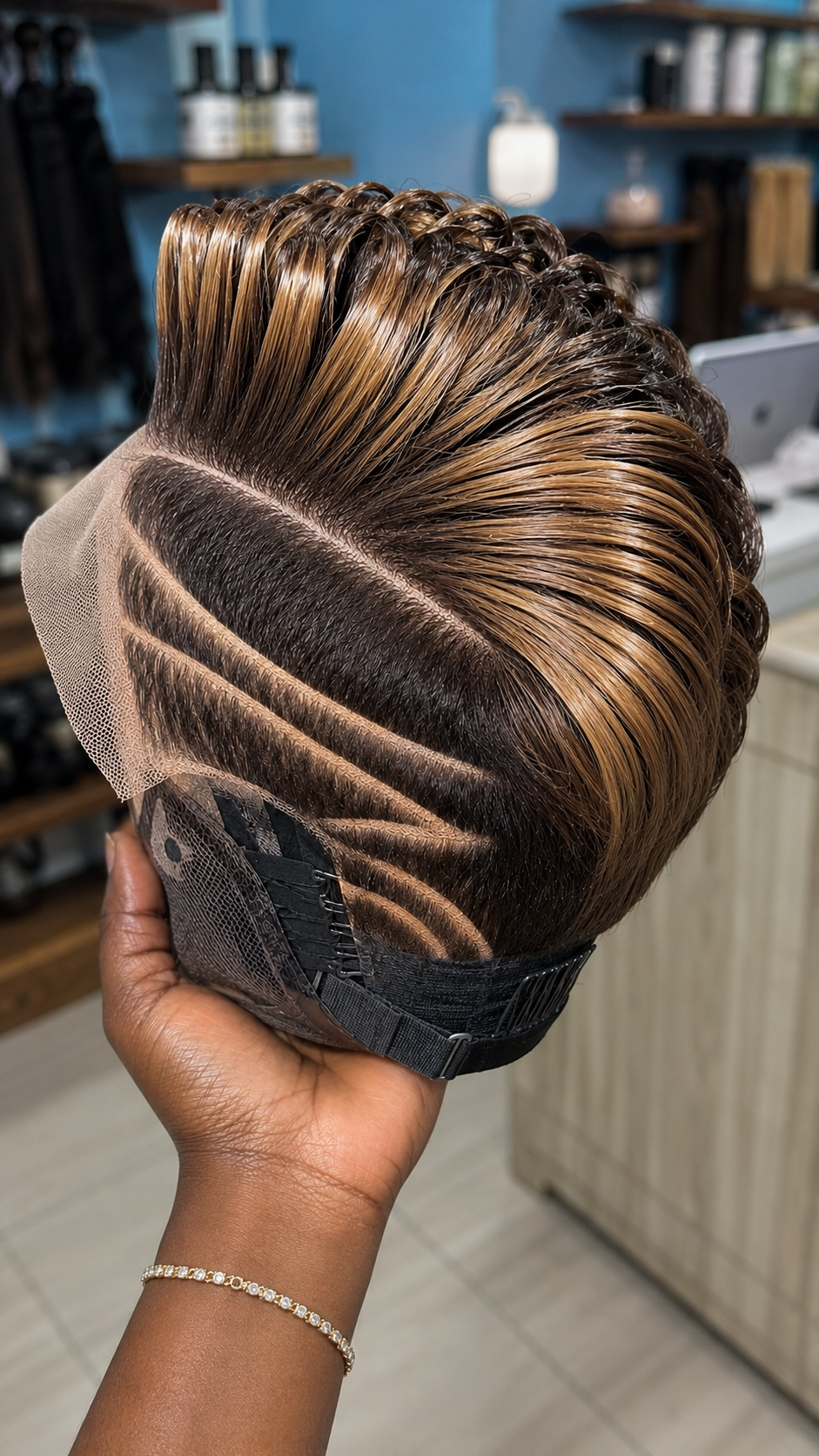
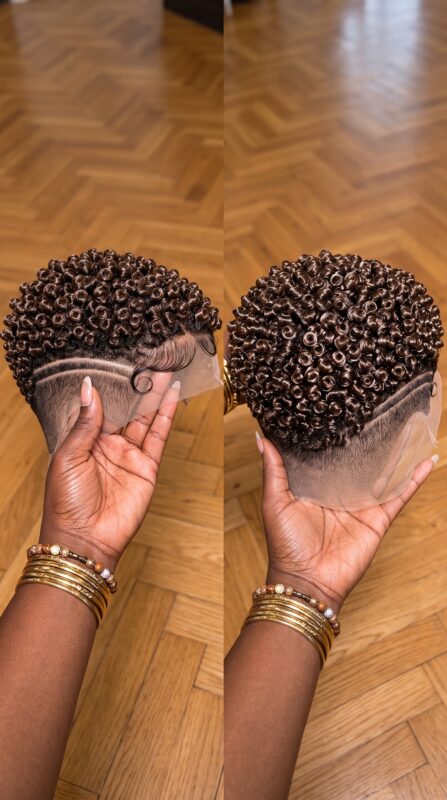
Three distinct carved lines sweep across the temple of this unit, anchoring a design where every single strand has a strict directional job to do. When you hold a structured, brushed-back short piece like this in your hands, you are looking at precision styling that relies entirely on structural tension and clean transitions. The golden honey and espresso brown highlights run through a high-profile pompadour crown that folds backward in seamless ridges, while the side panel transitions into a dark, textured low fade defined by geometric razored arcs. It is a striking, editorial silhouette, but it is also a build that completely exposes how the unit was constructed from the inner cap netting to the raw lace perimeter.
Brushed-back, directional short wigs leave nowhere for weak construction to hide. On a loose curly unit, voluminous coils naturally mask uneven tracks, coarse knots, and minor placement errors along the hairline. A sleek pompadour offers no such forgiveness. Every single ventilated hair along the temple must be knotted at the correct angle so it sweeps backward smoothly without bunching up or pulling away from the base mesh. The contrast between the warm golden highlights on top and the deep brown undertones below acts like a visual map, showing exactly where the machine wefts meet the hand-tied lace foundation.
Achieving a natural look with this style requires a solid understanding of how directional hair tension interacts with cap sizing. If the cap is even slightly too loose, brushing the crown back will cause the side perimeter to lift and buckle around your ears. If it is too tight, the delicate single knots along the carved lines will stretch and tear over time. Taking the time to evaluate the ventilation density, the internal comb positioning, and the maintenance needs of multi-tonal processed hair ensures that your unit retains its sculpted shape through repeated wears without losing its crisp lines.
Where To Buy Highlighted Pompadour Pixie Wigs
Custom makers: Bespoke wig ventilating artists and specialized master stylists are the premier choice for intricate swept-back styles. When you commission a custom piece, the maker ventilates the lace panel specifically to follow your natural temple contour and sets the directional hair flow backward from root to tip. You can specify exact highlight ratios, requesting fine honey blonde ribbons blended through an espresso base, as well as customized knot bleaching and pre-plucked densities tailored directly to your skin tone.
Instagram and TikTok sellers: Video-driven stylists regularly feature directional mohawk and pompadour cuts on their social platforms. These clips are invaluable because they show how the hair behaves when moved under natural light, allowing you to see if the swept crown maintains its height without stiff hairspray crust. Focus on verified creators who provide clear, close-up footage of the raw lace edge, the underside of the cap, and the transition lines between the carved fade and the voluminous top tracks.
Etsy: Independent creators on Etsy frequently produce handcrafted, salon-finished short lace units with elaborate parting designs. Look for shops with extensive portfolios showcasing hand-ventilated frontals, detailed sizing charts, and authentic customer unboxing photos. High-rated Etsy artisans often allow you to customize the placement of the internal security combs, request specific lace types like transparent French or ultra-thin HD film, and specify cap circumference measurements down to the half-inch.
Marketplaces like Amazon, AliExpress, and Temu: High-volume global marketplaces offer a wide selection of short, pre-styled pixie units at budget-friendly price tiers. When browsing these platforms, look for sellers with comprehensive photo reviews showing the inside of the cap and the raw lace border. Keep in mind that mass-produced units typically arrive with a standard factory set that may require restyling, precision lace trimming, and careful concealer tinting to match your forehead shade.
Local beauty supply shops and salons: Shopping in person allows you to physically inspect the weight, fiber quality, and construction of the piece before purchasing. You can test the elasticity of the rear perimeter, check whether the combs are double-stitched securely to the cap base, and evaluate how sheer the front lace panel appears directly against your skin in natural daylight.
Vendors and wholesalers direct: Sourcing directly from wholesale hair manufacturers is an efficient strategy for salon owners, stylists, and wig business operators. Wholesale suppliers offer bulk discounts on short lace front units, but it is always best practice to order a single test unit first. Inspect the sample for consistent track stitching, proper dimensional dye saturation, and durable lace netting before placing larger commercial orders.
Regionally (Lagos, Accra, Atlanta, London, South Africa): Major styling capitals are home to skilled artisans who excel in directional molding and short-hair customization. Stylists in Atlanta and London are renowned for razor-sharp hairline melting and seamless highlight blending, while boutiques in Lagos and Accra specialize in long-lasting, weather-resistant molded sets and durable cap structures tailored for active daily wear.
Vet the seller: Thoroughly evaluate any prospective seller by reviewing unedited customer feedback, video testimonials, and unboxing reviews across independent platforms. Ask direct technical questions regarding the origin of the hair, whether the directional sweep can be washed and re-molded with heat, and whether the lace is standard Swiss mesh or delicate HD film.
Red flags: Avoid vendors who rely exclusively on heavily filtered promotional images, refuse to show the inside cap construction, or advertise 100% virgin human hair at unrealistically low prices. Sellers who do not provide clear return policies, fail to specify cap dimensions, or provide vague answers about color processing should be avoided.
When you order, send: Provide your exact head circumference, temple-to-temple measurement across the hairline, and preferred lace shade. If you prefer the front lace left completely intact for personal trimming, state this clearly in your order notes.
Contact / order inquiries: WhatsApp [WhatsApp: +XX XXX XXX XX XX]
How Much It Costs
Tiered pricing:
-
Basic synthetic pre-molded units: $40 – $80. These entry-level pieces feature pre-set synthetic fibers with fixed directional styling and minimal lace coverage, suited for short-term or occasional wear.
-
Premium heat-resistant synthetic with HD lace: $85 – $160. Offering softer, more natural fiber movement, transparent lace fronts, and durable cap construction with adjustable straps.
-
Mid-tier 100% human hair highlighted pixie units: $175 – $320. Constructed with quality human hair, these feature hand-tied lace temples, custom multi-tonal dimensional color, and breathable wefted caps that can be washed and restyled.
-
Luxury custom virgin human hair directional units: $340 – $600+. High-end bespoke pieces crafted with cuticle-aligned virgin hair, precision-ventilated single knots, ultra-fine HD film lace, and custom-tailored cap dimensions.
What that includes and excludes: The purchase price generally covers the fully assembled unit, its factory curl and sweep set, and pre-attached combs. It typically excludes personalized lace bleaching, custom foundation tinting, precision hairline plucking, or professional salon installation fees. Specialized care products, display blocks, and travel storage cases are sold separately.
Shipping and duty: Standard domestic delivery averages $10 to $20, while expedited courier services (DHL, FedEx) range from $35 to $70 depending on the destination. For international shipments, account for regional import VAT, customs clearance fees, and carrier brokerage charges, which typically add 15% to 30% to the total purchase price.
Ongoing costs: Maintaining a multi-tonal, directional swept style requires routine upkeep. Plan on purchasing sulfate-free color-safe shampoos, hydrating deep-conditioning treatments, light styling waxes or pomades, setting mousse, and lace-melting sprays. Annual care and styling supplies generally range between $70 and $130.
First-year total: When combining the purchase of a mid-tier human hair unit ($240), international shipping and import duties ($50), essential maintenance products ($90), and occasional professional maintenance ($100), the realistic first-year cost of ownership is approximately $480.
Cost per wear: Wearing a well-constructed human hair short unit three times a week over the course of a year (approx. 150 wears) equates to roughly $3.20 per wear, representing substantial savings compared to bi-weekly salon coloring and styling appointments.
What a very low price signals: A directional, multi-tonal lace unit listed below $45 claiming to be authentic virgin human hair is almost certainly mislabeled. Ultra-low prices typically indicate harsh chemical acid-bath hair that strips the cuticles, fragile lace mesh that frays easily upon cutting, sparse wefts that expose the inner cap netting, or synthetic fibers that warp under heat.
Deposit structure: Bespoke orders and custom-colored directional pieces typically require an upfront deposit of 30% to 50% prior to production. The remaining balance, along with verified shipping fees, is settled after you review and approve high-resolution photos or video of the finished unit before dispatch. Always utilize secure payment options with built-in buyer protection.
Shipping, Delivery, And What To Expect After Ordering
Standard in-stock units generally dispatch within 2 to 4 business days, whereas custom-colored or hand-ventilated pieces require a production timeframe of 10 to 18 business days. Tracking details should be issued as soon as the courier scans the package.
Upon arrival, your unit will be securely packaged inside a protective netting sleeve and sturdy box. Because of handling during transit, the high-volume pompadour may arrive slightly flattened. This is completely standard; gently lifting the hair at the base with your fingers or a styling pick and applying a light mist of setting spray will immediately restore the swept volume. Inspect the raw lace panel under clear daylight for any tears or irregularities before cutting into the mesh or removing protective tags.
The Mechanics Of Directional Swept Ventilation
The defining feature of this pompadour cut is the way the hair flows upward and backward away from the face. In standard wig construction, hair is often ventilated to fall forward or naturally part down the center. For a directional style, each strand along the frontal perimeter must be hand-tied at an acute backward angle into the lace grid.
This specialized knotting technique prevents the hair from buckling or folding forward when brushed. When evaluating a swept-back unit, look closely at the root direction along the temple. The hair should rise cleanly from the mesh with natural lift rather than lying completely flat or showing bulky knots that point in opposing directions.
Dimensional Highlights: Placement And Depth On Short Cuts
The color design on this unit combines rich honey blonde ribbons woven over a deep espresso brown base. On a short, sculpted cut, highlight placement serves a functional purpose beyond pure aesthetics: it gives the eye a sense of movement and visual depth.
Because the pompadour is styled in smooth, defined ridges, the lighter strands catch the light on the high points of each wave, while the darker base hair creates natural shadow in the valleys. This tonal contrast prevents the short cut from looking like a flat, solid helmet of hair. However, because highlighted hair has been lightened, those golden ribbons are slightly more porous than the dark base and require regular hydration to prevent dryness and maintain their glossy sheen.
Geometric Carved Arcs And Temple Transition
Below the voluminous pompadour, the side of the unit transitions into a close-cropped, textured section accented by three parallel carved arcs. This geometric detailing mimics high-end barbering techniques, providing a modern, graphic contrast to the soft ridges above.
The carved lines are created by leaving narrow, bare gaps between ventilated sections or by precision-trimming the density along specific tracks. For these lines to look authentic when worn, the perimeter of the lace must melt completely into your skin. Any visible lace edge or mismatched tint along the temple will immediately break the illusion of a sharp, skin-faded hairline.
Cap Architecture: Combs, Tension Straps, And Stability
A directional, swept-back style requires exceptional cap stability to keep the hairline flush against your forehead throughout the day. The internal architecture of this unit is engineered specifically to prevent shifting and lifting.
Two sturdy wire combs are placed along the lower sides just behind the temples, anchoring into your natural hair or a velvet wig grip to keep the carved perimeter pulled taut. At the rear nape, heavy-duty elastic adjustment straps allow you to fine-tune the circumference tension. This ensures the cap hugs the occipital bone securely, distributing tension evenly so the front lace remains completely flat without relying on heavy layers of adhesive.
Before You Pay
-
Is the lace frontal made from transparent Swiss mesh or ultra-thin HD film that complements your skin tone?
-
Has the hair been confirmed as 100% human hair that can be washed, moisturized, and heat-styled?
-
Does the seller provide clear, unfiltered photos of both the outer styling and the inner cap construction?
-
Are the cap dimensions fully compatible with your head circumference and temple-to-temple measurements?
-
What are the specific terms regarding returns or exchanges if the unit does not match the listed color or fit?
Trimming The Lace
Trimming the lace on a directional pompadour unit requires extra precision because the entire temple area is fully exposed. Place the unit on a secure canvas head or adjust it on your own head to map out your natural hairline curvature.
Using sharp, fine-tipped shears or an eyebrow razor, cut the excess lace along the front and temples using small, delicate zigzag motions rather than one continuous straight line. Leave approximately 1 to 2 millimeters of lace beyond the first row of ventilated hairs to prevent damaging the root knots. Once trimmed, apply a matching lace tint spray or lightweight powder foundation along the underside of the mesh to ensure an invisible, skin-fused finish.
Search Terms
highlighted pompadour pixie wig · honey blonde swept back pixie · carved side short lace wig · dimensional brown blonde pixie · textured fade short human hair wig · directional swept pixie wig · glueless lace front pompadour · short geometric carved wig
Final Thoughts
A highlighted pompadour pixie wig with carved temple detailing is a masterclass in modern, structured hair design. The seamless interplay between the voluminous, honey-toned crown and the graphic, tapered sides creates an elevated look that commands attention. Because this style fully exposes the hairline and temple transitions, its success rests entirely on the quality of its ventilation, precise cap fit, and proper lace customization.
By investing in well-constructed cap architecture and maintaining the moisture balance of the multi-tonal human hair, you ensure that this editorial cut stays crisp, glossy, and secure through every wear. Take your time trimming the lace to your natural contours, keep the directional ridges defined with lightweight styling products, and enjoy a confident, impeccably polished look.