If you only judge a curly pixie wig from the front, you are looking at the easy half. Turn this one around and the story changes. Above the nape the hair stops and a wide sheet of bare lace runs down the back of the head, sitting on skin with...

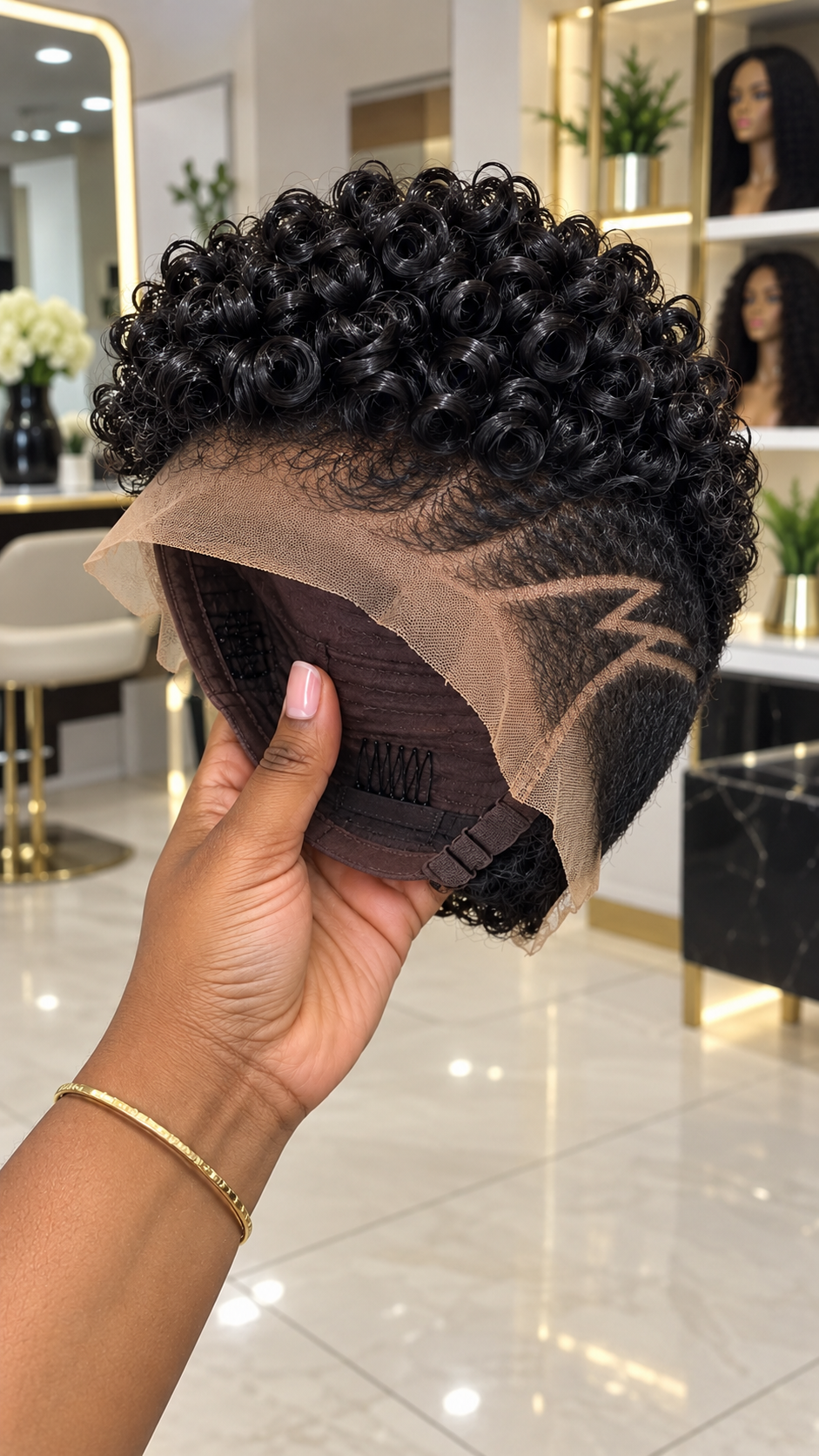
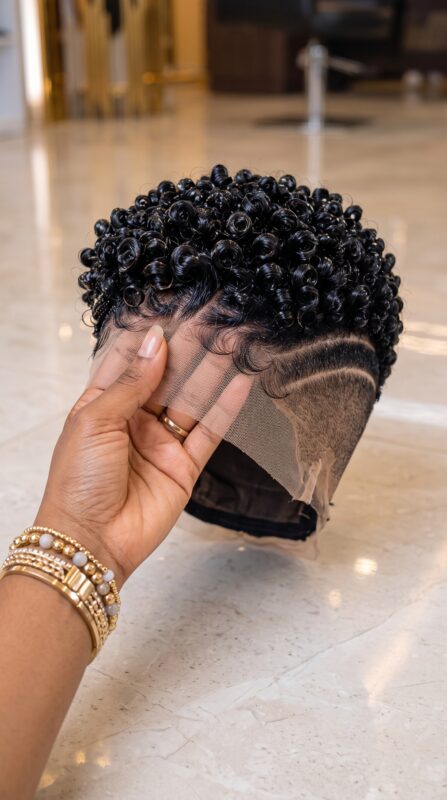
A black curly wig can be visually dramatic without relying on highlights, contrasting colors, or exaggerated length. The distinctive character of this lace pixie comes from two very different styling elements: a densely packed collection of glossy circular curls above and a sharp lightning-inspired pattern cut visually through the dark temple area. The upper hair creates a rounded, elevated silhouette, while the lower section introduces angular movement through a series of pointed, zigzag-shaped separations.
Photographed before installation, the wig is held in one hand inside a brightly illuminated salon. Its untrimmed beige lace extends across the front and side, exposing part of the construction beneath the styled hair. A dark brown fabric cap, interior combs, and adjustment hardware are visible. The presentation allows a potential buyer to examine both the decorative hairstyle and practical fitting details that would otherwise be concealed once the wig is installed.
The upper portion contains numerous tightly arranged black spiral rings, many with visible circular openings. The curls overlap in several directions, creating a compact but elevated crown. Along the visible side, the hair becomes considerably flatter and closely arranged, providing a dark surface for the lightning-like temple design. The angular channels contrast sharply with the circular curls above, giving the wig its recognizable identity.
For customers searching for a black spiral pixie lace wig with a lightning bolt side pattern, this photograph is a useful reference. It demonstrates that the most important purchasing decision is not simply finding a black curly unit. The buyer must consider whether the wig maker can reproduce the individual ring shapes, the compact side silhouette, and the precise geometry of the decorative temple channels.
Contents
The most unusual element appears along the visible temple. Rather than using a single sweeping curve or two parallel channels, the design incorporates several angular separations that change direction sharply, creating an appearance reminiscent of lightning bolts.
The upper channel begins near the rearward portion of the visible temple and travels diagonally through the dark hair. Its path includes a pointed change in direction, forming a distinctive zigzag. Beneath it, additional narrow channels echo the angular movement, creating a layered pattern.
The pale exposed areas stand out against the nearly black side hair. Their contrast makes the design visible even though the surrounding strands are very dark.
These channels should not automatically be described as razor-shaved lines on a natural scalp. The photograph shows a wig, and the lighter separations belong to the visible styling and construction of that unit. The precise technique used to create them cannot be established from the image alone.
The sharp changes in direction distinguish this design from ordinary curved temple artwork. A stylist who replaces the zigzag channels with rounded arcs would produce a noticeably different result.
The upper angular separation appears broader and more prominent, while the lower markings are narrower and follow related but not identical paths. This variation prevents the side from resembling a repetitive series of straight stripes.
The surrounding hair remains closely arranged, allowing the exposed channels to maintain their visual prominence. If the side hair were made substantially longer or fuller, portions of the pattern could become concealed.
When commissioning a similar wig, the customer should provide a close-up reference of the temple and specify that the pointed directional changes must remain visible.
The hair appears consistently black across the upper curls and lower temple. Bright reflections are visible on many of the circular rings, but these appear to result from the glossy strands catching the salon lighting rather than from a clearly identifiable secondary hair color.
The deepest areas between the curls look nearly black, while their outer surfaces reflect charcoal and silver-gray highlights from the surrounding lights.
This creates considerable visual depth without requiring blonde, copper, brown, or burgundy streaks.
The side hair is also dark, allowing the pale angular channels to stand out strongly. This contrast is central to the appearance of the temple artwork.
Customers seeking the same effect should begin with a consistent natural black or raven black shade. A seller may use a commercial color number such as 1 or 1B, but the exact match should be confirmed through photographs or samples rather than assumed from the numbering system.
The curls have a highly reflective appearance, especially around their circular outer surfaces. However, gloss alone does not establish whether the hair is human hair, synthetic fiber, or a blend.
Different materials can reflect light strongly depending on their finish, styling products, and the environment in which they are photographed.
A buyer should ask the seller to confirm the fiber composition and provide care instructions appropriate to that material.
The goal is to reproduce the dark, reflective appearance without making unsupported assumptions about the hair’s origin or quality.
The crown contains a dense arrangement of small and medium circular curls. Many resemble compact barrel rings, with dark openings visible at their centers.
Unlike loose corkscrew curls that hang downward, these rings appear positioned close to the head in overlapping layers. Their arrangement creates a rounded silhouette with noticeable elevation above the temple.
The central curls are especially prominent. Several face outward, revealing circular openings surrounded by glossy strands. Others tilt upward or sideways, adding variation to the surface.
Smaller curls fill the spaces between larger rings and continue toward the outer edges. This gives the upper hair a cohesive appearance without requiring every curl to be identical.
The photograph shows a relatively full crown, but the individual rings remain distinguishable. Their separation is an important part of the hairstyle’s visual appeal.
A wig maker attempting to reproduce this hairstyle should consider both curl size and overall density.
Adding excessive hair could make the rings overlap too heavily, obscuring their circular openings. Using too little hair might create visible gaps and weaken the rounded silhouette.
The stylist should also plan how the curls transition toward the side. The upper rings remain elevated, while the lower temple hair sits much closer to the cap.
This contrast creates a clear division between the decorative crown and the angular side pattern.
The photograph does not reveal the complete rear curl arrangement. A buyer seeking an accurate reproduction should request an additional photograph showing the back of the wig.
At the front, the curls approach a closely arranged hairline with fine strands visible against the beige lace.
The transition is less abrupt than the contrast between the crown and temple. Small strands and shorter curls help connect the raised upper hair to the lower front perimeter.
The lace remains untrimmed, extending beyond the hairline. This allows the viewer to distinguish the styled hair from the surrounding mesh.
The photograph does not establish whether the front hairline has been individually customized or whether additional plucking or styling is required.
Buyers should ask the seller whether the wig is supplied with its current hairline arrangement and whether professional customization is included in the purchase price.
The underside of the wig is clearly visible in the photograph. A dark brown fabric cap forms the interior foundation, with stitched sections following the shape of the unit.
At least two interior combs are visible along the cap. Adjustment hardware is also present near the lower edge, including a strap with fastening components.
These details are useful because they provide evidence of some of the wig’s internal construction. However, the photograph does not reveal every attachment point or the complete cap perimeter.
The visible hardware may assist with positioning and retention, but it does not prove that the wig can be worn securely without adhesive by every customer.
Cap size, head shape, attachment preferences, and the manufacturer’s instructions all influence the appropriate installation method.
Ask the seller for the cap circumference, front-to-nape measurement, ear-to-ear dimensions, and a complete underside photograph.
Confirm the number and location of attachment combs, the available adjustment range, and whether the cap is designed for a particular installation method.
The beige lace should also be discussed. Although it is clearly visible, its commercial grade cannot be established from the photograph. Claims about HD lace or specialized lace technology require independent confirmation.
A buyer should also ask whether the lace will arrive untrimmed and whether the seller offers a professional trimming service.
Not every wig stylist specializes in geometric side designs. A professional who regularly installs straight or loosely curled lace wigs may not have extensive experience reproducing pointed lightning-like channels.
Look for wig makers, barbers experienced in wig customization, or specialist salons with portfolios showing intricate temple patterns and sculpted pixie hairstyles.
The most useful examples are close-up photographs that show the precision of the decorative channels.
When contacting a stylist, send the reference image and explain that the side pattern contains angular changes rather than ordinary curved lines.
The stylist should confirm whether the proposed cap and hair arrangement can support the pattern without compromising the surrounding hairline.
The photograph shows the decorative pattern on one visible side of the wig. However, the orientation of a handheld product photograph does not automatically establish how the design will appear when worn.
The customer should specify whether the lightning pattern is intended for the left or right temple.
It is also important to discuss the relationship between the pattern and the ear. The lower channel approaches the ear-side region, so fitting can influence how much of the design remains visible.
A custom stylist should check these proportions before making permanent alterations.
A ready-made black curly pixie may provide a similar color and rounded upper silhouette. However, the lightning-inspired temple design makes this reference more specialized.
Ready-made options may be suitable for buyers who are flexible about the exact side pattern. Some units may have decorative lines, but their shapes and placement can differ considerably.
A custom order is more appropriate when the angular channels are essential.
The maker can plan the design around the customer’s preferred side, cap measurements, and desired crown height.
Before purchasing a base wig for later customization, ask the stylist whether its side density and construction are suitable for the intended pattern.
Attempting to add intricate channels to an unsuitable unit may require extensive alterations and could produce a less accurate result.
The cost of a comparable wig may depend on the hair material, cap construction, number of circular curls, and complexity of the angular temple design.
Specialized styling labor can be particularly important because the upper ringlets and lower geometric channels require different forms of precision.
The following USD amounts are illustrative planning ranges only. They are not verified live retail prices, confirmed seller quotations, or a valuation of the photographed wig.
| Wig Category | Illustrative USD Range | Potential Cost Considerations |
|---|---|---|
| Premium Custom | $340–$790+ | Individually arranged spiral rings, detailed lightning temple geometry, custom cap fitting, and specialist styling labor. |
| Standard Custom | $175–$395 | Customized black ringlet styling and angular side channels on a suitable prepared wig foundation. |
| Basic Human Hair | $95–$245 | A possible starting unit requiring additional curl setting and decorative temple customization. |
| Premium Synthetic | $65–$180 | May provide a pre-styled black spiral alternative if the fiber and construction support the desired arrangement. |
| Basic Synthetic | $25–$85 | A lower-budget black curly option that may not reproduce the exact ring structure or lightning pattern. |
The photograph does not establish whether the displayed wig contains human hair, synthetic fiber, or a blend. These categories represent possible purchasing routes rather than verified characteristics of the product.
Additional charges may include lace preparation, cap adjustment, professional installation, shipping, and future styling restoration.
When comparing quotations, ask whether the decorative lightning pattern and completed spiral arrangement are included. A generic curly wig should not be compared directly with a fully customized unit.
The side pattern depends on the exposed channels remaining visible. Repeated brushing or rubbing may cause neighboring strands to shift into the separations.
Because the channels contain pointed angles, even small changes in strand direction could alter their appearance.
A stylist should explain how to refresh the side hair without changing the geometry.
Customers should avoid attempting to deepen or reshape the channels with cutting tools unless the wig maker has confirmed the appropriate method.
Permanent alterations could remove hair needed to maintain the original design.
The upper curls require a different care approach. Their circular openings are central to the hairstyle, and excessive manipulation may disturb the arrangement.
Avoid brushing through the rings without guidance from the maker. Pulling the curls apart may increase apparent volume but reduce their recognizable circular shape.
If the wig contains human hair, cleansing and conditioning should account for the setting technique and products used during styling.
If synthetic fiber is used, heat tools should not be applied unless the manufacturer confirms the material’s heat tolerance.
The glossy appearance should not be treated as evidence that heavy oils or frequent product application are necessary.
When a custom unit arrives, inspect the upper curls and side pattern before trimming the lace.
Check whether the crown contains open circular rings rather than ordinary loose curls. The curls should form a compact, elevated silhouette with visible individual shapes.
Next, examine the lightning channels. Their pointed directional changes should match the agreed reference as closely as the custom work allows.
Inspect the cap, interior combs, adjustment hardware, and lace for visible damage or loose stitching.
A fitting appointment should establish how the wig sits on the head and whether the temple design remains visible in the intended position.
Only after these checks should permanent lace trimming or additional styling be considered.
The combination of glossy black ringlets and angular temple artwork creates a hairstyle that can stand out without contrasting hair colors.
It may appeal to customers seeking a distinctive look for celebrations, portrait photography, fashion events, or everyday personal styling.
The black color offers flexibility when coordinating clothing and accessories. The intricate curls and geometric side pattern can remain the main visual focus alongside simple outfits.
For frequent wear, the buyer should consider the maintenance required to preserve the ringlets and exposed channels.
Someone who prefers minimal styling may want to discuss whether the maker can provide a more manageable interpretation while retaining the lightning-inspired design.
This wig demonstrates how a single dark hair color can support two contrasting forms of artistry. The upper spiral rings create depth through circular openings and reflective strands, while the temple introduces sharp angular movement through the lightning-inspired channels.
The exposed beige lace and visible interior hardware also provide useful information for fitting and installation, although the complete construction must still be confirmed with the seller.
For a faithful reproduction, buyers should prioritize the circular curl arrangement, compact temple density, and accurate placement of the pointed side pattern.
A skilled wig maker who understands these relationships can help the customer select an appropriate base, plan the decorative styling, and prepare the unit for comfortable wear.
The most recognizable quality of this black lace pixie is not simply its curl density or shine. It is the contrast between the rounded upper rings and the sharp lightning geometry beneath them, carefully combined into one distinctive hairstyle.
Raven black lightning bolt lace wig · Black open spiral ring pixie · Zigzag temple channel curly wig · Glossy black circular crown curls · Dark brown cap adjustable comb wig · Beige untrimmed lace lightning side art · Angular triple temple parting pixie · Black barrel ringlets geometric side design