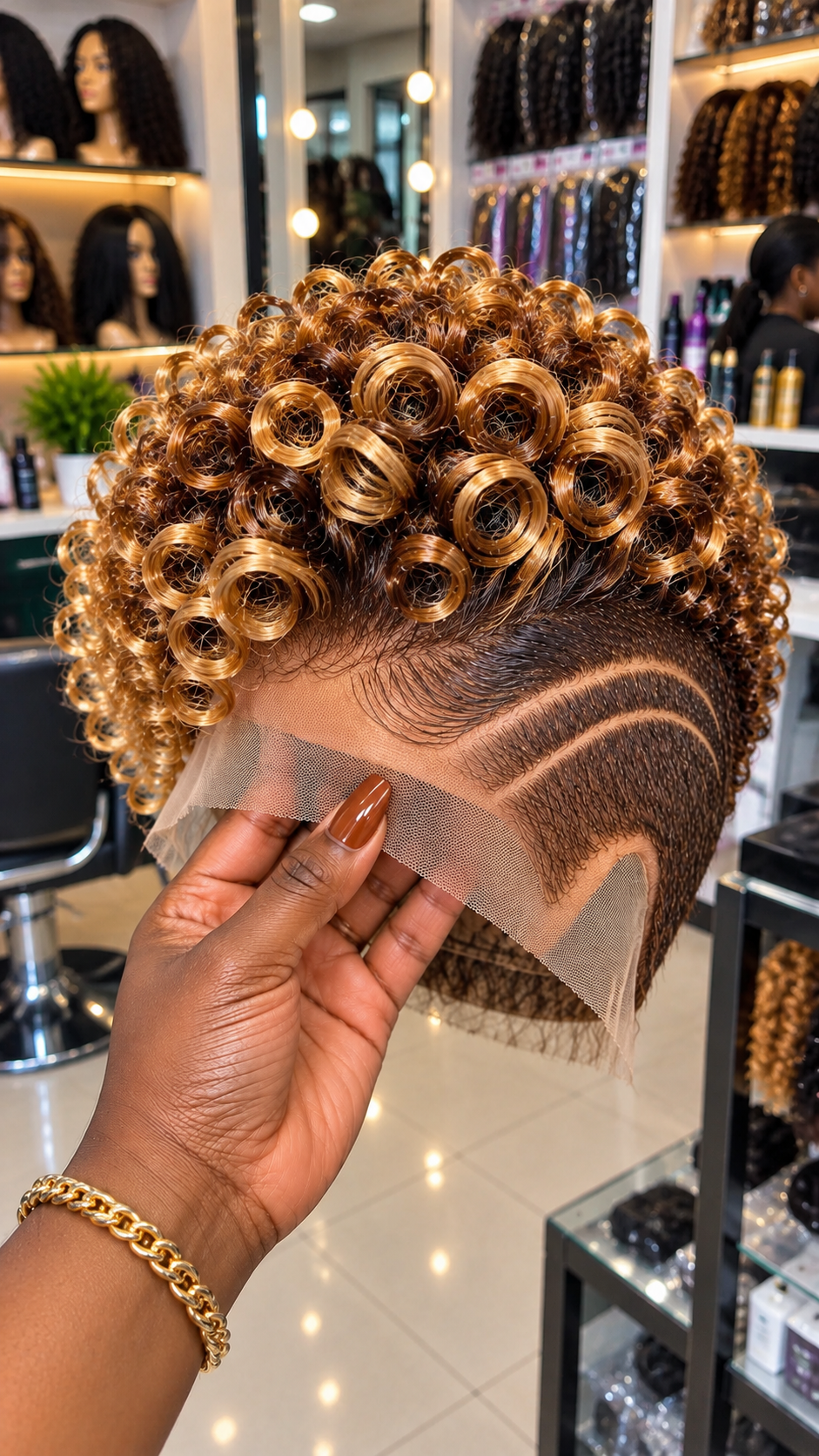
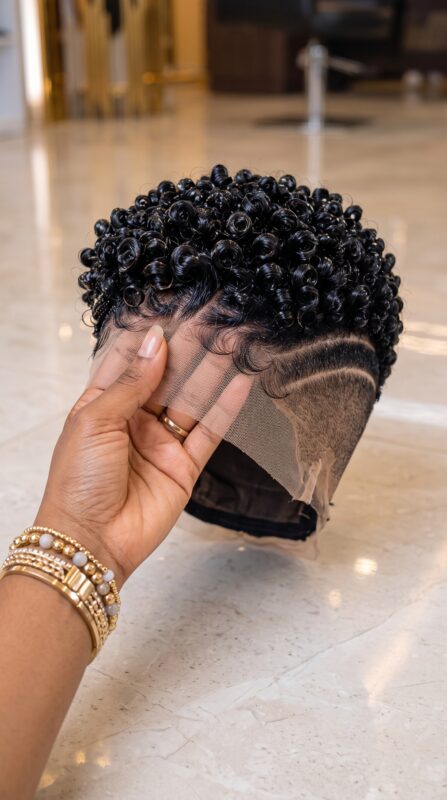
Imagine ordering a golden curly wig and receiving a head full of ordinary corkscrew curls. The color might be beautiful, the lace might fit, and the overall length might be suitable, yet the result would still miss what makes this particular hairstyle distinctive. The photograph shows a carefully arranged collection of open circular coils, each displaying a glossy golden surface around a darker interior. Beneath the crown, chocolate-brown hair is directed toward the temple, where two sweeping carved channels create an unmistakable side profile.
This is a hairstyle in which the arrangement of the curls matters just as much as the shade. Large circular openings are concentrated through the front and central upper section, while smaller ringlets fill the surrounding areas. Golden honey reflections alternate with caramel-brown strands and deeper chocolate tones. The side panel remains substantially darker, creating a deliberate contrast with the illuminated crown.
The wig is being held inside a beauty supply store before installation. Its beige lace extends beyond the front and temple hairline, and a small portion of the underside is visible beneath the mesh. Because the unit is not yet installed, buyers can examine details that might otherwise be concealed, including the exposed lace, the transition between crown and side hair, and the positioning of the two carved curves.
For anyone considering this style, the most useful purchasing strategy is to evaluate it as three connected design decisions: the diameter and arrangement of the golden rings, the dark foundation beneath them, and the exact shape of the temple arches. Those elements should guide every conversation with a wig maker or seller.
Golden Ringlets With Visible Centers, Not Conventional Loose Curls
The upper hairstyle contains numerous circular formations that resemble tightly arranged, open-centered rings. Several of the largest are positioned near the front and middle of the crown, where their hollow centers are clearly visible. Smaller curls appear along the edges and between the larger formations.
These curls are distinctive because the hair strands travel around the circular openings in broad, coordinated bands. Some rings face almost directly toward the camera, while others are tilted or partially concealed by neighboring curls.
That variation gives the upper hair a layered appearance. The crown does not resemble a collection of identical rollers placed in straight rows. Instead, the rings overlap and face different directions, creating a dense arrangement with individual circular shapes remaining recognizable.
The visible front-left area contains several smaller loops that extend slightly downward, while the central section includes larger, more prominent circular openings. The rightward portion becomes more compact as the curls approach the darker side hair.
The hairstyle has considerable detail, but the overall silhouette remains relatively compact. The curls do not form long hanging spirals or extend into shoulder-length hair.
What a Wig Maker Needs to Understand About Ring Size
A custom stylist should not simply be instructed to add more curls. Excessive curl density can obscure the open centers and produce a crowded surface without the distinctive circular appearance.
Similarly, making every curl the same size may remove the visual variation shown in the photograph. The larger rings create recognizable focal points, while the smaller curls fill the gaps around them.
Ask the wig maker to reproduce the relationship between large open rings and smaller surrounding coils. A close reference photograph is more useful than inventing an exact curl diameter from an image that provides no reliable physical scale.
During construction, request a photograph from slightly above the crown. That angle can reveal whether the circular openings remain visible or whether the hair has become compressed into ordinary curls.
The final ring arrangement should be approved before shipping, especially if the curls require specialized setting methods that would be difficult for the buyer to reproduce independently.
The Color Story Runs From Chocolate to Caramel and Honey Gold
The upper curls show a rich combination of warm golden honey, caramel brown, and deeper reddish-brown reflections. The brightest golden strands appear along the raised surfaces of the rings, where the store lighting strikes them directly.
Inside the circular openings, the hair looks considerably darker. In several places, chocolate-brown strands are visible beneath the golden sections, creating depth within the crown.
The color distribution is not completely uniform. Some rings appear predominantly golden, while others contain more brown or caramel tones. This variation helps individual curls stand apart visually.
The lower side section remains dark brown, approaching espresso in the most deeply shaded areas. That darker foundation is important because it creates a visual boundary between the elaborate upper curls and the closely arranged temple hair.
The photograph does not establish how the colors were produced. They could involve pre-colored fibers, color processing, or a combination of differently colored strands. The exact technique and hair material must be confirmed with the supplier.
Choosing a Shade Without Making the Wig Too Yellow
Golden blonde, honey blonde, caramel, and ginger are sometimes used loosely in wig listings. However, these descriptions can refer to substantially different colors.
The reference shows a warm golden appearance with brown depth rather than a uniformly pale blonde shade. A wig made entirely from bright yellow-gold hair could lose the darker contrast that makes the ringlets visually interesting.
When ordering, ask for a honey-gold crown with caramel-brown variation and a distinctly darker chocolate foundation. Provide the image and request color samples photographed under neutral lighting.
Store lighting can intensify golden reflections, so an additional daylight photograph is useful. It helps establish whether the proposed color remains rich and warm without becoming unexpectedly orange or pale.
If a custom maker offers color swatches, compare the proposed golden shade directly against the darker foundation color. The relationship between them is more important than selecting either shade independently.
Two Curved Temple Arches Give the Side Its Identity
The visible side contains two prominent curved channels that sweep across the darker hair. They follow a similar direction, with the upper line positioned above the lower one.
The curves begin toward the upper side area and travel forward in broad arcs. Their paths are not perfectly straight, and they do not form sharp geometric corners. Instead, they follow the rounded contour of the temple section.
The dark hair between the channels creates a narrow curved band, allowing the two lines to remain visually separate.
The lower channel sits above the area where the ear would be positioned when the wig is worn. The photograph does not show the unit on a head, so the exact relationship to an individual wearer’s ear will depend on fitting.
These are two principal carved lines. There is no clearly visible third parallel channel, cross-line pattern, or additional decorative stripe within the side panel.
For a faithful reproduction, that restraint matters. Adding extra lines could make the design more complicated without making it more accurate.
Preserving the Curvature During Barber Work
The two channels should be planned in relation to the cap size and the direction of the surrounding hair. A design that appears balanced on one head form may sit differently on another.
Before carving, a specialist should position the wig correctly and confirm where the upper and lower curves will fall.
The lines should remain narrow enough to preserve the dark band between them. If the channels are widened excessively, they may merge visually or expose too much of the foundation.
Because removing hair from a wig can be irreversible, buyers should avoid unnecessary corrective cutting. If the wig already contains the intended arches, further barber work may not be required.
A close side photograph should be requested before a custom order is finalized. It allows the buyer to verify the number of lines, their spacing, and the overall curvature.
The Dark Front Sweep Connects the Ringlets to the Temple
Between the golden crown and the carved side section, the hair follows a different direction. Dark strands sweep diagonally toward the temple, lying closer to the foundation than the elevated circular curls.
This transitional area is visually important. Without it, the golden rings could appear disconnected from the lower side design.
The strands are arranged in coordinated directions, with the darker hair creating a gradual movement from the crown toward the front hairline.
Near the lace, fine hairs form a curved boundary rather than a perfectly straight edge. The visible hairline includes delicate strands that extend toward the front, although the final appearance after installation cannot be determined from the photograph alone.
The dark transitional section also prevents the golden curls from covering the carved arches. Its relatively close arrangement helps keep the side pattern visible.
What the Untrimmed Lace Reveals Before Installation
A broad section of beige lace extends beyond the front and side hairline. The mesh is particularly noticeable below the dark temple section, where it hangs freely while the wig is being held.
The lace has not yet been trimmed to the shape of an individual wearer’s hairline. This suggests that fitting and customization may still be necessary before the wig can be worn as a finished style.
Fine dark hairs are visible near the front boundary, but the photograph does not establish how naturally the lace will blend against skin once installed.
The mesh appears beige under the store lighting. However, its exact specification cannot be confirmed visually. The presence of lace does not establish that the unit uses HD lace or any particular premium lace technology.
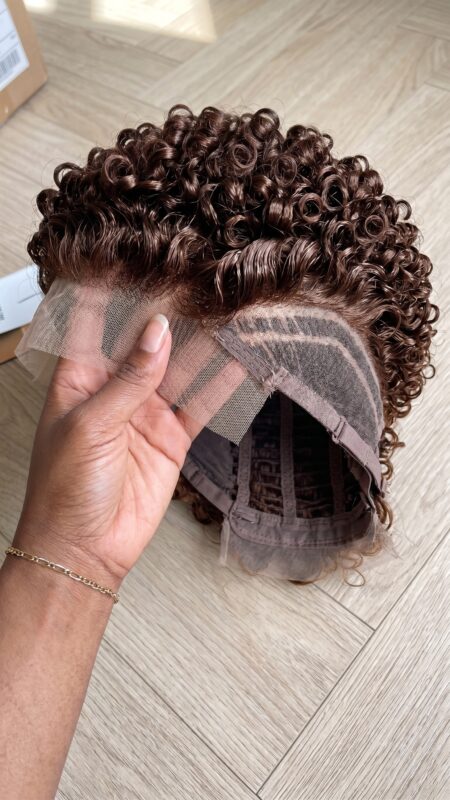
Only a limited portion of the interior is visible beneath the front edge. The photograph does not provide enough information to identify the complete cap construction, attachment system, or adjustment hardware.
Requesting the Underside Photographs That Matter
Before paying, ask the seller to turn the wig inside out and photograph the complete cap. The image should show the front, sides, and back, including any combs, clips, bands, or adjustment straps.
Request the cap circumference, front-to-back measurement, and ear-to-ear dimensions. These specifications should be compared with the intended wearer’s measurements.
Ask whether the wig is designed for adhesive-free use, and request an explanation of the attachment method. It should not be advertised as glueless based solely on the appearance of the lace.
Also confirm whether the excess lace is intended to be trimmed by a professional installer or whether the seller offers that service before shipping.
For this hairstyle, the fitting process is particularly important because the carved temple arches should sit in a suitable position relative to the face.
Where to Find a Wig With This Particular Combination
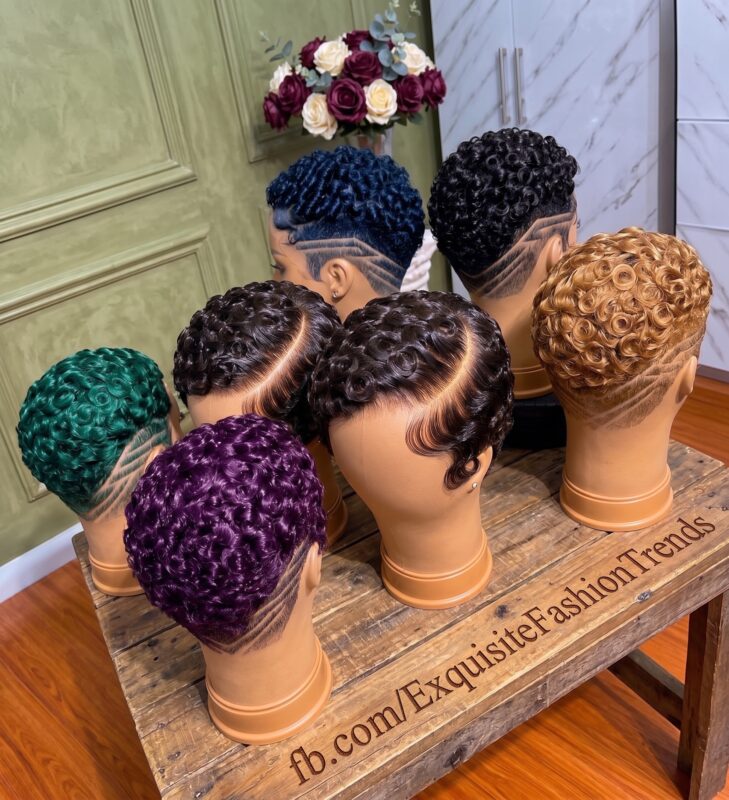
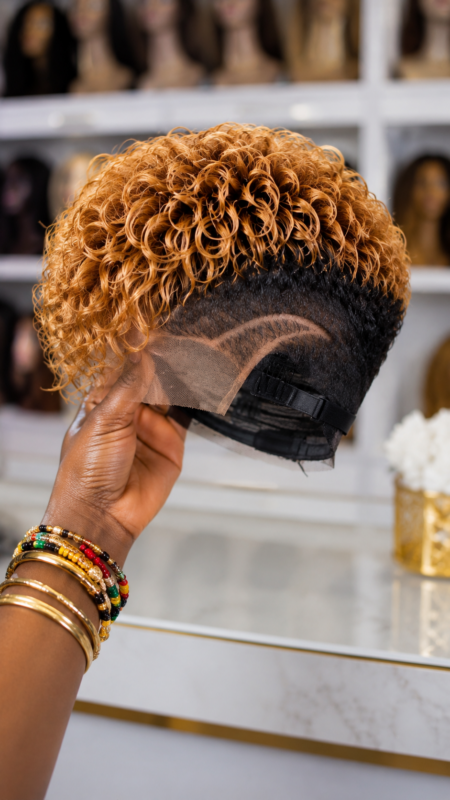
A ready-made golden curly pixie wig may share the general color and length, but the open circular rings and double temple arches make this design more specialized.
Online wig marketplaces, independent custom wig makers, specialist lace wig boutiques, and local beauty supply stores are possible places to begin searching.
Useful search descriptions should combine the color, curl structure, and side detailing rather than relying on a generic phrase such as blonde curly wig.
When contacting a supplier, describe the hairstyle as a honey-gold circular coil pixie lace wig with chocolate-brown roots and two sweeping temple lines.
Send the original photograph and identify the features that must remain consistent: large open-centered curls, warm golden and caramel variation, a dark transitional side section, and exactly two curved channels.
Ask whether the seller can reproduce the hairstyle using available materials. A product listing containing a similar photograph does not guarantee that the actual unit will match the reference.
Custom Ordering and Salon Booking
A custom commission may be preferable when the buyer wants close control over the curl arrangement and side pattern. However, the seller should demonstrate experience with sculpted circular curls rather than only conventional loose ringlets.
Request photographs of previous completed work and confirm which services are included in the quotation.
Some wig makers may provide the color and base construction but leave the final circular setting or barber detailing to another professional. Establish these responsibilities before placing an order.
For a local salon appointment, ask whether the stylist can perform cap fitting, lace trimming, hairline customization, and any required curl adjustments.
If the temple arches need to be created after delivery, confirm that the stylist has experience cutting decorative patterns into wig hair without damaging the foundation.
The most sensible sequence is to inspect the delivered wig, verify its measurements, fit it to the wearer, and then complete any necessary permanent adjustments.
Illustrative Pricing for Honey-Gold Circular Coil Wigs
The following USD amounts are broad illustrative planning ranges, not verified live prices for the photographed wig. Actual quotations may vary substantially according to material, supplier, location, color work, styling labor, and included services.
| Wig Category |
Illustrative USD Range |
Relevant Cost Considerations |
| Premium Custom |
$360–$880+ |
Individual construction, honey-gold color arrangement, elaborate circular curl styling, twin temple arches, and possible fitting services |
| Standard Custom |
$195–$460 |
Customized caramel and golden coloring, selected cap options, sculpted ringlets, and specified side detailing |
| Basic Human Hair |
$105–$285 |
Base human-hair unit with potential additional charges for coloring, ringlet setting, and precision carving |
| Premium Synthetic |
$75–$205 |
Pre-styled circular curl appearance, color variation, cap specifications, and fiber-dependent care restrictions |
| Basic Synthetic |
$30–$110 |
General honey-blonde curly pixie resemblance, simpler construction, and potentially less accurate ringlet or temple details |
The photograph does not confirm whether the wig contains human hair, synthetic fiber, or a blend. The categories above are purchasing alternatives rather than confirmed descriptions of the pictured unit.
The circular curl arrangement may contribute significantly to the total cost because each visible ring requires careful positioning. A less expensive wig with ordinary curls may not provide the same appearance.
The golden color variation may also affect the quotation. If a human-hair unit requires additional lightening or coloring, the process may involve extra labor and could influence the hair’s condition.
The two carved temple arches represent another potential service. Some custom makers include decorative cutting, while others charge separately or refer buyers to a barber.
Before confirming an order, request an itemized price covering the base wig, coloring, styling, cap options, lace customization, installation, shipping, and applicable taxes.
Keeping the Golden Rings Distinct After Purchase
The main maintenance challenge is preserving the open circular shape of the upper curls. Aggressive brushing or repeated pulling can separate the strands that form each ring.
Because the crown contains numerous overlapping curls, careless handling may also cause neighboring rings to become tangled or lose their intended positions.
Ask the supplier how the ringlets were formed and which products are appropriate for the actual fiber. The photograph does not reveal whether the curls were created through heat setting, molding products, or another method.
Synthetic hair may have restrictions involving heat and coloring. Human hair may permit different treatments, but previously processed golden shades can require careful handling.
Do not attempt to restore flattened rings using high heat until the material and its temperature limitations have been confirmed.
Protecting the Color and Side Pattern
Golden and caramel shades may change in appearance depending on lighting, product buildup, and the condition of the strands. If the unit contains processed human hair, the supplier should provide suitable color-care guidance.
Heavy styling products may accumulate inside the circular openings and cause adjacent strands to stick together. Use only products recommended for the confirmed fiber and styling method.
The dark temple section should be maintained separately from the upper curls. Avoid pulling golden strands downward across the carved arches, as this may obscure the pattern.
If the side channels become less visible, ask a professional to assess whether the surrounding hair can be repositioned before any additional cutting.
When storing the wig, use an appropriately sized support that does not compress the crown or stretch the cap. Protect the lace from snagging and avoid placing pressure directly on the raised rings.
Judging the Finished Wig by Its Most Important Details
A faithful reproduction should be evaluated through several close photographs rather than a single promotional image.
First, examine the circular curls. The largest rings should retain visible openings, while smaller curls should fill the surrounding areas without creating excessive volume.
Next, compare the color placement. Warm honey-gold and caramel tones should dominate the upper hair, with chocolate-brown depth remaining visible beneath the rings and throughout the side section.
The temple should contain two distinct sweeping arches. Their curvature and spacing should resemble the reference without introducing extra lines or removing excessive hair.
Finally, inspect the lace and cap construction. Confirm the measurements, attachment method, and fitting requirements before any permanent trimming takes place.
The defining appeal of this wig lies in the way its bright golden circular coils rise above a darker, carefully arranged foundation. The twin temple arches provide a recognizable side signature, while the untrimmed lace shows that the piece still requires fitting consideration. Buyers who prioritize those specific details are more likely to obtain a result that genuinely resembles the reference rather than a generic golden curly pixie.
Search Terms
honey gold open circle curl lace wig · caramel blonde ringlet crown pixie · chocolate brown roots golden coil wig · twin sweeping temple arches hairpiece · double curved side channel blonde wig · beige untrimmed lace honey curls · golden spiral rings dark temple panel · glossy caramel circular coil pixie wig