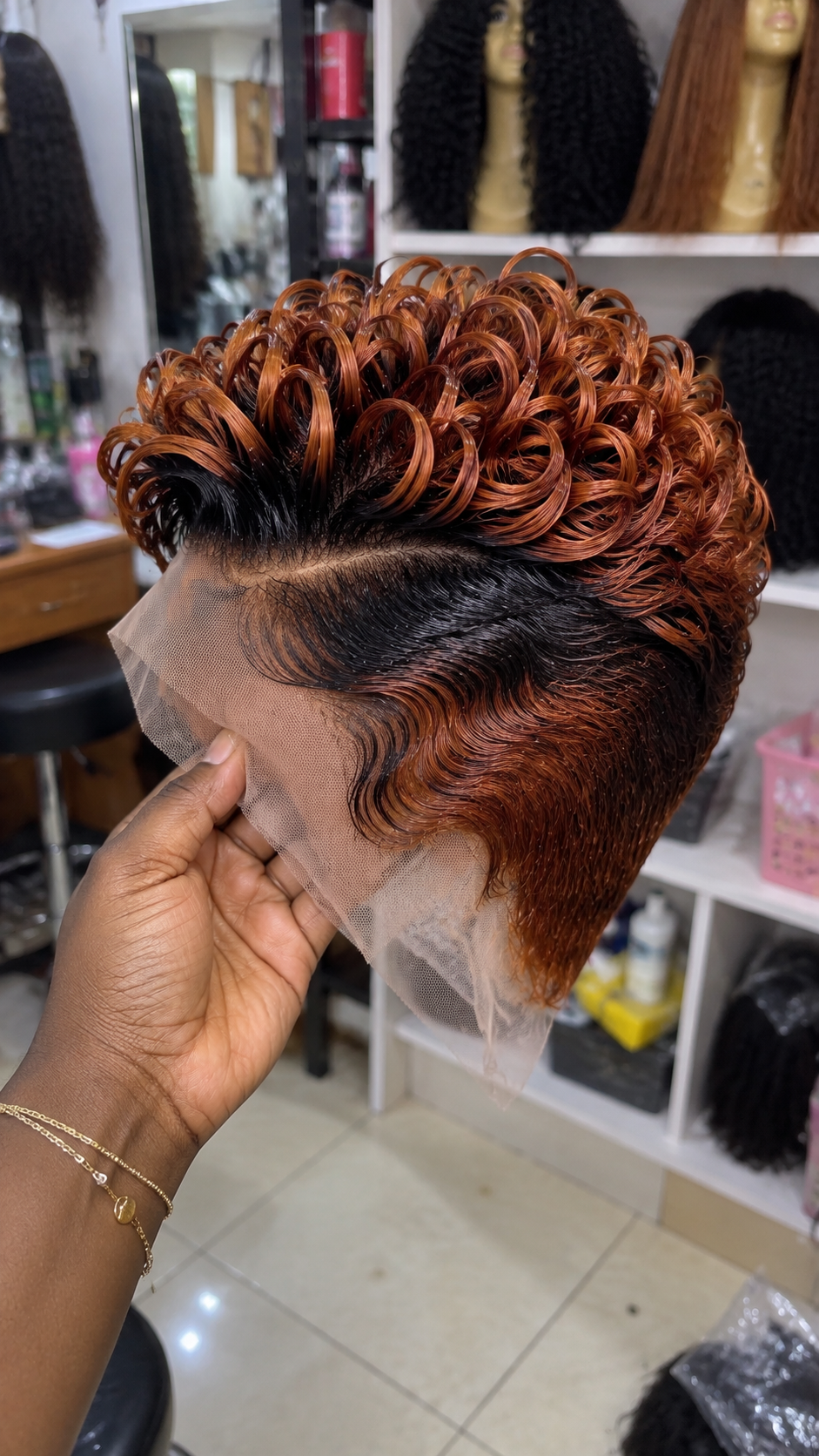
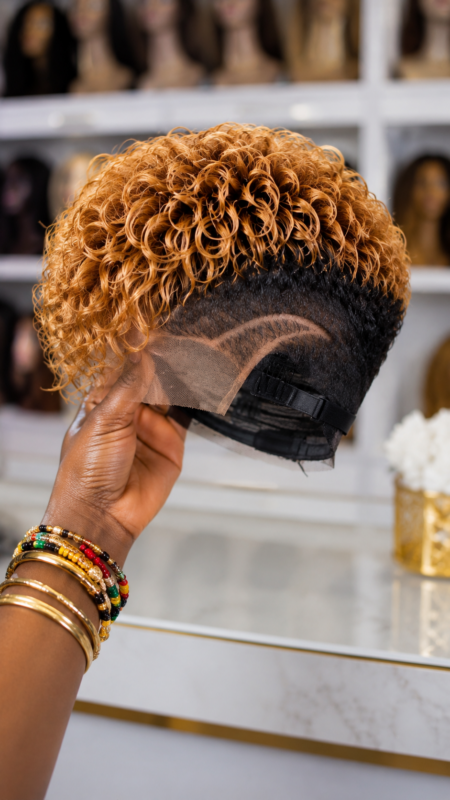
A dramatic hair color becomes even more interesting when the styling reveals where that color begins, changes direction, and meets a contrasting section. This burnt copper pixie lace wig offers a particularly distinctive example. Its upper area contains numerous elongated circular curls in a rich copper-orange shade, while a dark foundation separates those raised loops from a carefully sculpted side panel. A visible diagonal part introduces the transition, and the temple area displays flowing S-shaped waves that carry warm copper tones toward the lower edge.
The hairstyle is photographed before installation, held in one hand inside a wig shop. The extended beige lace remains visible around the front and side, making it possible to examine the hairline and the arrangement of the sculpted sections. The photograph does not reveal the complete cap interior or establish whether the hair is human or synthetic, but it provides an unusually clear view of the styling decisions that make this particular wig recognizable.
For buyers interested in copper pixie lace wigs, this design deserves attention for more than its color. The relationship between the raised loop curls, exposed diagonal separation, dark upper side, and flowing temple waves is what distinguishes it from ordinary copper curly units.
Burnt Copper Curls Rising From a Dark Foundation
The crown is dominated by warm copper-orange strands arranged into raised loops. Several curls form nearly complete circles, while others bend into elongated arches before joining neighboring sections.
The color appears strongest along the upper surfaces of the loops, where the strands catch the light. In shaded areas between the curls, deeper auburn and reddish-brown tones are visible.
Near the base of the crown, the hair becomes noticeably darker. Black or very deep brown sections remain visible beneath the copper loops, establishing a contrasting foundation that separates the upper hairstyle from the side.
This placement differs from a uniformly colored ginger pixie. The darker foundation contributes to the depth of the hairstyle and prevents the copper loops from appearing as one uninterrupted mass.
The copper is also not distributed as a conventional blonde-tipped ombre. Instead, the brighter strands occupy most of the visible raised curls, while darker hair remains concentrated around their base and the upper side panel.
Why the Dark Foundation Matters When Ordering
Customers requesting a reproduction should specify that the darker hair must remain visible beneath the copper crown. A supplier who colors every strand the same shade may produce an attractive wig, but the result will not have the same contrast.
Likewise, a unit with copper only at the ends of otherwise black curls may look substantially different from the reference.
When discussing color placement, provide a close photograph showing the transition from the raised loops into the darker hair. Ask whether the supplier can reproduce the relationship between the two areas rather than simply offering a generic copper color option.
The exact coloring process cannot be determined from the image. Human hair may be colored through chemical processing, while synthetic units may use manufactured colored fibers. Buyers should confirm the material and color method before purchase.
The Crown Uses Elongated Loops Instead of Ordinary Ringlets
The upper hairstyle contains numerous open, ribbon-like curls that rise from the dark foundation and curve into circular formations. Their openings vary in size, producing a lively arrangement rather than a perfectly uniform grid.
Some loops stand relatively upright, while others lean toward the side or rear. This variation creates a layered crown with visible movement across its surface.
The curls are not loose, downward-hanging ringlets. They are arranged close enough together to create a compact pixie silhouette, although their raised shape gives the crown noticeable elevation.
Several front curls bend forward slightly before turning upward and backward. Others form larger circular openings near the upper center. Toward the visible rear, the loops become more closely clustered.
The photograph shows the upper and side portions clearly, but it does not provide a complete rear view. The exact arrangement across the back should therefore be confirmed through additional product photographs.
Evaluating the Curl Arrangement Before Purchase
Buyers should compare the shape and direction of the loops rather than relying entirely on the term curly pixie. A wig with very small finger coils may produce a denser appearance, while loose spiral curls may fall downward instead of maintaining the raised circular structure.
Ask the seller for a photograph taken from above. This angle can reveal whether the loops are distributed across the crown or concentrated only along the front.
A short video can also help demonstrate whether the curls retain their arranged shape when the unit is gently moved. However, the video should not be treated as proof of long-term durability.
Request information about whether the curls are permanently formed or require regular setting. The answer will influence the maintenance routine and the amount of professional styling needed after washing.
A Diagonal Part Creates Separation Without a Shaved Side Pattern
One of the most important details is the exposed diagonal separation beneath the raised curls. The part travels across the upper side, creating a visible boundary between the copper crown and the darker, closely arranged hair below.
This channel should not be confused with a series of barber-carved lines. The visible design contains a principal diagonal part, while the lower section is styled into flowing waves rather than multiple parallel shaved stripes.
The separation allows the copper loops to remain visually distinct from the darker side. It also gives the hairstyle a directional appearance, guiding the eye from the front toward the rear.
Immediately beneath the part, the hair appears dark and glossy, arranged close to the underlying shape. This creates a relatively flat area before the copper-toned waves become more prominent around the temple.
Preserving the Part During Customization
The position of the diagonal separation should be agreed upon before the wig is completed. Moving the part can change how much space is available for the raised curls and the side-wave arrangement.
For a custom order, ask the wig maker whether the part is established through the placement of the hair, through styling, or through both methods.
That distinction matters because a part created mainly through temporary styling may require different maintenance from one incorporated into the construction.
A buyer should avoid attempting to widen the separation by removing strands without professional advice. Cutting or plucking too aggressively may create permanent gaps or expose the cap beneath.
The Temple Waves Introduce a Second Copper Styling Technique
The visible temple area contains a flowing S-shaped wave formation. Unlike the circular loops above, these strands lie much closer to the underlying wig surface.
The waves begin beneath the darker upper side and curve downward toward the lower edge. Their copper coloring becomes more prominent as the pattern approaches the temple and sideburn area.
This creates a distinctive visual progression: raised copper loops at the top, a dark diagonal separation beneath them, and closely arranged copper waves along the lower side.
The wave pattern is especially noticeable near the front temple, where the strands curve inward and outward before continuing downward.
Fine dark strands are also visible near the front hairline, contributing to the transition between the lace and the styled side.
Why the Temple Should Not Be Treated Like the Crown
The upper loops and lower waves rely on different styling arrangements. Attempting to brush or curl both areas in the same way may disturb the original design.
The crown depends on maintaining raised circular openings, while the temple waves depend on retaining their directional curves and close-fitting appearance.
When commissioning a reproduction, ask whether the wig maker has experience creating both sculpted loop curls and finger-wave-inspired side styling.
A stylist experienced only with ordinary curly wigs may be able to reproduce the crown color but not the controlled temple arrangement.
The appropriate setting products and techniques depend on the fiber and its compatibility with moisture, heat, and styling agents.
The Untrimmed Lace Shows the Wig Before Its Final Fitting
A broad beige lace extension is visible around the front and lower side of the unit. The lace remains uncut, extending beyond the hairline and beneath the sculpted temple section.
This presentation allows the viewer to see where the hair begins and how the side styling is positioned relative to the lace.
The front edge contains fine dark strands, while the lower temple area includes copper-toned hair arranged into curved formations.
The lace appears as a fine mesh in the photograph, but its exact grade and composition cannot be confirmed visually. Buyers should request the manufacturer’s specifications.
The image does not clearly display the complete cap interior, fastening combs, adjustable straps, or other attachment components. These details should not be assumed from the presence of lace alone.
Confirming Installation Requirements
Before ordering, ask whether the unit is intended for adhesive installation, adhesive-free wear, or another fitting method.
Request a complete interior photograph showing the cap construction and any available security components.
Cap measurements should also be established before customization. A poorly fitting cap may shift the diagonal part or position the temple waves too far forward or backward.
If the buyer intends to use the wig regularly, comfort and security should be considered alongside the appearance.
Finding a Wig Maker Who Understands the Color and Styling Relationship
A supplier specializing in custom pixie lace wigs may be better equipped to reproduce this design than a general retailer offering only standard curly units.
Begin by searching for professionals experienced in sculpted pixie curls, copper-colored lace wigs, and finger-wave styling.
Local wig boutiques can be useful when the buyer wants to inspect color and cap construction before committing. Online wig makers may offer additional customization options, but the quality of communication becomes especially important.
Provide the reference photograph and explain that the design must retain the dark foundation beneath the copper loops, the diagonal separation, and the flowing temple waves.
Ask the supplier to identify which details can be reproduced accurately and which may require adaptation.
Approving the Finished Unit Before Shipping
Request photographs showing the front hairline, the visible temple, the opposite side, the crown, and the rear.
The current reference establishes the appearance of one side but does not reveal whether the opposite side contains matching waves or a different arrangement.
Ask for a close view of the dark-to-copper transition and the diagonal part. These areas are particularly important because they distinguish the hairstyle from a uniformly colored curly pixie.
Confirm whether the unit will arrive fully styled and whether any additional salon work is required before installation.
For custom orders, establish the revision policy before payment. Changes to the curl placement or side-wave arrangement may not be possible after the unit has been completed.
Comparing Ready-Made Copper Pixies With Custom Orders
A ready-made copper pixie may offer a similar color and compact silhouette at a lower initial cost. However, it may not include the dark foundation, diagonal part, or sculpted temple waves.
Some ready-made units may be suitable for professional restyling, but this depends on the material and construction.
Custom production allows the buyer to specify the relationship between the crown loops and the side-wave panel. It may also provide more control over cap measurements and hairline placement.
The best option depends on the buyer’s priorities. Someone primarily interested in the copper color may be satisfied with a simpler unit, while a customer seeking the complete photographed hairstyle may prefer a specialist commission.
Illustrative Prices for Copper Loop Curl Pixie Lace Wigs
The following USD figures are illustrative planning ranges rather than verified current product prices. They represent possible purchasing categories and do not identify the material used in the photographed wig.
| Wig Category |
Illustrative Price Range |
Possible Cost Factors |
| Premium Custom |
$330–$740+ |
Individual cap sizing, copper color placement, raised loop construction, diagonal part positioning, and specialist temple-wave styling. |
| Standard Custom |
$180–$370 |
Selected cap options with customized copper loops and a coordinated side-wave arrangement. |
| Basic Human Hair |
$100–$255 |
A human-hair starting unit that may require additional coloring, curl setting, and temple styling. |
| Premium Synthetic |
$75–$175 |
A manufactured copper pixie with prearranged curls and possible sculpted side styling. |
| Basic Synthetic |
$30–$85 |
A lower-cost copper curly unit that may not reproduce the diagonal part or intricate temple waves. |
The combination of color placement and two different styling techniques may increase the amount of labor required. The raised loops need to maintain their circular appearance, while the temple waves require careful directional arrangement.
The dark foundation also influences the coloring process. A unit with uniform copper fibers may be less expensive to manufacture than one requiring selective color placement, depending on the supplier’s methods.
Additional expenses may include lace customization, cap sizing, shipping, taxes, and salon installation.
Ask for an itemized quotation rather than comparing only the advertised price. A lower-cost base wig may require substantial additional work to achieve the photographed design.
Booking a Salon Appointment for the First Installation
The first fitting should begin with cap placement and hairline alignment. The diagonal part and temple waves must sit in the intended position for the hairstyle to retain its original proportions.
A professional wig stylist can assess whether the cap fits comfortably and whether the lace lies appropriately against the forehead and temple.
Only after the correct position is established should any necessary lace trimming be considered. Cutting too close to the hairline may damage delicate strands or reduce the available fitting margin.
The stylist should also inspect the crown loops for any displacement caused by packaging or shipping.
If the curls require restoration, the method should be selected according to the confirmed fiber type and manufacturer instructions. Heat or chemical styling should not be applied without establishing compatibility.
Maintaining the Copper Loops Without Disturbing the Temple Waves
The most important maintenance principle is to treat the upper and lower styling areas separately.
The raised copper loops should be handled carefully to preserve their circular openings. Repeated brushing may stretch the curls or cause neighboring loops to merge.
The temple waves require attention to direction and placement. Brushing across the wave ridges can disturb their curves and reduce the distinctive S-shaped appearance.
For human-hair units, a qualified stylist may be able to reset displaced sections using appropriate products and techniques. The hair’s coloring history should be considered before applying heat or additional processing.
For synthetic units, avoid assuming that conventional styling tools are suitable. Some fibers have specific heat limits, while others may be permanently damaged by high temperatures.
Protecting the Copper Color Between Wears
Warm copper shades can change in appearance with lighting and, depending on the material and coloring method, may require particular care to maintain their original intensity.
If the wig is made from colored human hair, follow the supplier’s recommendations for washing products and color preservation.
If the color is manufactured into synthetic fibers, conventional hair dyes may not be appropriate. Confirm the recommended cleaning and styling methods before attempting any color adjustments.
Store the wig on a suitable stand that supports the crown without compressing the loops. Avoid placing objects against the sculpted temple area.
When transporting the unit, allow enough space for the raised curls and protect the lace from unnecessary pulling or folding.
Choosing This Copper Pixie for Its Distinctive Construction
This hairstyle offers a compelling option for customers who appreciate compact curls combined with carefully arranged side styling. Its burnt copper color provides warmth, while the dark foundation gives the upper loops greater visual depth.
The diagonal part introduces structure without relying on multiple carved side channels. The flowing temple waves create a second point of interest, making the side profile particularly distinctive.
For everyday use, the buyer should consider cap comfort, installation requirements, and the amount of maintenance needed to preserve the loops and waves.
For occasional wear, the intricate styling may be especially appealing when the hairstyle itself is intended to be a prominent part of the overall appearance.
Before purchasing, request complete product photographs, verify the hair material, confirm the cap construction, and establish whether the finished styling is included in the price.
The most successful reproduction will preserve the raised copper loop curls, visible dark foundation, diagonal upper-side separation, and carefully sculpted temple waves. Those details form the visual identity of the design and provide a practical guide for evaluating a ready-made unit or commissioning a custom wig.
Search Terms
Burnt copper loop curl pixie wig · Black root copper crown lace unit · Diagonal part sculpted temple wave wig · Auburn orange circular ribbon curls · Copper S wave side pixie hairstyle · Beige untrimmed lace copper wig · Dark foundation raised copper ringlets · Finger wave temple with copper crown loops