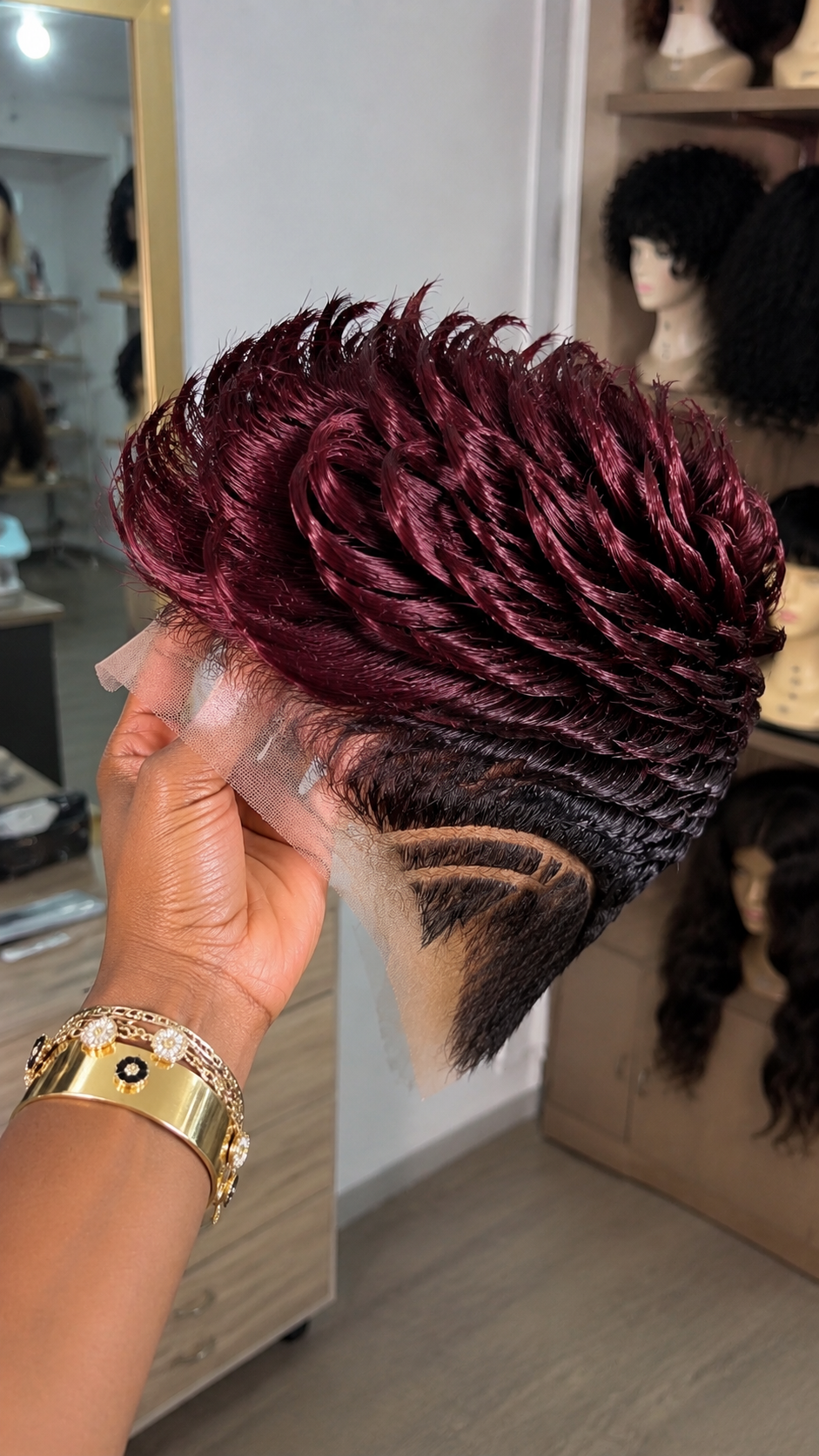
Run your finger down a single twisted section from the crown toward the nape and feel where the rope-like pattern shifts into black. That shift is not a fade of one continuous color — it is two separate zones meeting, burgundy claiming the top of the head and black holding the back, with a blended transition where the two meet in the middle.
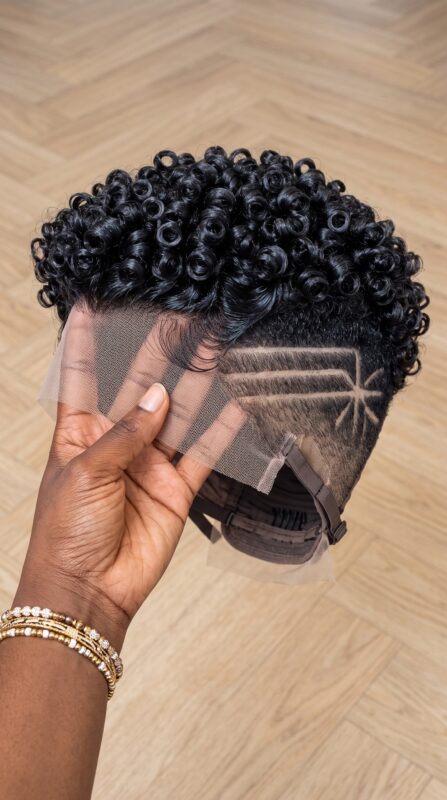
This is a twisted, rope-textured pixie wig, the curl built from wound, two-strand twist sections rather than set ringlets or spiral curls, photographed with the lace pulled aside at the nape. The twist pattern itself is the standout technical detail here — thicker, more defined, and mechanically different from the curled units covered elsewhere in this category.
Twist texture behaves differently from curl in almost every practical way that matters for a buyer: how it holds shape, how it responds to humidity, and how a two-zone color like this burgundy-to-black combination ages across a pattern built from wound strands instead of set curls.
Where To Buy This Burgundy Twist Pixie Wig
Custom makers are worth seeking out for twist-textured units specifically, since a rope-twist pattern needs to be wound by hand section by section, and consistency in twist size matters as much as consistency in curl diameter does on a curled unit.
Instagram and TikTok sellers post twist-textured units often, but the twisted rope pattern can be harder to judge from a photo than a curl, since a poorly wound twist and a well-wound one can look similarly defined under good lighting.
Etsy listings occasionally specify twist size and technique, which is worth checking directly since “twist” gets used loosely to describe several different textures.
Marketplaces like Amazon, AliExpress, and Temu rarely distinguish twist texture from curl texture clearly in their listings, so a photo described as “curly” may actually be showing twisted rope sections like this one.
Local beauty supply shops and salons let you unwind a single twist gently and see how it holds or loosens, which is the clearest way to judge twist construction quality in person.
Vendors and wholesalers direct typically produce twist-textured units at the base construction stage, winding each section before the unit is finished and shipped to individual sellers.
Regionally, twist-textured units in burgundy, wine, and two-zone color combinations show up often through vendors in Lagos, Accra, Atlanta, London, and South African hair districts.
Vet the seller by asking whether the twist pattern is set with a temporary technique that will loosen with washing, or constructed to hold its rope shape permanently, since the two require very different care routines.
Red flags include listings that use “curly” and “twisted” interchangeably without clarifying which one you are actually looking at, and no willingness to show the twist pattern after a wash.
When you order, send a note on your preferred twist thickness, since thicker twists like the ones in this photo read differently at a distance than finer, tighter twist sections would.
Contact / order inquiries: WhatsApp [WhatsApp: +XX XXX XXX XX XX]
How Much It Costs
Tiered pricing for a twist-textured unit with a burgundy-to-black two-zone color runs $180–$440 for human hair, with the hand-wound twist construction adding $35–$80 over a comparable curled unit, and the two-zone color adding another $30–$70 on top of a single solid tone. A good synthetic version runs $70–$160, and a basic synthetic falls between $30–$75.
What that includes and excludes typically covers the unit as delivered with its existing twist pattern, not a re-twisting service if sections loosen with wear, and not color-matching if the burgundy and black zones need refreshing at different rates.
Shipping and duty add $15–$60 depending on origin, with twist-textured units sometimes needing extra padding in transit to prevent sections from flattening or unwinding.
Ongoing costs include a twist-defining cream or gel to maintain the rope pattern between washes, a satin cap to protect the twists overnight, and periodic re-twisting if sections begin to loosen with regular handling.
First-year total, including the unit, upkeep products, and one professional re-twist if needed, tends to land between $270 and $570 for a well-maintained human hair version.
Cost per wear on a $330 unit worn twice weekly across a year comes out to roughly $3.20 per wear, a figure that puts the added labor of twist construction and two-zone color into better perspective.
What a very low price signals on a twist pattern this defined is usually a curl set to mimic a twisted look rather than an actual wound twist, which loosens and unwinds differently than a genuine twist section does.
Deposit structure for custom twist-and-color orders like this commonly runs 30–50% upfront, remainder due before shipment, kept on a payment method that allows a dispute if the delivered twist pattern or color placement does not match what was discussed.
Shipping, Delivery, And What To Expect After Ordering
Hand-wound twist construction takes real time — expect 7–15 business days before a custom order ships, longer if each section is wound individually rather than processed with a faster curl-setting method. International delivery adds another 7–21 days.
What arrives should hold defined, rope-like twist sections, not curls that merely resemble twists from a distance. If the texture looks closer to a set curl than an actual wound twist once you handle it, that discrepancy is worth raising with the seller before styling or wearing the unit.
Photograph the twist pattern and the burgundy-to-black transition zone the day the unit arrives, before any product is applied. That photo becomes your reference if the twists loosen or the color zones shift with normal wear.
Twisted Rope Texture vs Set Curl
A twist is built by winding two sections of hair around each other, creating a visible rope-like line running the length of each section — you can see it clearly in this photo, where each twisted piece shows that distinct spiral seam rather than a smooth, single-strand curl. A set curl, by contrast, is a single section of hair shaped around a rod or curling tool, with no internal twist line at all.
This mechanical difference matters for how the unit behaves in daily wear. A well-constructed twist tends to hold its shape through humidity better than a set curl does, since the wound structure resists reverting the way a curl pattern set purely with heat or product can. It also unwinds differently — a twist loosens gradually from the ends inward, while a set curl typically loosens as a full section all at once.
Judging twist quality from a photo alone is genuinely difficult, since a tightly wound twist and a loosely wound one can both look defined under good lighting. The more reliable test is handling a single section directly, or asking the seller for a video showing the twist unwound partway and re-wound.
Burgundy Crown, Black Nape — A Zone Transition, Not A Root-To-Tip Fade
The color here is not applied along the length of individual strands the way a root-melt gradient would be. Instead, it is organized by zone across the head — burgundy claiming the crown and upper section, black holding the nape and lower back, with the transition blended where the two areas meet rather than gradually shifting strand by strand.
This is a different logic from a front-to-back two-tone placement, where one color sits at the hairline and another at the crown. Here, the division runs roughly top-to-bottom, which means the two colors are exposed to noticeably different amounts of light and heat during normal wear — the burgundy crown catches most of the direct exposure, while the black nape stays comparatively protected.
Expect the burgundy zone to show fading well before the black one does, simply because of that exposure difference, not because of any flaw in how the color was applied. Ask the seller whether the blend zone between the two colors is achieved through a gradual color transition or a harder line that has been softened afterward, since that affects how noticeable regrowth-style fading will look over time.
The Chevron Lace Detail At The Nape
Where the lace has been lifted at the back, a faint angled pattern is visible in the base construction beneath the black section — a detail worth noting briefly rather than treating as the main story here, since angled track construction of this kind has come up before in this category on a different unit. If you are specifically comparing base construction techniques, ask the seller directly whether this follows the same chevron approach or a different pattern.
Why Twist Thickness Changes The Overall Silhouette
The individual twisted sections in this photo are noticeably thick, each one wide enough that the whole crown reads as a bold, sculptural shape rather than a fine, detailed texture. Thinner twists, wound from smaller sections of hair, produce a different overall silhouette entirely — more texture per square inch, a softer overall outline, and a longer construction time since more individual sections need to be wound to cover the same area.
Neither thickness is objectively better, but they photograph and wear differently enough that it is worth specifying which one you actually want before ordering a custom unit. A photo of thick, bold twists like these will not accurately represent what a finer twist pattern looks like, and the reverse is equally true — ask for the specific twist size you have in mind rather than assuming a seller will interpret “twisted” the same way you do.
Before You Pay
- Is the texture an actual wound twist, or a curl set to resemble one in photos?
- How does the seller describe the burgundy-to-black transition — hard line softened, or true gradual blend?
- Will the twist pattern hold through humidity and normal handling, based on any video evidence?
- Since the burgundy zone gets more light exposure, what is the expected fade timeline compared to the black zone?
- What does re-twisting or maintenance cost if sections loosen within the first few months?
Trimming The Lace
Trim carefully around the nape section specifically, since the twisted texture there sits differently against the lace than a curled or straight section would, and cutting through a twist near its base can cause it to unwind from that point.
Work in small sections, checking the fit against your own hairline as you go, and leave a slightly generous margin near any twisted sections rather than a tight, flush cut.
Search Terms
burgundy twist pixie wig · two strand twist curly pixie wig · black and burgundy twist wig · rope twist texture pixie wig · wine red twist pixie wig human hair · zone color twist pixie wig · twisted texture lace front pixie · burgundy crown black nape wig
Final Thoughts
Twist and curl look similar enough in a still photo that most buyers never learn to tell them apart, but they behave very differently once you actually wear one. A wound twist holds through humidity in a way a set curl often cannot, and it unwinds on its own terms, gradually, rather than losing its whole shape at once.
Layer a two-zone color like this burgundy crown and black nape on top of that texture, and you get a unit with two separate things to track over time: how the twist holds, and how unevenly the color fades given how differently each zone gets exposed to light. Ask about both before you buy, not just the one that photographs best.