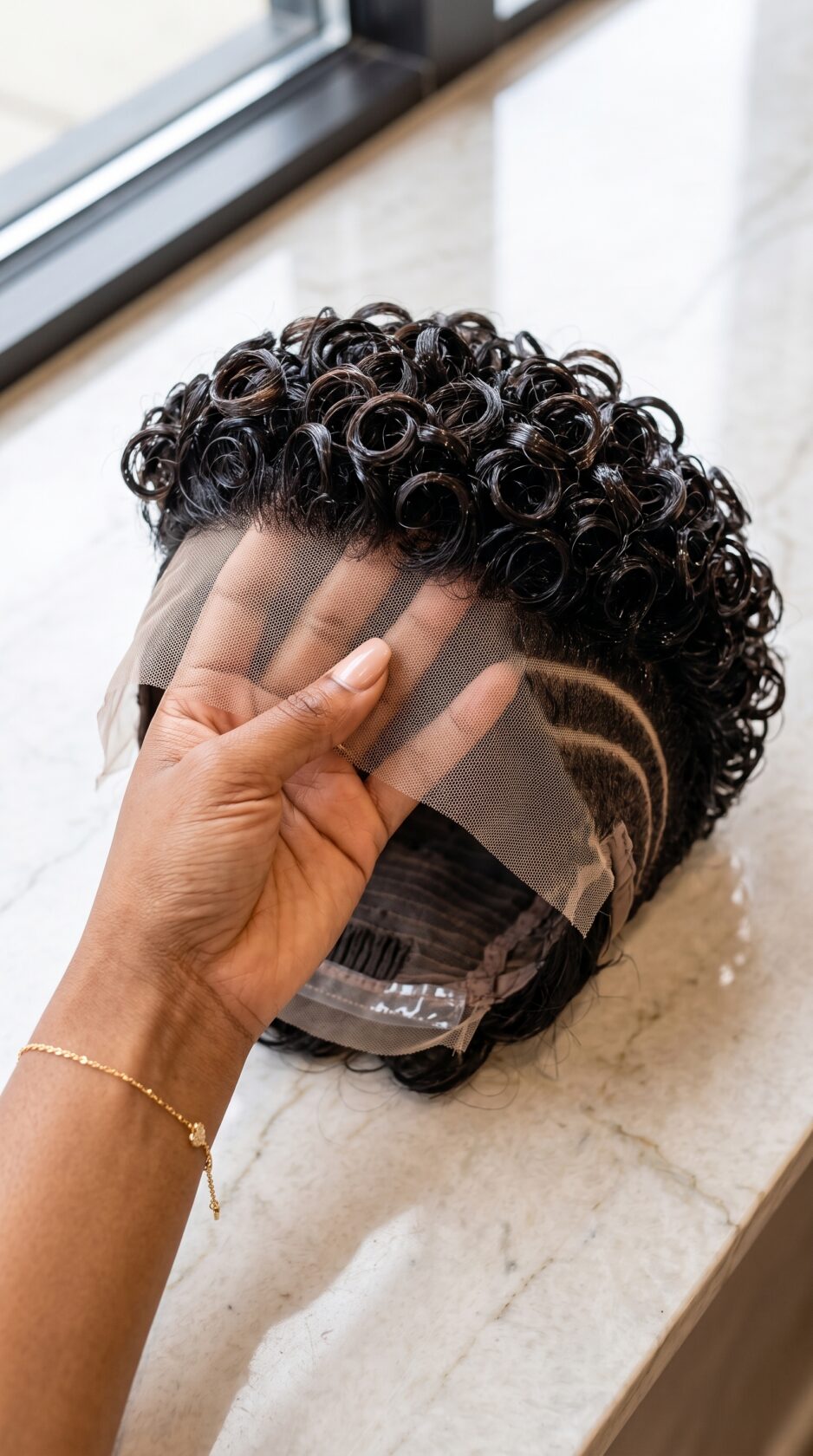
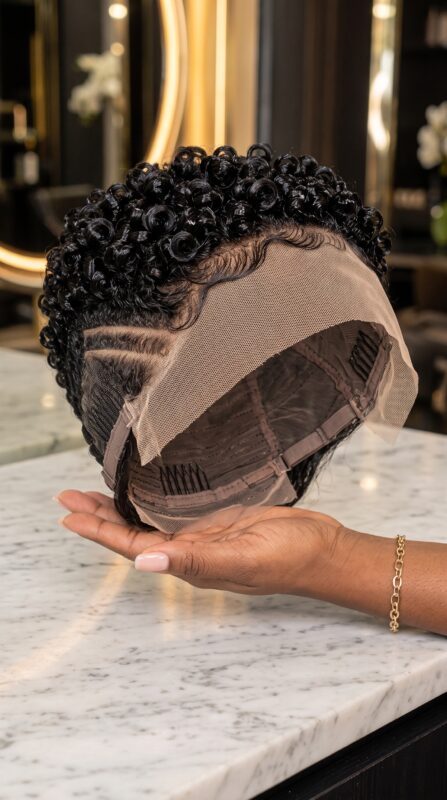
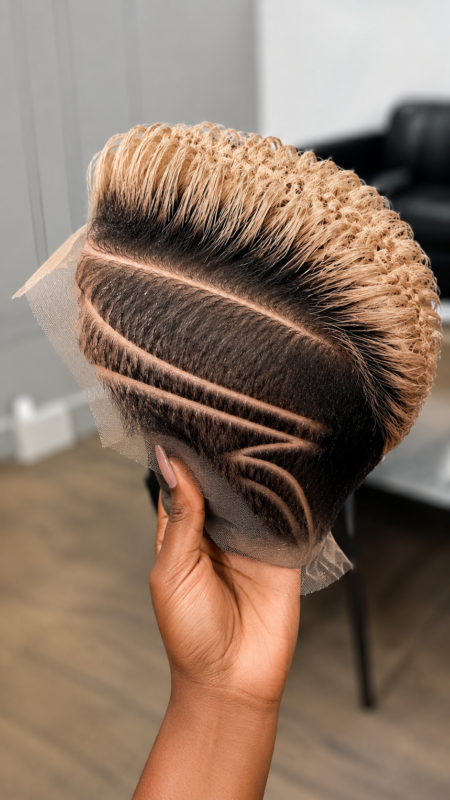
Turn the unit over before you trust the words “full lace.” Held this way, the truth is right there on the underside: a sheer lace panel across the front, and behind it rows of machine-sewn wefts, an adjustable strap, and small combs. That is not a full lace cap. It is a lace front on a wefted cap, and the difference decides where you can part, how the unit breathes, how long it lasts, and how much it should cost. Most buyers never flip the unit over, so most buyers do not know which of these they actually bought. The lace at the front does the selling. The wefts at the back tell you what you own.
This is not a downgrade, and that is the part worth being clear about. A wefted cap is sturdier than full lace, cheaper to make, and holds up longer under daily wear. What it gives up is parting freedom: you can part along the front lace where the hair looks like it grows from skin, but you cannot part down the middle or off to the side over the wefted section, because there is no scalp-like lace there to sell the illusion. On a short curly pixie wig, where you rarely part anywhere but the front anyway, that trade is usually the smart one.
So the question is not whether a wefted cap is worse than full lace. It is whether you are paying full-lace money for a wefted cap, or being told you can part anywhere when you cannot. Read the underside and you never get caught by either.
Where To Buy A Curly Pixie Wig And Know The Cap You Get
Custom makers should state the cap type plainly and show you the underside on request. Ask directly: lace front on a wefted cap, full lace, or 360. A maker who builds honestly will name it without hedging; one who calls everything “full lace” is counting on you not turning it over.
Instagram and TikTok sellers photograph the front and rarely the inside, so ask for a video of the cap turned out. You want to see whether the back is lace or wefts, where the parting lace ends, and what hardware holds it on. A curly pixie wig sold on a front shot alone is hiding its cap.
Etsy works with makers who post underside photos and real buyer images. The risk is a listing that shows only the styled front and describes the cap vaguely. Read reviews for anyone who mentions where they could part it.
Marketplaces like Amazon, AliExpress, and Temu sell a lot of wefted-cap lace fronts labelled loosely, sometimes as “full lace” when they are not. That is fine if the price matches a wefted cap, which is lower. Judge by the underside photos, and treat a full-lace claim at a suspiciously low price as a wefted cap in disguise.
Local beauty supply shops and salons let you turn the unit inside out in your hands, which is the one certain way to know the cap. You pay a premium in-store, but you leave knowing exactly what you bought.
Vendors and wholesalers direct make sense across several units with a minimum, and cap types are usually stated clearly in bulk listings. For a single unit, a maker who shows the inside beats a vague stock description.
Regionally, both honest wefted-cap lace fronts and true full-lace units come strongly out of Lagos, Accra, Atlanta, London, and across South Africa, where sellers who show the cap on video are easy to find.
Vet the seller the usual way plus one cap test: check the account age, look for real buyer photos, time a plain question for a genuine reply, and ask them to name the cap type and show the underside. A seller who dodges the inside shot is the seller to skip.
Red flags: a unit called “full lace” with no underside photo, a full-lace claim at a wefted-cap price, a refusal to show the cap on video, and vague cap descriptions that avoid the words weft or lace.
When you order, send your measurements and a plain question about the cap, and say how you intend to part it, because if you only ever part at the front a wefted cap is right, and if you part all over you genuinely need full lace. Match the cap to your habit before you pay.
On payment, thirty to fifty percent down with the balance before shipping is standard for custom work. Use a method you can dispute, and ask for an underside photo of the finished cap before releasing the last part.
Contact / Order Inquiries: WhatsApp [WhatsApp: +XX XXX XXX XX XX]
How Much It Costs
Cap type is one of the biggest price levers on a curly pixie wig, bigger than most buyers realise, so knowing which cap you are paying for is how you avoid overpaying.
Human hair, full lace cap with bleached knots and a graded hairline, the most versatile and most fragile build: roughly $260 to $500. Human hair, lace front on a wefted cap, the build in this photo, sturdier and cheaper: about $170 to $360. Human hair, basic wefted cap with a small front lace: around $90 to $200. Good synthetic on a wefted cap: $60 to $140. Basic synthetic: $20 to $55.
The gap between a full lace and a wefted-cap lace front is real money, often a hundred dollars or more on a human unit, and it buys parting freedom, nothing else. On a short curly style you almost never use that freedom, which is why paying the full-lace premium here is usually spending on a feature you will not touch. The honest move is to buy the wefted cap and put the difference toward better hair or a finer front lace.
Shipping and any customs charge sit outside the price and change with where you live, so plan a realistic band and confirm your own country’s import rate rather than trusting a single quoted figure.
Then the later costs, which actually favour the wefted cap. Full lace is delicate and tears at the parting over time; a wefted cap takes daily handling far better and lasts longer, so it costs less to keep as well as less to buy. A canvas block and pins, curl product, and gentle washing cover most of it. First-year math, honestly: a wefted-cap human unit plus shipping plus any customs plus a small kit plus upkeep tends to land between a low three-figure total and somewhat above the sticker, generally less than a comparable full-lace unit over the same year.
Per wear, a wefted-cap lace front is one of the better values in short units because it is cheaper up front and more durable. A full-lace claim at a wefted-cap price is not a bargain; it is a mislabel, and the cap you receive tells the real story.
Deposits follow the custom pattern: thirty to fifty percent to start, balance before shipping, and an underside photo of the finished cap before the last payment clears.
Shipping, Delivery, And What To Expect After Ordering
Turn the unit inside out the moment it arrives and confirm the cap matches what you paid for, because this is the one thing you can verify instantly and the one thing sellers most often blur. Ask that it ship packed so the front lace is not creased, choose a tracked service for custom work, and confirm your country’s import charge before it lands. When it arrives, check that the strap and combs adjust to your head and that the front lace is intact, then judge the cap against the description. What you unbox should be the exact build you were promised, and the underside is where a mismatch shows first.
Wefts Mean You Part At The Front Only
The rows of wefts across the back are hair sewn onto a sturdy cap, not knotted into scalp-like lace, so there is no natural-looking parting over that section. Your parting lives at the front lace and nowhere else. For a short curly pixie this is rarely a limit, since the style is worn brushed up and forward, but if you dreamed of a deep side or centre part across the crown, a wefted cap will not give it. Know how you part before you decide the cap matters.
Full Lace Buys Freedom You May Never Use
A true full lace lets you part anywhere because the whole cap mimics scalp, which is genuinely useful for long, restyled, or frequently re-parted looks. On a short curly unit that is worn one general way, that freedom mostly sits unused while you carry the higher price and the greater fragility. Full lace is the right cap for versatility and the wrong cap for a fixed short style. Buy it when your styling actually needs it, not by default.
The Strap And Combs Are For A Glueless Hold
The adjustable strap and combs on the underside let the unit grip your head without adhesive, which matters on a short piece that has little weight to hold it down. Check the strap tightens to your measurement and the combs sit firmly, since a secure glueless fit is what keeps a short curly unit in place through a day. This hardware is about fit, not cap type, but a good wefted cap pairs it well.
Before You Pay
- Is this a full lace cap, a lace front on a wefted cap, or a 360, in plain words?
- Can I see the underside on video before I commit?
- Where can I actually part it, and does that match how I wear my hair?
- Am I being charged a full-lace price for a wefted cap?
- Do the strap and combs adjust to hold a short unit without glue?
Trimming The Lace
Only the front lace needs trimming on a wefted-cap unit, so your work is limited to that panel, which is simpler than a full-lace cut. Trim in small offset steps and leave a shallow margin rather than cutting flush, and stop where the lace meets the wefts, since there is nothing to melt beyond the front. If this is your first lace cut, have a stylist shape the front so it sits clean against your skin, and leave the wefted section entirely alone, because it is not meant to be cut.
Search Terms
curly pixie wig · lace front pixie wig · wefted cap pixie unit · full lace pixie wig · glueless curly pixie · short curly wig cap type · bleached knots lace front pixie · durable wefted curly wig
Final Thoughts
The most useful thing in this photo is not the curls, it is the underside, because that is where a unit stops being a marketing photo and becomes a specific thing you own. This one is a lace front on a wefted cap, and that is a perfectly good build, sturdier and cheaper than full lace and well matched to a short curly style you part only at the front. The mistake is never the wefted cap itself. The mistake is paying for full lace and receiving this, or expecting to part anywhere and finding you cannot.
Buy it by turning it over first, every time, and by matching the cap to how you actually wear your hair. For a short curly pixie, a wefted-cap lace front is usually the honest, durable, sensible choice, and the money you save against full lace is better spent on the hair and the front lace you will see every day. Full lace is worth its premium only when you truly part all over. Read the underside, and no seller can sell you a cap you did not want.