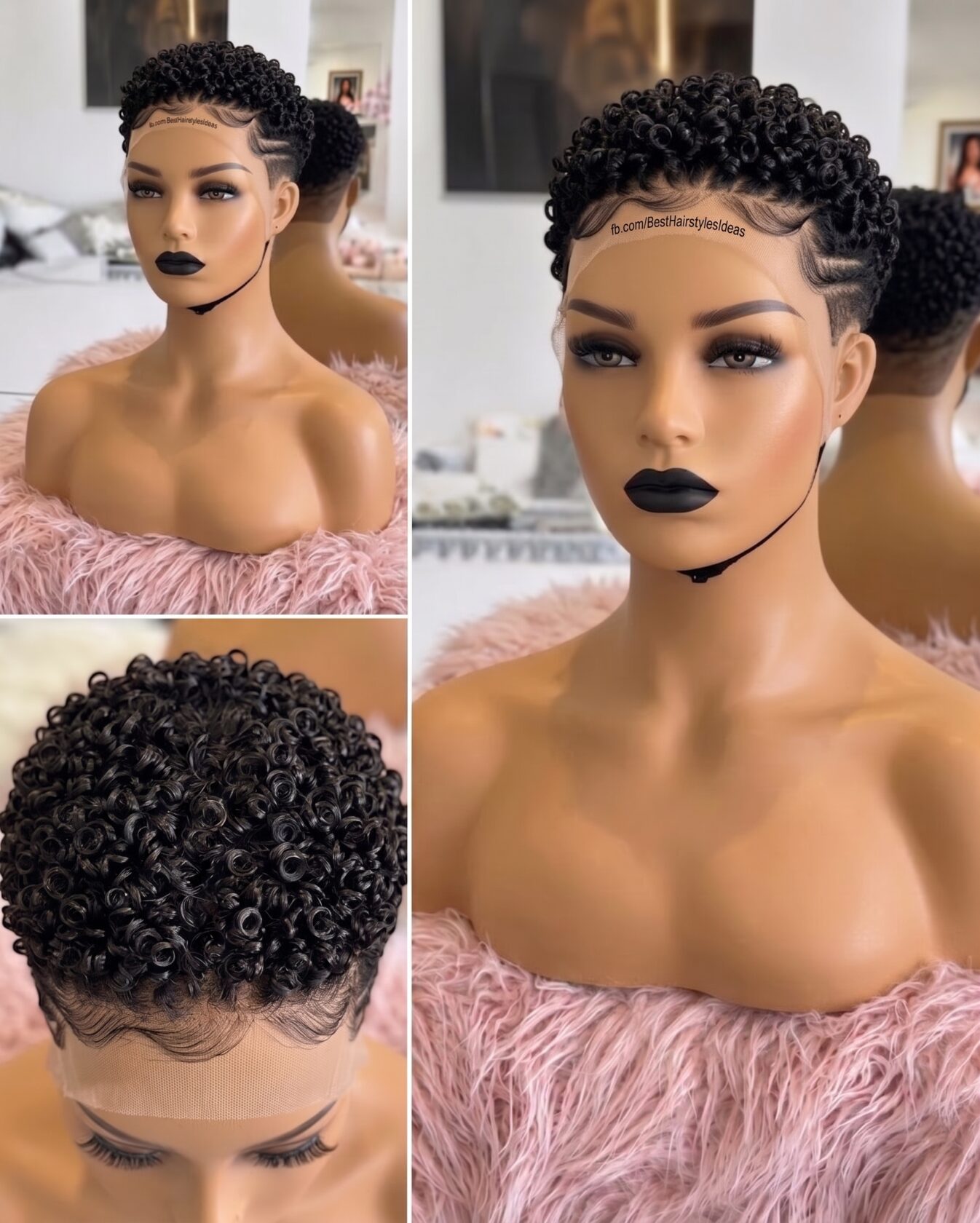
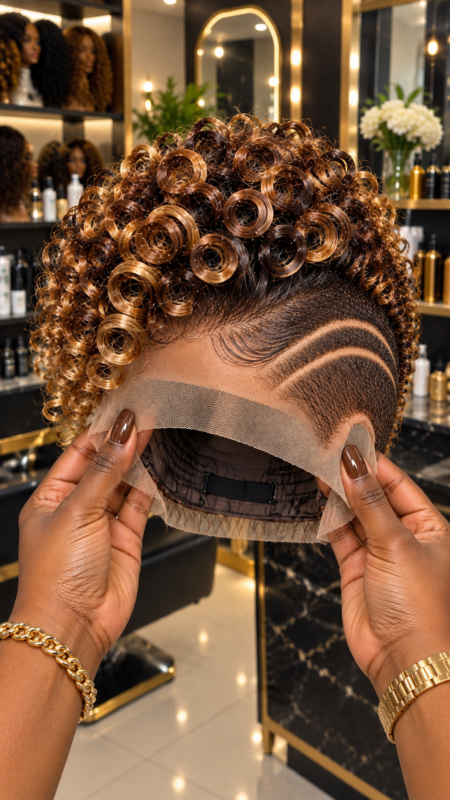
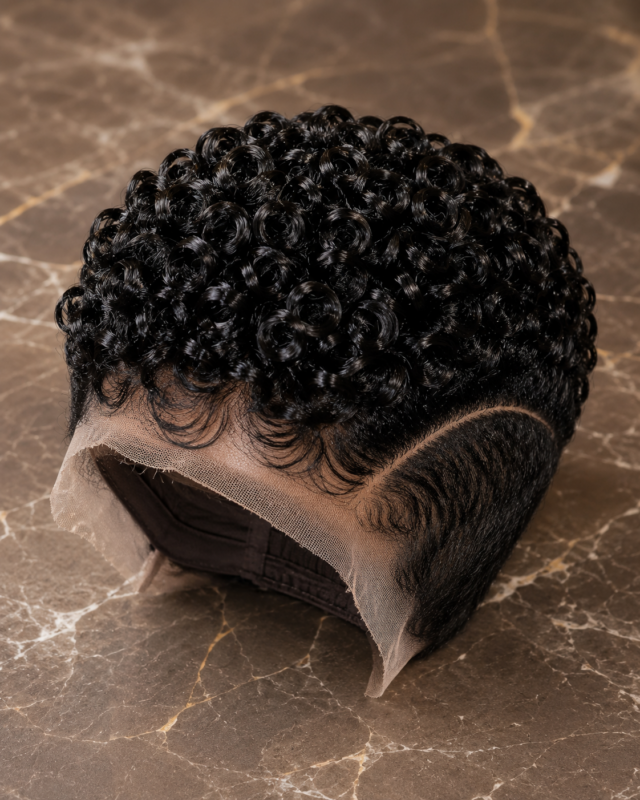
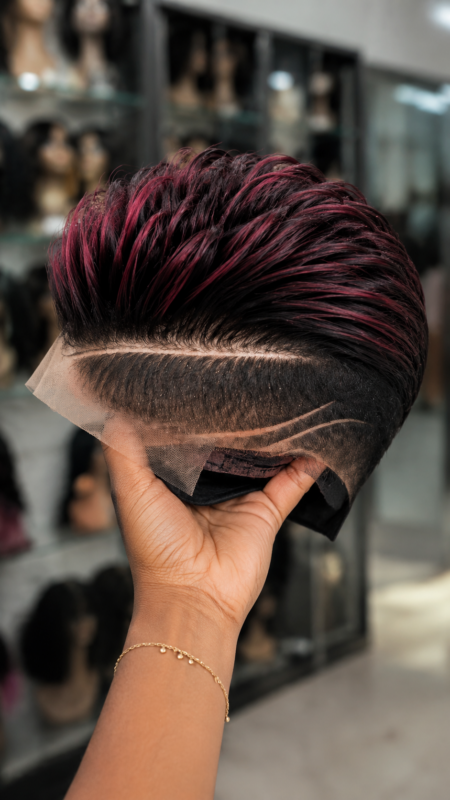
Three shots in one frame: a wide face-on view, a tight close-up on the hairline, and a straight-down shot of the crown from above. Tight glossy coils, a soft fringe framing the forehead, small carved lines tucked behind the ear on one side. This is what a genuinely useful product listing looks like — not because the wig itself is unusual, but because of how much more you can judge from three angles than from one.
Most listings give you a single flattering shot and expect you to trust the rest. A collage like this one is doing real work: each angle is answering a different question, and together they cover most of what a single photo cannot.
Where To Buy A Wig Like This
A maker who posts multi-angle listings by default is worth prioritising over one who does not, regardless of which specific style you are after. It signals a seller confident enough in their construction to let you inspect it from more than one direction before you commit.
Custom wig makers and lace studios are the main route. Search with the style itself plus quality-signalling terms: “curly pixie wig multi angle photos,” “HD lace pixie wig full listing,” “curly fringe pixie wig human hair,” “carved line pixie wig with combs.” Sellers who invest in proper photography sets tend to also invest in the construction itself — the two habits usually travel together.
Instagram and TikTok wig specialists are the richest source, and this is exactly the kind of post to look for: face-on, close-up, and top-down in one carousel or grid post. A single glamour shot with nothing else in the account’s recent posts is a weaker signal than a maker who consistently documents pieces from multiple angles.
Etsy works for made-to-order pieces. Favour listings with several photos over listings with one hero image, and read the buyer-uploaded photos specifically, since they often fill in angles the seller’s official listing skips.
Contact / Order Inquiries: WhatsApp is the standard channel for independent makers. [WhatsApp: +XX XXX XXX XX XX] — send this exact photo set as a reference and ask directly: “Can you send me photos like this from these same three angles, plus a shot of the cap interior?” A maker who already shoots this way will have no trouble adding one more angle.
How Much It Costs
Solid black, no lifting or toning, so every dollar above a basic unit is buying hand-finishing, not colour.
100% human hair, sheer lace, bleached knots, curled fringe, carved line detail, glueless cap: generally $200–$430
100% human hair with simpler styling and no line design: typically $150–$300
100% human hair, basic cap, sparse density: typically $70–$180
High-quality synthetic with comparable finishing: usually $60–$140
Basic synthetic curly pixie: often $20–$55
The arithmetic worth knowing: nothing about a multi-angle photo set changes the price of the wig itself, but it does change how much you can verify before paying that price. A unit priced identically to a competitor’s is a meaningfully better bet if the listing lets you actually inspect the construction from several sides rather than asking you to trust one flattering angle.
What Each Angle Actually Proves
The wide face-on shot is the weakest angle for judging construction and the strongest for judging fit and proportion. It shows how the fringe frames the face, how the crown volume balances against the head, and whether the overall silhouette suits the shape being modelled. This is the angle sellers rely on most, and it is the one that tells you the least about quality.
The tight close-up on the hairline is where the real inspection happens. At this range you can judge knot density and whether they are bleached, whether the lace tone is close to the skin beneath it, how the baby hairs are finished at the front, and how cleanly any carved line meets the lace edge. If a listing only has one close-up, this is the angle it should be.
The top-down crown shot answers a question neither of the other two can: how the part and crown area look from directly above, which is exactly the vantage point of anyone taller than you standing nearby, or your own reflection in a mirror above eye level. It also often reveals density evenness across the whole crown in a way a side-angle photo can hide, since thin patches are easiest to spot from directly overhead.
What Even Three Angles Still Hide
A collage like this is a genuine improvement over a single photo, but it has limits worth knowing before you assume you have seen everything.
None of these three angles show the cap interior — the straps, combs, and seams that determine how the piece actually wears. Ask for that separately; it is a different photo entirely and sellers who show three good exterior angles do not always think to include it.
None of them are video, so none can show you how the curls move, whether they bounce back after being touched, or whether the piece sheds when handled. A still photo, however sharp, freezes the one moment that looks best.
And a mannequin, however photographed, is not skin — lace tone and transparency read differently against plastic than against a real forehead, no matter how many angles you view the plastic from.
The Curled Fringe And The Carved Line Detail
The front is built as a soft curled fringe rather than a flat cut edge, framing the forehead with small ringlets that taper at the ends. This takes real curl-setting skill to hold at the very front of a piece, where there is no weight behind it to keep the shape settled. Judge it on uniformity and spring across all three angles — a fringe that looks lively face-on but flat from above is not fully consistent.
Behind one ear, small carved lines are tucked in rather than run boldly across the whole side. A subtler, more contained line detail like this is easier to keep clean than a long sweeping design, but it still needs to be judged on the same basics: even width, smooth curves, and a clean finish rather than a ragged one.
The Tight Coils, The Lace, And The Knots
The coils are small, tight, and packed densely at the crown, visible clearly in the top-down shot specifically. Tight coils show thinness immediately, so density has to be genuinely full for the crown to read right — and the overhead angle is exactly where a maker cannot hide a thin patch behind clever angling.
The close-up shot is where to check the knots properly: on a careful unit they are bleached so the lace reads as scalp rather than a scatter of dark dots. This same angle is also where lace tone against the mannequin’s skin becomes clear, though remember that plastic and real skin behave differently.
The Cap
None of the three angles here show the cap interior, so ask before you buy: is it glueless, with combs and an adjustable strap? A glueless cap secures mechanically — no adhesive on your skin, no removers, no slow traction damage to your own edges. But glueless only works if the fit is right. Measure your head with a soft tape — from the front hairline, around above the ears, around the nape, and back to the start. Most caps run 21.5–22.5 inches, but real heads vary, so ask whether the maker builds to your measurement.
Before You Pay
Can you add a photo of the cap interior to match these three angles?
Can you send a short video showing curl movement and bounce?
How do I keep the fringe curled and the line detail clean day to day?
Are the knots bleached, and what lace tone are you using?
Is the cap glueless — combs and an adjustable strap — and can it be built to my head measurement?
Trimming The Lace
Cut slowly and follow your natural hairline. Leave a small margin instead of going flush, and use small staggered cuts rather than one straight line. Use the close-up angle from listings like this one as your reference for how much lace margin to leave, rather than guessing. If you are new to lace, pay a stylist for the first cut and copy what they do.
Search Terms
curly pixie wig multi angle photos · HD lace pixie wig full listing · curly fringe pixie wig human hair · carved line pixie wig with combs · tight coil pixie wig human hair · where to buy curly pixie wigs with detailed photos
Final Thoughts
Study this listing for the habit it represents, not just the wig in it. A face-on shot, a close-up, and a top-down angle together tell you far more than any single photo could — about fit, about knot quality, about density evenness across the whole crown.
But even three good angles leave gaps: no cap interior, no video, no real skin to test lace against. A maker willing to show you three angles is usually willing to fill those gaps too, if you ask. Request what is missing before you buy, not after. Decide honestly, then buy accordingly.