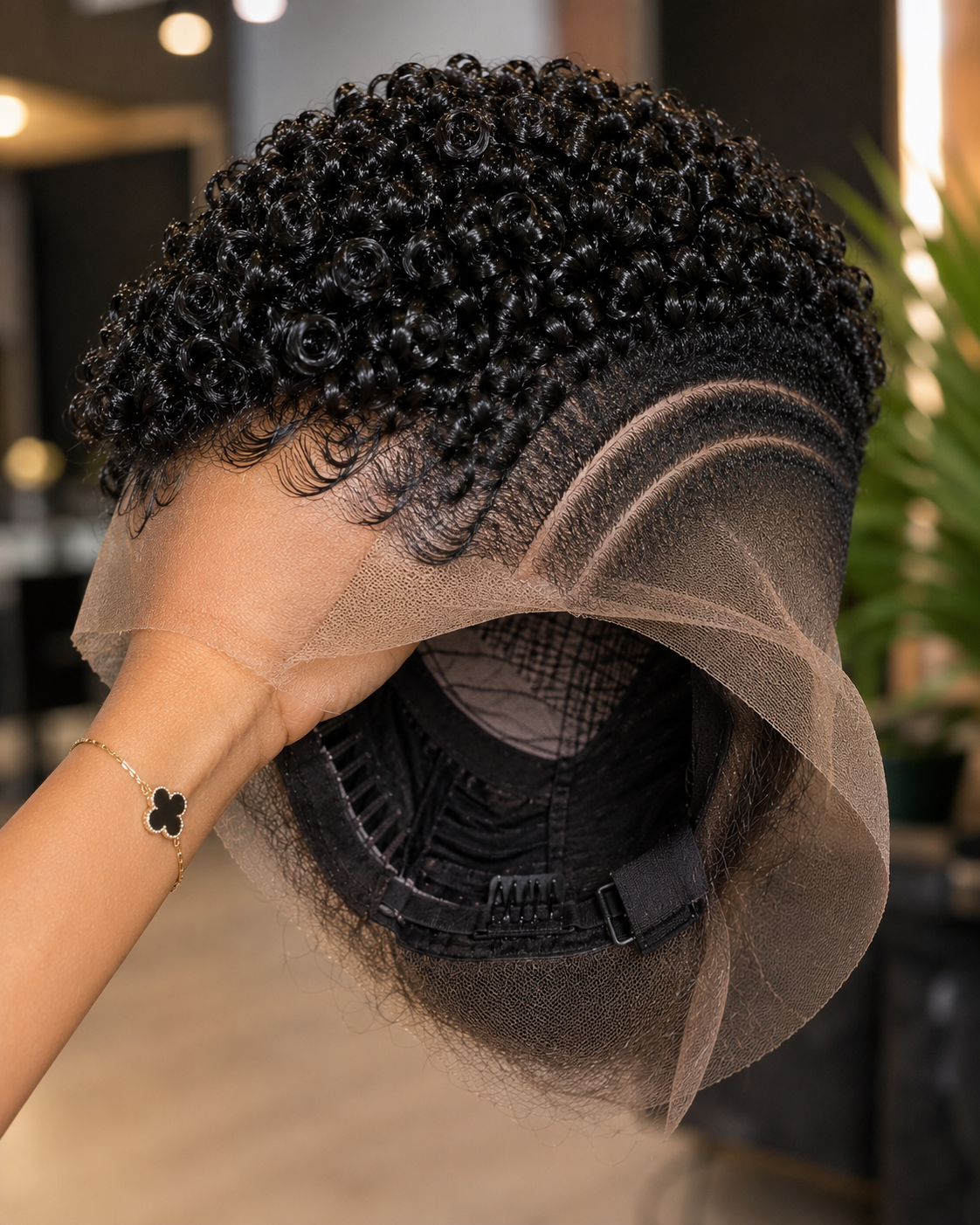
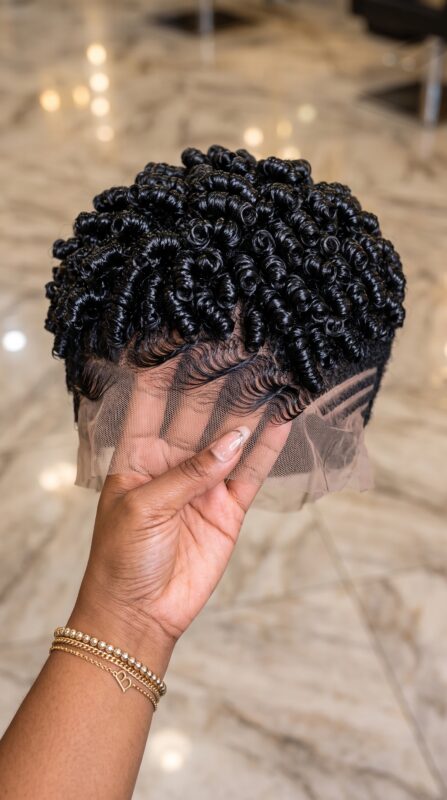
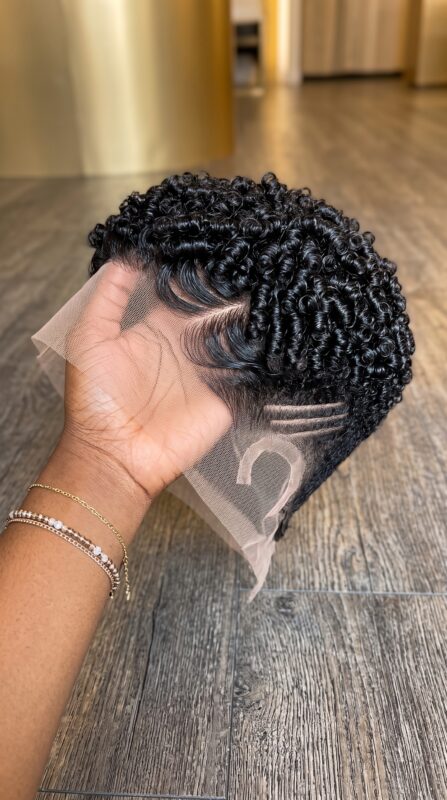
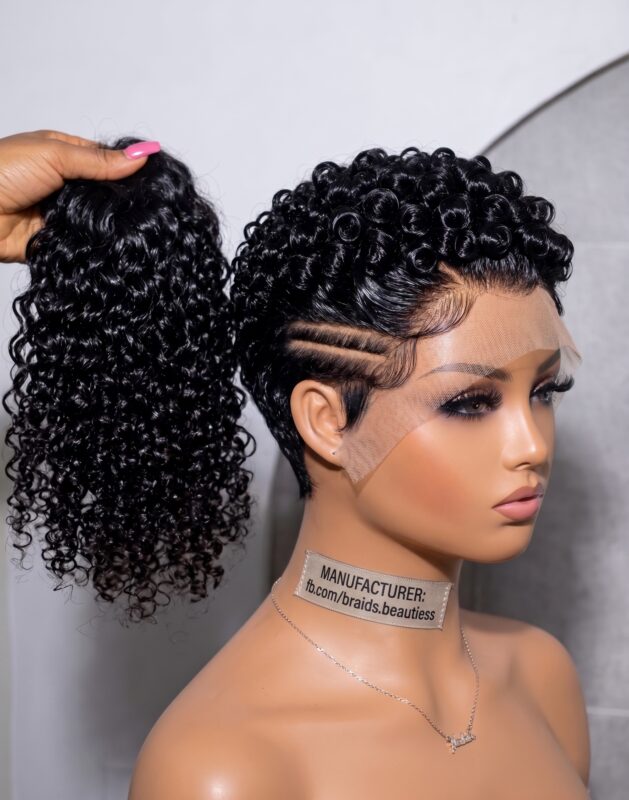
There’s an unusual amount of lace on this piece, and that’s the story. It doesn’t stop at the front hairline — it sweeps down past the temple, over the ear, and right along the side, with two curved lines carved directly into it. Held open with the cap fully exposed, you can see the whole construction laid bare: the coily crown, the laid baby hairs, the sheer mesh, and inside, a comb and adjustable strap.
Most short wigs aren’t built this way. Here’s what the difference is worth, what it costs, and how to find a maker who does it.
Where To Buy A Wig Built Like This
The vocabulary matters more than usual here, because makers who work with extended side lace rarely surface under generic search terms.
Custom wig makers and lace studios are the primary route. Search construction language rather than style language: “extended lace pixie wig,” “full side lace short wig,” “lace side pixie wig human hair,” “HD lace tapered pixie.” Then scan their portfolio specifically for side profile shots. Makers proud of their lace work photograph the side deliberately. Makers who aren’t, quietly avoid the angle.
Instagram and TikTok wig specialists are in practice the richest source, because many post exactly this kind of unglamorous, hand-held, cap-exposed footage. Prioritise those sellers — nobody photographs a cheap cap on purpose. Video is doubly valuable, since it shows how the lace behaves in real, uncontrolled light rather than under a softbox.
Etsy works well for made-to-order pieces, where independent artisans will build from a reference photo. But ask directly whether the lace extends past the front, because listings almost never specify it.
Contact / Order Inquiries: For most independent makers, WhatsApp is the standard order channel. [WhatsApp: +XX XXX XXX XX XX] — and send this exact message, because it’s the single question that separates serious makers from the rest:
“Does the lace extend down the sides, or is it front lace with wefted sides? And can you send a close-up side profile of the fade?”
How they answer will tell you, in one sentence, who you’re dealing with.
How Much It Costs
Solid black means no lifting, no toning, no bleach damage — so every dollar above a basic unit is buying construction and hand-finishing, not colour.
- 100% human hair, extended side lace, bleached knots, hand-laid edges, carved curved lines, graduated fade, glueless cap: generally $220–$450
- 100% human hair, front lace only with wefted sides, otherwise comparable: typically $120–$280
- 100% human hair, basic build, no side lace or edge work: typically $70–$180
- High-quality synthetic with extended lace construction: usually $60–$140
- Basic synthetic coily pixie: often $20–$55
The specific figure worth knowing: extended side lace typically adds $40–$80 over an equivalent front-lace-only piece. Hand-laid edges add another $30–$60. Stack them and you arrive at roughly double the price of a basic unit — which is the honest arithmetic of hand work.
Hair origin (Brazilian, Malaysian, Vietnamese, and others), curl density, and design complexity all shift the final number, so a direct quote based on your specifications will always beat any published range.
Shipping, Delivery, And What To Expect After Ordering
Made-to-order timing. Extended lace and hand-knotted fades are slow. Expect two to four weeks, not the one-to-three typical of simpler builds. Be sceptical of anyone promising this level of construction in a few days.
Lace arrives untrimmed, as shown — and there’s considerably more of it than usual on a piece like this, since it runs down the sides as well as the front.
International shipping is common with Instagram, TikTok, and Etsy sellers, though delivery windows and customs fees vary by country. Ask about tracked shipping before paying.
Returns are usually limited on custom pieces. Get the policy in writing.
Cap fit is the most common regret. Send your measurement and ask whether they build to it.
Why The Side Lace Changes Everything
Every buying guide tells you to inspect the front hairline. Sound advice — but incomplete for a pixie.
On a long wig, the sides of the cap are hidden under a curtain of hair. Nobody sees the temple. On a short wig, there’s no length to cover anything. The sides are permanently exposed — in profile, in photographs, when someone’s standing beside you at a counter.
Most lace pixies use wefts there: rows of hair machine-stitched to fabric. Cheap, fast, fine when hidden. The problem is that wefts have visible structure. At conversational distance they read as exactly what they are — hair sewn onto a base.
Lace doesn’t. Extend it down the side, knot each hair individually into that fine mesh, and the taper appears to grow from skin. That’s why the two carved lines here look cut into hair rather than drawn onto fabric. There’s nothing behind them but scalp and mesh.
The Twin Curved Lines
Two curved lines run parallel through the taper, echoing each other as they sweep back.
With a single line you only have to be consistent with yourself. With two, you must be consistent with each other — matching arc, matching width, and identical spacing from start to finish. Any drift is immediately visible. If the gap widens at the back, the eye catches it instantly.
Check for: consistent spacing along the entire run, matching width on both curves, crisp edges with no ragged sections, and both lines terminating cleanly rather than trailing off.
The Fade, The Knots, And The Edges
The fade graduates from full coils down through progressively shorter lengths into fine stubble, then dissolves into the lace. Every hair in that taper was knotted individually at a decreasing length. No clipper involved. A bad fade has a hard stop, patchy density, or hair that’s uniformly short rather than genuinely graduating. This one doesn’t.
The knots are bleached. The lace reads as scalp rather than a field of dark specks — a deliberate, time-consuming production step and one of the more reliable markers of a careful maker.
The baby hairs are hand-laid in soft, curved, varied strokes that thin outward into wisps. Blunt uniform rows are the fastest tell of a cheap piece. The honest caveat: they loosen — with wear, washing, humidity, sleep. Ask your maker how to re-lay them and with what products. If you won’t maintain them, buy plainer and keep the difference.
The curls are tight, glossy, and evenly dense across the crown, with no thin patches. In solid black there’s nowhere for poor curl quality to hide.
The Cap
Through the opening: a comb and an adjustable strap with buckle, stitched into a wefted interior. This is a glueless build — it secures mechanically rather than chemically.
That’s worth valuing properly. No adhesive on your hairline means no skin irritation, no chemical removers, and no slow traction damage to your own edges over months of daily wear. It also means a two-minute install rather than twenty.
But glueless depends entirely on fit. Measure your head: tape from the front hairline, around above the ears, around the nape, and back. Most caps run 21.5–22.5 inches, but real heads vary well beyond that. A maker who asks for your number before building is taking the work seriously.
Before You Pay
- Does the lace extend down the sides? (The question nobody asks.)
- Can I see a close-up side profile of the fade?
- Are the knots bleached, and what lace type and tone?
- Is the cap fully glueless — comb and adjustable strap?
- What’s the cap circumference, and can it be built to my measurement?
- Are the baby hairs hand-laid, and how do I re-lay them?
Trimming The Lace
Cut slowly. Follow your natural hairline. Leave a small margin rather than going flush. Use small staggered cuts instead of one straight line, which produces a natural, irregular edge rather than an obviously manufactured one.
Take extra care with the side lace — it’s larger, more awkward, and mistakes there are more visible on a short wig, not less. If you’ve never trimmed lace before, pay a stylist for the first cut. It’s permanent, and the piece is expensive.
Search Terms
extended lace pixie wig · full side lace short curly wig · HD lace tapered pixie wig · lace side fade wig human hair · glueless coily pixie with combs · bleached knots short curly wig · where to buy extended lace pixie wigs
Final Thoughts
Everyone shops the front hairline. Almost nobody shops the sides — and on a short wig, the sides are what people actually see when they’re standing next to you.
Extended side lace is the fix. It costs more, takes far longer to build, and is almost never advertised, because most makers simply don’t do it. Which makes it the most useful question you can ask a seller, and the one they’ll least expect.
Ask it before you pay. The answer is worth more than any product description you’ll read.