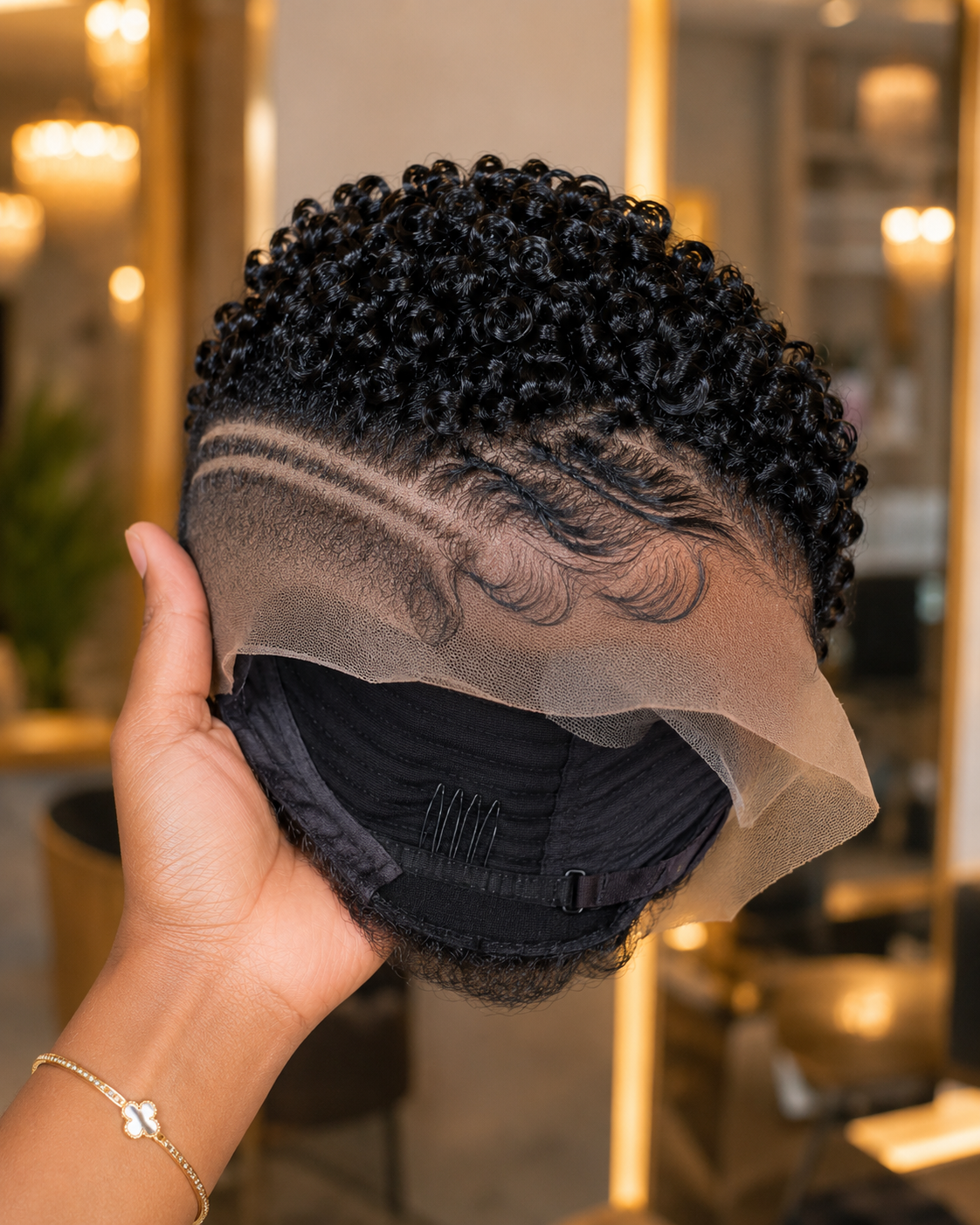
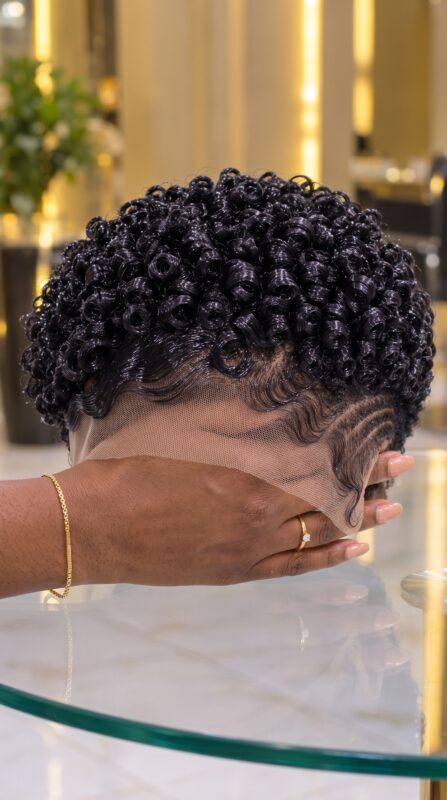
Held open with the cap exposed, this piece lays out its full construction in one frame: tight coily curls at the crown, two clean parallel lines carved into a tapered fade, a swept baby-hair edge running along the temple, sheer lace with bleached knots, and inside — a comb and an adjustable strap.
Nothing here is styled to flatter. Which is exactly what makes it worth reading properly. Let’s go through what’s good, what it costs, and what to ask before you spend anything.
The Twin Lines Are Harder Than They Look
Two parallel lines cut into the fade, running back from the temple. Simple, clean, restrained — and considerably more demanding than it appears.
Here’s why. With a single line, you only have to be consistent with yourself: keep a steady width, hold a steady angle. With two, you now have to be consistent with each other as well. Both lines must hold the same width, run at the same angle, and maintain identical spacing between them from start to finish.
Any drift is immediately visible. If the gap widens at the back, the eye catches it instantly. If one line is fractionally thicker than the other, you’ll see it. There’s no busy pattern to absorb the error, and there’s no un-carving it once it’s cut.
What to check: consistent spacing along the entire run, matching width on both lines, crisp edges with no ragged or feathered sections, and both lines terminating cleanly rather than trailing off.
The Swept Edge
Along the temple, fine baby hairs are laid into soft, swept strokes that fan back along the hairline. This is more restrained than the elaborate sculpted-wave work you’ll see on some pieces — and that restraint is a reasonable design decision here, since the carved lines are already providing structure below.
What makes it good work:
- The strokes vary in length and direction. Real baby hairs are irregular; they don’t march in formation.
- The density tapers outward, thinning into individual wisps rather than ending in a hard block of hair.
- It looks brushed, not painted. Bad edge work has a flat, dark, lacquered quality — as though drawn on with a marker rather than laid with a comb.
The upkeep reality: laid edges loosen. With wear, washing, humidity, and sleep. Expect to re-lay them regularly. Ask your maker for their method and product recommendations before buying — and if you know you won’t do it, buy a plainer piece and keep the money.
The Lace, The Knots, And The Cap
The lace is fine, sheer, and warm-toned, translucent enough that you can see the black cap right through it. Generously long and untrimmed, extending well past the hairline — correct, since that excess is your margin to cut along your hairline rather than a factory’s average.
The knots are bleached. Each hair in a lace wig is tied to the mesh with a small knot; left dark, those knots show as a field of black specks where scalp should be. Here the lace reads as skin. It’s a deliberate, time-consuming production step, and one of the more reliable indicators that a maker took care.
Inside the cap: a comb visible at the crown and an adjustable strap with a buckle at the nape, stitched into a wefted interior. This is a glueless build — it secures mechanically rather than chemically.
That’s genuinely worth valuing. No adhesive on your hairline means no skin irritation, no chemical removers, and no slow damage to your own edges over months of daily wear. It also means a two-minute install instead of a twenty-minute one.
But glueless lives or dies on fit. Too loose and it shifts. So measure your head before ordering: tape from the front hairline, around above the ears, around the nape, and back. Most caps run 21.5–22.5 inches, but real heads vary well outside that range. A maker who asks for your measurement before building is taking the work seriously; one who never mentions it is guessing.
The Curls And The Fade
The coils are tight, glossy, and evenly dense across the crown, with no thin or sparse patches. On a solid black piece there’s no colour to distract you — curl quality is fully exposed, and nothing here is hiding.
Follow the side and you’ll see the taper: curls graduating from full at the crown down through progressively shorter lengths until they fade into the lace. That gradient is hand-knotted, hair by hair, at decreasing lengths. There’s no clipper involved. It’s slow, unglamorous work, and it’s where cheap units give themselves away — with hard stops, patchy density, or a “fade” that’s really just uniformly short hair.
What This Piece Costs
Black hair means no lifting, no toning, no bleach damage. Every dollar above a basic unit is buying construction and hand-finishing:
- 100% human hair, quality lace, bleached knots, swept edges, twin carved lines, graduated fade, glueless cap with comb and strap: generally $180–$400
- 100% human hair, basic cap and lace, no edge or design work: typically $70–$180
- High-quality synthetic with comparable construction: usually $50–$120
- Basic synthetic coily pixie: often $20–$55
Roughly double the price for hand-finishing. Whether that’s justified comes down to one question: does it matter to you that people can’t tell?
Where To Buy A Wig Like This
- Custom wig makers and lace studios. Search with construction vocabulary rather than style words: “glueless coily pixie wig,” “HD lace pixie with carved lines,” “bleached knots short curly wig,” “laid edge lace front pixie.” Sellers fluent in these terms understand what they’re building.
- Instagram and TikTok wig specialists. Prioritise the ones posting cap interiors and side profiles rather than only front-facing glamour shots. Nobody photographs a cheap cap on purpose — showing it is a confidence signal.
- Etsy. Solid for made-to-order. Read the reviews specifically for mentions of lace, knots, cap fit, and comfort, and prioritise buyer-uploaded photos over the seller’s staged shots.
Contact / Order Inquiries: [WhatsApp: +XX XXX XXX XX XX] — send one request: “Can you show me the unit held open, so I can see the cap, the lace, and the side fade?” It costs the seller thirty seconds, and how they respond tells you almost everything about who you’re dealing with.
Before You Pay
- Are the knots bleached, and what type and tone of lace?
- Can I see a side profile of the fade?
- Is the cap fully glueless — comb and adjustable strap?
- What’s the cap circumference, and can it be built to my measurement?
- Are the baby hairs hand-laid, and how do I re-lay them?
- Can you carve the lines to my preferred spacing and angle?
Trimming The Lace
Ships uncut, as shown. Cut slowly, follow the natural curve of your hairline, leave a small margin rather than going flush, and use small staggered cuts rather than one straight line — this produces a natural, irregular edge instead of an obviously manufactured one.
If you’ve never done it before, pay a stylist for the first trim. The cut is permanent, and a rushed job can undo an otherwise excellent piece.
Search Terms
glueless coily pixie wig · HD lace pixie wig with carved lines · bleached knots short curly wig · laid edge lace front pixie · twin line design pixie wig human hair · where to buy glueless pixie wigs with design
Final Thoughts
There’s a version of this piece that costs a third of the price and looks fine in a photograph. Same curls, same colour, same general shape. What it wouldn’t have is bleached knots, sheer lace, a hand-knotted fade, laid edges, or a cap you can actually fit to your head.
And every one of those things is invisible in a styled product shot — which is precisely why they get skipped, and precisely why you should ask about them directly.
So make the held-open photo your standard. Ask for it every time, from every seller. It shows you the lace, the knots, the hairline, the fade, the comb, and the strap in one honest frame — everything that determines whether the piece will look real and stay comfortable. It costs them nothing. And if they won’t send it, you already have your answer.

I need this wig
I needed it