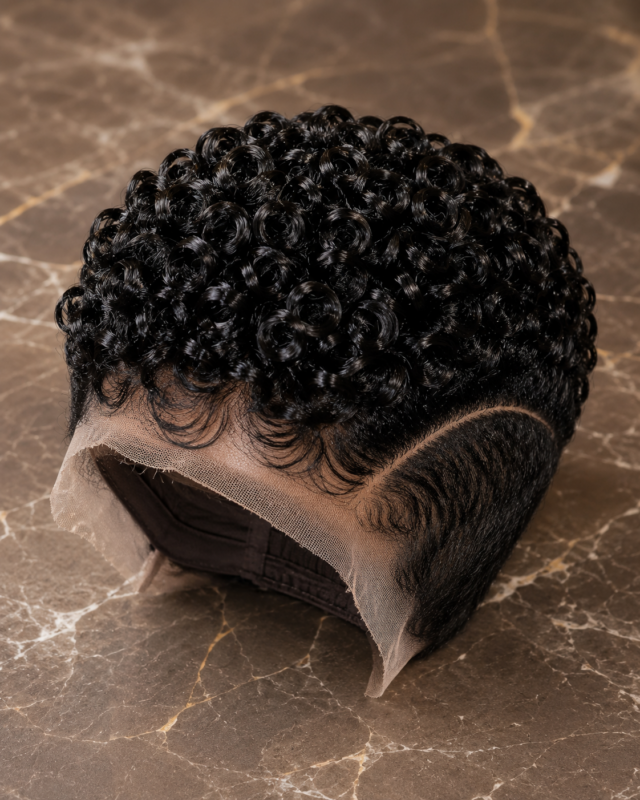
This is the closest look you’ll get at what actually separates a convincing short wig from an obvious one, and it has almost nothing to do with the curls.
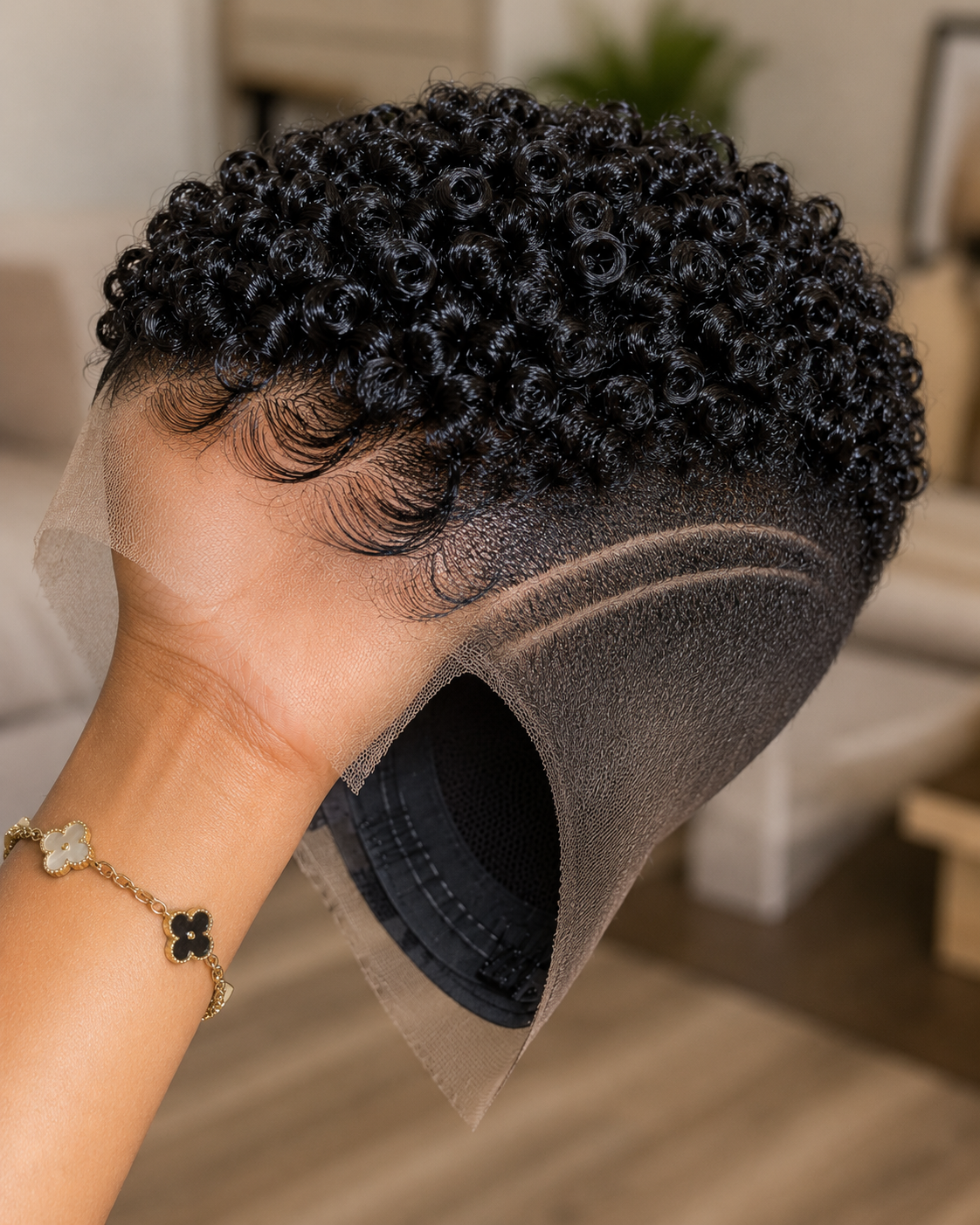
Held up in natural light, hand slipped inside the cap, the piece shows its hand completely. At the top: dense, glossy coily curls with real spring. At the front: a row of hand-laid baby hairs curling delicately along the hairline. And down the side — the part that matters most — a sweeping curved line carved into a tapered fade that graduates from full curls down to fine stubble, all of it sitting on lace, not on a wefted cap.
That last detail is the entire ballgame on a short wig. Most buyers never think to check it. Let’s go through everything properly, then cover what it costs, where to find one, and the questions that will save you from a bad purchase.
Why The Side Lace Is The Detail Nobody Asks About
Almost every guide tells you to inspect the front hairline. Reasonable advice — it’s the first thing anyone sees. But on a pixie, the front hairline is only part of the story, because there’s no length falling down to cover anything.
Think about it practically. On a long wig, the sides of the cap are hidden under a curtain of hair. Nobody sees the temple. Nobody sees the area above the ear. But on a short cut, those areas are permanently exposed — in profile, in photos, when someone is standing beside you at a counter or sitting next to you in a meeting.
Most lace pixies put lace only at the front, then use standard wefts for the sides — rows of hair machine-stitched onto fabric. Wefts are efficient and cheap, and they work perfectly well when they’re hidden. The problem is that wefts do not look like scalp. They have a visible structure. At arm’s length, in decent light, they read as fabric with hair sewn to it, because that’s exactly what they are.
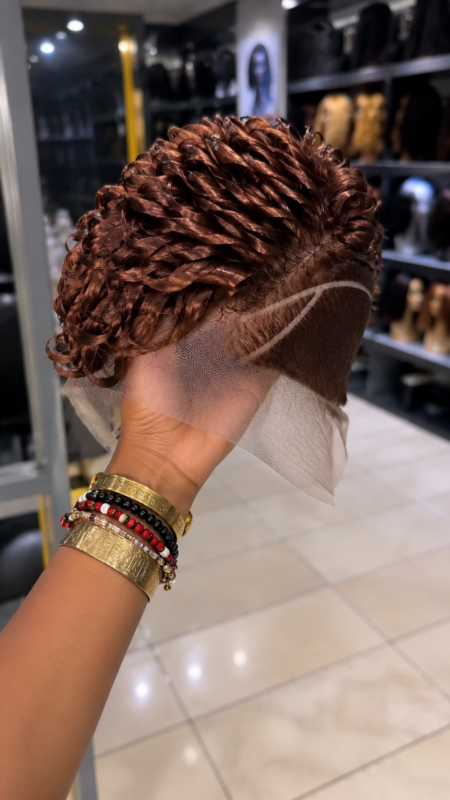
Lace solves this. When you extend the lace down the entire side, each hair in that taper is individually knotted into a fine, transparent mesh that sits directly against skin. The result is that the taper appears to grow from the scalp rather than sitting on top of it.
Which is precisely why the fade in this piece is so convincing, and why the curved line reads as carved into hair rather than drawn onto a base. There’s nothing behind it but skin and lace.
The cost of building this way: dramatically more hand-knotting hours, more lace, and a slower build. It’s why side lace is uncommon, why almost nobody advertises it, and why it commands a genuine premium.
The Fade: The Hardest Thing To Build On A Short Wig
Follow the side of this piece with your eye. The curls at the crown are full and dense. As you move down, they get shorter. Then shorter again. Eventually they become fine, sparse stubble, and then they vanish into the lace entirely.
There is no clipper involved in that. Nobody cut this fade. Every single hair in the taper was individually knotted at a progressively shorter length, working down the side, one at a time. It’s a genuinely painstaking process, and it’s the single clearest place where a cheap unit exposes itself.
What a poor fade looks like:
- A hard, abrupt stop where the curls simply end
- Patchy density — visible thin or bald areas within the taper
- Hair that’s uniformly short across the whole side rather than genuinely graduating
- A “fade” that’s really just a printed or shadowed effect on the lace
What a good one looks like — visible here: a smooth, continuous gradient from full curl through medium, through short, through stubble, into nothing. Even density the whole way down. No steps, no gaps, no boundary where the taper meets the lace.
Ask any seller for a close-up side profile of the fade. If every photo they own is front-facing, there is usually a reason.
The Curved Line
The carved line sweeping through the taper is a single continuous curve, holding a consistent width from where it begins near the crown all the way through to where it tapers out.
This is deceptively difficult. With a multi-line pattern, small errors in one line get visually absorbed by its neighbours. With a solo line, there’s nowhere to hide — any wobble, any thickening or thinning, any break in the curve is immediately obvious. It has to be right first time, because you can’t un-carve it.
Note also the restraint of the design choice. One clean curve, nothing more. With curls this dense and glossy, a busy swirl or multi-line pattern would fight the texture for attention. A single confident line adds structure without noise.
The Hairline And The Baby Hairs
At the front, fine baby hairs are laid by hand into soft, curving strokes that fan along the hairline.
Why they’re good:
- They vary. Each stroke has its own length, curve, and direction. Real baby hairs are irregular and slightly chaotic; they don’t march in formation.
- They thin outward. Density drops off as the hairline moves away from the main body of hair, tapering into individual wisps. A cheap unit gives you a dense, uniform wall of hair with a hard edge — recognisable instantly, from across a room.
- They look brushed, not painted. Bad edge work looks flat, dark, glossy, and stiff, as though drawn on with a marker. These look like hair that’s been laid with a comb.
The honest downside nobody puts in a listing: hand-laid edges do not last. They loosen with wear, with washing, with humidity, and with sleeping on them. You should expect to re-lay them regularly — possibly within days of installing.
Before you buy, ask your maker two questions: how do I re-lay these, and what products do you recommend? A good maker will send instructions or a short video without hesitation. And be honest with yourself: if you know you won’t maintain them, buy a plainer piece and keep the money, because beautiful edges you can’t reproduce are a one-week luxury.
The Lace And The Knots
The lace here is fine, sheer, and warm-toned — translucent enough that you can see straight through it to the cap interior. That’s quality lace. The budget alternative is thicker, more opaque, often grey- or pink-cast, and it will remain visible against your skin no matter how carefully you trim it.
The knots are bleached. Every hair in a lace wig is tied to the mesh with a small knot. Left dark, those knots show as a field of black specks where scalp should be — one of the fastest ways a wig gives itself away in bright light. Bleaching them is a deliberate, time-consuming extra step, and the fact that this lace reads as skin rather than dots tells you the maker took it.
The lace is also generously long, extending well past the hairline and down over the side. That excess is intentional and correct — it’s your margin to trim along your hairline rather than a factory’s guess at an average one.
Inside The Cap
Through the opening you can see the interior construction: a stretchy, wefted crown with clean stitching. The rest of the cap follows the standard glueless pattern — combs to grip your natural hair, and an adjustable strap at the nape to tighten the fit.
This matters more than most buyers appreciate. A gorgeous wig that shifts, slides, or pinches ends up in a drawer. Comfort and security are cap features, not hair features, and the cap is the one thing you cannot assess from a styled mannequin photo.
Glueless is worth understanding as a concept. It means the unit secures mechanically — combs gripping your hair, strap tightening to your head — rather than chemically, with adhesive bonded to your skin. The benefits are real:
- No adhesive on your hairline. Wig glues and lace bonds can irritate skin, clog follicles, and over months and years contribute to traction damage along your natural edges.
- Minutes to install and remove. No glue, no solvent remover, no lengthy melt-down process.
- Far better for daily wear, and for anyone rotating between multiple pieces.
The trade-off: glueless relies entirely on fit. Too loose and it will shift. Which makes the adjustable strap — and your own head measurement — genuinely important.
Measure yourself before ordering. Run a tape from your front hairline, around above the ears, around the nape, and back to the start. Most standard caps land between 21.5 and 22.5 inches, but real heads vary well outside that. A maker who asks for your measurement before building is taking the job seriously. One who never mentions it is guessing.
The Curls
Worth a moment, even though they’re the least technically demanding part of this piece.
The coils are tight, springy, glossy, and individually defined, with genuine bounce. On a solid black unit there’s no colour to distract you — curl quality is fully exposed, with nowhere to hide. Dull, frizzy, or clumped curls would be obvious here, and they aren’t.
Density across the crown is even and full, with no thin or sparse patches. Sparse crowns are common on budget units, and there is no fixing it after purchase.
What This Piece Costs
Solid black means no lifting, no toning, no bleach damage, no fade risk — so every dollar above a basic unit is buying construction and hand-finishing, not colour. That’s exactly the right place to spend money, because construction is what makes a wig look real.
- 100% human hair, extended side lace, bleached knots, hand-laid hairline, graduated fade, carved curved design, glueless cap with combs and adjustable strap: generally $220–$450
- 100% human hair, front lace only with wefted sides, basic build, no hairline or fade work: typically $70–$180
- High-quality synthetic with comparable construction: usually $60–$140
- Basic synthetic coily pixie: often $20–$55
Understanding the gap: extended side lace alone typically adds $40–$80 over a front-lace-only equivalent. Hand-laid edges add another $30–$60. A properly graduated hand-knotted fade adds more still. Stack them together and you arrive at roughly double the price of a basic unit — which is the honest arithmetic of hand-finishing.
Whether that’s worth it comes down to a single question: does it matter to you that people can’t tell? If yes, this is where the money goes. If not, buy simpler and spend the difference elsewhere.
Hair origin (Brazilian, Malaysian, Vietnamese, and others), curl density, and design complexity all shift the final figure, so a direct quote from your chosen maker based on your exact specifications will always be more accurate than any range.
Where To Buy A Wig Built Like This
The vocabulary you search with matters enormously here, because most sellers simply don’t build this way and won’t come up under generic terms.
Custom wig makers and lace studios. The primary option. Search using construction language rather than style language: “extended lace pixie wig,” “full side lace short wig,” “lace side pixie wig human hair,” “HD lace tapered pixie,” “glueless coily pixie with combs.” Sellers fluent in these terms understand what they’re building. Sellers whose listings say only “beautiful curly wig” often do not.
Then — critically — look through their portfolio for side profile shots. Makers who are proud of their fades photograph them deliberately. Makers who aren’t, quietly avoid the angle. A grid full of front-facing glamour shots and zero profiles is telling you something.
Instagram and TikTok wig specialists. In practice, the richest source. Many independent makers post exactly this kind of unglamorous, hand-held, cap-exposed footage — and those are the ones to prioritise. Nobody photographs a cheap cap on purpose. Video is doubly useful because it shows curl movement and how the lace behaves in real, uncontrolled light rather than under a studio softbox.
Etsy. Solid for made-to-order pieces, where independent artisans will often work from a reference photo. Read the reviews specifically for mentions of lace quality, knots, cap fit, and comfort — not just “it’s pretty.” And prioritise buyer-uploaded photos over the seller’s own staged shots. Sellers photograph in flattering light; buyers photograph in bathrooms.
General wig retailers and beauty supply stores. Fine if you want an affordable synthetic piece, but extended side lace and hand-laid edges are essentially never found in mass retail. If construction is what you’re after, this isn’t the channel.
Contact / Order Inquiries: For most independent makers, WhatsApp is the standard order channel. [WhatsApp: +XX XXX XXX XX XX] — and here is the message that will do more work than any other:
“Does the lace extend down the sides, or is it front lace with wefted sides? And can you send a close-up side profile of the fade, plus a photo of the cap held open?”
That single message separates serious makers from the rest almost instantly. It takes them a minute to answer. How they respond — openly, or evasively — tells you who you’re dealing with.
Shipping, Delivery, And What To Expect After Ordering
- Made-to-order timing. Extended side lace and hand-knotted fades are slow work. Expect two to four weeks rather than the one-to-three typical of simpler builds. Be sceptical of anyone promising this level of construction in a few days.
- Lace arrives untrimmed, as shown. There’s more of it than usual on a piece like this, since it runs down the sides as well as across the front. Take your time.
- International shipping is common with Instagram, TikTok, and Etsy sellers, though delivery windows and customs fees vary considerably by country. Ask about tracked shipping and estimated timelines before paying.
- Returns are usually limited on custom pieces, since they’re built for you. Get the seller’s policy in writing before money changes hands.
- Cap fit is the most common regret. Send your measurement. Ask whether they build to it.
Trimming The Lace
The lace ships uncut, and on this piece there’s a lot of it.
- Cut slowly and leave a small margin. Follow the natural curve of your hairline rather than cutting flush against the hair.
- Use small, staggered cuts rather than one straight line — this produces a natural, irregular edge instead of an obviously manufactured one.
- Don’t rush the side lace. It’s larger and more awkward than the front, and mistakes there are more visible on a short wig, not less.
- If you’ve never done it, pay a stylist for the first trim. The cut is permanent and the piece may have cost you several hundred. It’s cheap insurance.
The Questions That Actually Filter Sellers
Most buyers ask about colour and length. These are the ones that determine whether you’ll be happy:
- Does the lace extend down the sides, or is it front lace with wefted sides? (The question nobody asks.)
- Can I see a close-up side profile of the fade?
- Are the knots bleached, and what type and tone of lace is it?
- Is the cap fully glueless — combs and an adjustable strap? How many combs?
- What’s the cap circumference, and can it be built to my measurement?
- Are the baby hairs hand-laid, and how do I re-lay them when they loosen?
Any maker worth buying from will answer all six without friction.
Search Terms That Help Find This Style
extended lace pixie wig · full side lace short curly wig · HD lace tapered pixie wig · glueless coily pixie wig with combs · bleached knots short curly wig · hand-laid edges lace front pixie · lace side fade wig human hair · where to buy extended lace pixie wigs
The front hairline gets all the attention, and it deserves some of it. But on a short wig, the sides are what people actually see — standing next to you in a queue, sitting beside you at a table, in every photograph taken in profile. And wefted sides do not look like scalp, no matter how immaculate the front is.
Extended side lace fixes that. It costs more, takes longer to build, and almost nobody advertises it, because most makers simply don’t do it. Which means it’s the one question worth asking that most buyers never think of — and the answer will tell you, in a single sentence, whether the maker you’re talking to is building wigs or just assembling them.
Add a properly hand-knotted graduated fade, bleached knots, laid edges, and a glueless cap you can fit to your own head, and you have a piece that survives daylight, survives close inspection, and survives being seen from the side. That’s what the money buys. Nothing else on a short wig matters half as much.

Where to get the pixies they are very beautiful I’m interested in them I’m from eSwatini please send location and prices for different pixies..most of people likes them but the problem is location, how can we find them we want to support