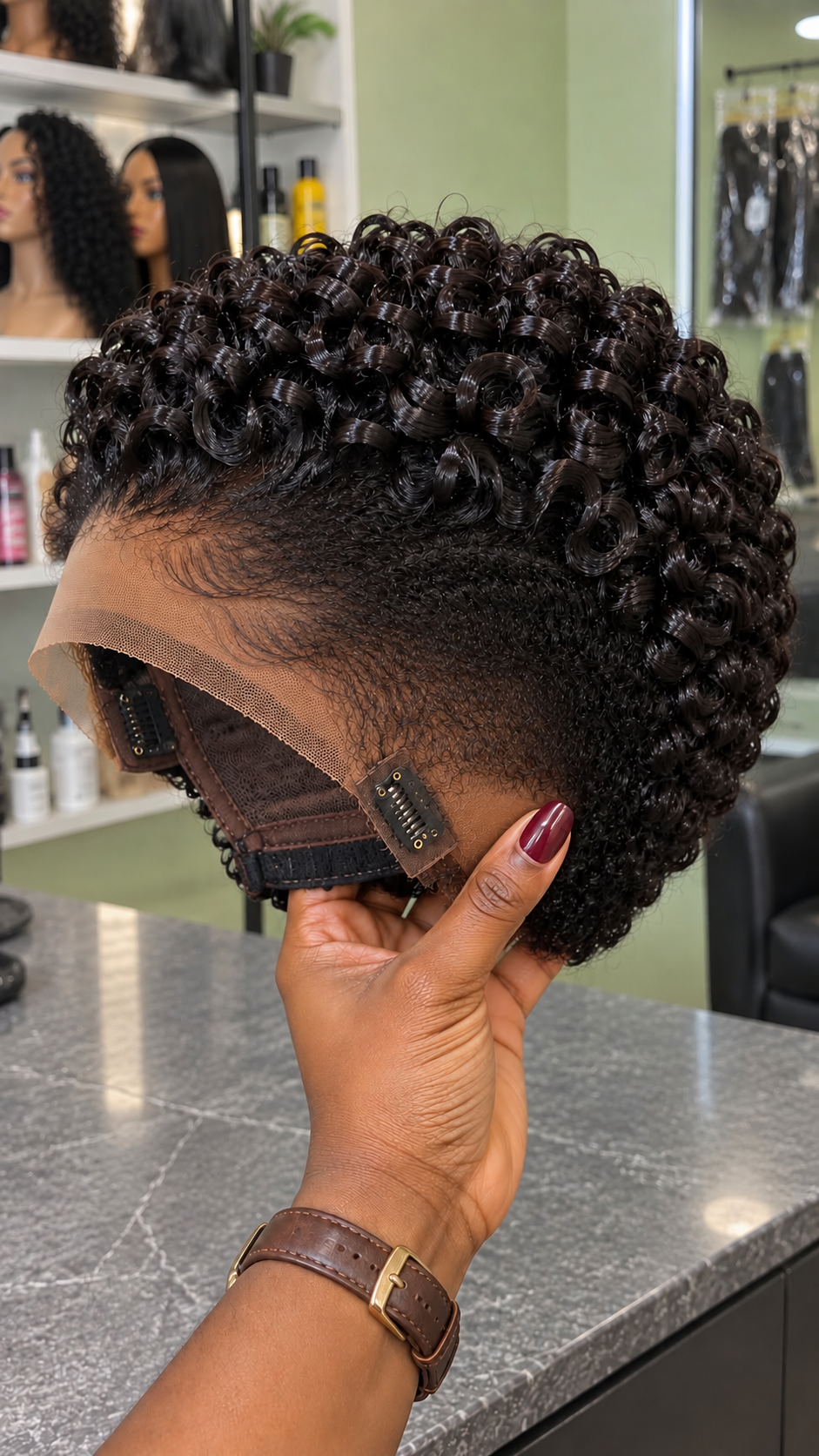
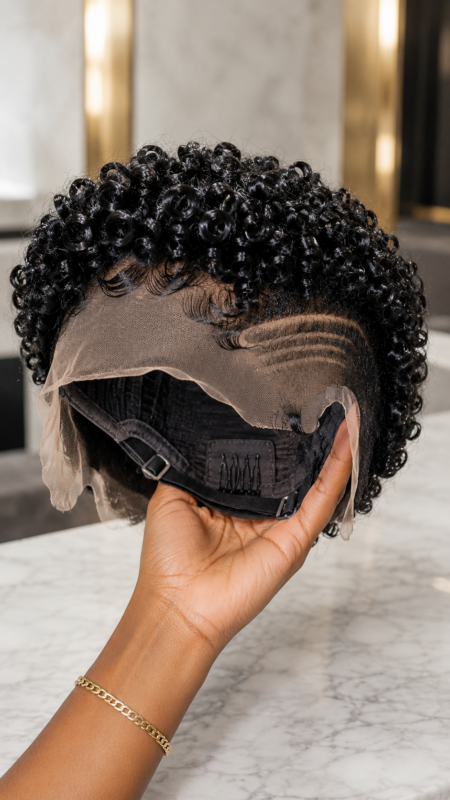
There is a meaningful difference between a wig that has been decorated to resemble a barber haircut and one that achieves its appearance through the careful distribution of hair itself. This natural-black sculpted wig belongs to the second category. Its crown contains numerous glossy, open tubular spirals, while the visible side gradually changes into much smaller, tightly arranged curls. No prominent shaved stripes, lightning motifs or exposed geometric channels interrupt that transition. The result is a compact hairpiece whose silhouette depends on curl scale, controlled density and the relationship between the upper crown and lower perimeter.
The photograph shows the unit being held from underneath inside a wig salon. The front lace remains untrimmed, portions of the dark brown cap are exposed, and two small comb-style attachments can be seen near the interior perimeter. A dark band is also visible within the lower foundation. These details make the image useful for discussing construction as well as appearance, although the photograph does not confirm the fiber type, complete adjustment system, commercial lace grade or suitability for adhesive-free installation.
What distinguishes this particular wig from many other sculpted spiral designs is the natural-looking side progression. The larger circular coils are concentrated above, a much finer curled field occupies the central side, and the lower portion becomes progressively less dense. That graduation creates the impression of a carefully tapered hairstyle without depending on decorative razor work.
The Side Transition Is the Most Important Part of This Design
The first area worth examining is not the top of the crown but the dark section beneath it. Hair density and curl size change gradually from the elevated spirals into a compact field of much smaller curls. This is what gives the wig its distinctive profile.
The upper edge of the side contains densely gathered hair that connects directly with the larger crown formations. Farther down, the strands become progressively finer, with less outward projection. Near the lower perimeter, the hair is substantially closer to the foundation.
Unlike a design with a sharply exposed carved boundary, this transition does not require a prominent scalp-toned line separating the areas. The relationship is established through a change in curl diameter, length and density.
For a custom wig maker, reproducing this progression accurately is more important than adding decorative elements. A wig with identical spiral curls extending all the way to the bottom would not have the same appearance.
The Absence of Carved Lines Is Intentional
Many compact sculpted wigs use double stripes, curved pathways or angular markings along the side. The visible side of this unit does not display those decorations. Instead, the hair forms a continuous dark field beneath the spiral crown.
This gives the wig a quieter appearance and allows the upper curls to remain the central focus.
The absence of side carving should be included explicitly in a custom order. A stylist familiar with highly decorated wigs might otherwise introduce a line simply because similar crown styles often contain one.
That addition would change the reference rather than make it more accurate. The side already has visual interest through its gradual shift from larger curls into fine close strands.
The Crown Contains Raised Tubular Spirals With Open Centers
Across the upper surface, individual sections are rolled into compact circular formations. Several have prominent openings, while others are narrower and tightly wound. The mixture creates a dense crown without making every curl identical.
The spirals sit close enough together to provide substantial coverage, yet many remain individually recognizable. Their glossy outer surfaces reflect light, while the recessed centers appear much darker.
These are not ordinary loose ringlets hanging downward. They are arranged around the rounded crown, with enough elevation to create a sculpted upper profile.
A customer ordering this hairstyle should describe the construction as compact open tubular spirals with mixed curl diameters. A generic request for black curly hair could result in a completely different type of curl.
Individual Coil Openings Create the Crown’s Dimension
One of the strongest visual characteristics is the contrast between reflective outer strands and dark inner spaces. The circular openings make it possible to distinguish neighboring curls even though the entire wig belongs to a nearly uniform black color family.
This means maximum density is not necessarily the ideal goal. Filling every opening with additional hair could reduce the definition of the coil pattern.
A professional should distribute the curls so that larger formations retain their recognizable centers while smaller coils occupy the remaining spaces.
For quality control, an overhead photograph is particularly valuable. It allows the buyer to evaluate the balance between individual curl size and overall coverage rather than relying only on a flattering side view.
Natural Black Creates Depth Without Added Highlight Colors
The hair appears predominantly natural black or very deep espresso-black. Glossy reflections create subtle charcoal and warm dark-brown appearances on some raised strands, but there is no clear evidence of separately colored highlights.
The appearance relies on light passing across the curved surfaces rather than contrasting color placement.
For buyers who want a monochromatic wig, this is an important distinction. Adding golden, copper or silver streaks would change the visual balance and draw attention away from the detailed curl arrangement.
When ordering, request a rich natural-black shade with a reflective finish. If exact color matching matters, ask for a neutral-light photograph of the available hair rather than relying on indoor salon lighting alone.
The Upper Crown Maintains a Rounded Shape
The spiral curls are distributed across the top in a relatively even rounded arrangement. Some larger formations sit near the upper center and forward edge, while smaller ones follow the side and rear contour.
This creates volume where it is needed without extending the same projection across the lower side.
For custom construction, the maker should preserve this concentration of volume. Making the entire wig equally full could produce an oversized silhouette. Flattening the upper coils would remove the sculpted crown.
The reference depends on a recognizable difference between the raised top and the compact lower hair.
The Front Uses Fine Directional Strands
Near the front lace, the hair becomes finer and more elongated. Several strands sweep gently across the edge before transitioning into the denser upper curls.
These directional pieces create a gradual hairline appearance rather than placing a heavy row of spirals immediately against the mesh.
The fine strands should be evaluated during fitting. Removing them automatically could change the relationship between the front perimeter and the raised crown.
A custom stylist should preserve their general direction while adapting the final lace boundary to the wearer when appropriate.
The Lower Side Resembles a Fine Natural Curl Field
The most distinctive aspect of the lower side is its concentration of very small curls. Instead of appearing completely flat or shaved, the hair retains a compact coiled structure.
Those tiny formations become less prominent toward the perimeter, creating a tapered effect through controlled density.
This construction offers a more organic appearance than a side divided into multiple sharply exposed channels.
For a faithful reproduction, the maker should avoid removing so much hair that the lower foundation appears nearly bare. The reference shows visible strands throughout the transition.
Density Should Decrease Gradually Rather Than Abruptly
The side does not change suddenly from large spirals to an empty surface. There is an intermediate region containing smaller, densely arranged curls before the hair becomes finer near the edge.
This intermediate zone is important because it connects the crown and lower perimeter.
If the maker skips it, the wig could resemble a raised curl cap placed directly above a shaved section.
A professional should therefore plan the distribution of hair across the entire side rather than styling the crown first and treating the lower area as an afterthought.
The Rear Should Continue the Same Gradual Progression
Although much of the outer crown and side are visible, the photograph does not provide a complete rear view. A buyer should therefore request a rear three-quarter photograph before approving a custom version.
The image should reveal how the upper spirals transition into the smaller lower curls and whether the density decreases consistently.
The back should be evaluated independently rather than assumed identical to the visible side.
For online purchases, this additional view helps establish whether the hairstyle is completed around the entire unit rather than concentrated in the primary camera angle.
The Untrimmed Lace Leaves Room for Final Placement
A broad section of beige-brown mesh extends beyond the front hair-bearing perimeter. The lace has not yet been trimmed to the outline of an individual wearer.
This provides fitting flexibility because the stylist can position the cap before determining where excess lace should be removed.
The apparent mesh color is influenced by lighting and surrounding skin tones. Its exact shade should be confirmed through the seller’s product options.
The photograph does not establish HD lace or another specific commercial grade. Those claims should be supported by actual supplier specifications.
Two Interior Comb Attachments Are Visible
The underside shows small comb-style components near the left and right interior perimeter. Their presence is a useful construction detail because some wearers prefer internal combs while others may want alternative attachment arrangements.
These components should not automatically be interpreted as evidence of adhesive-free suitability.
Whether a wig can be worn securely without adhesive depends on its complete construction, cap fit and intended attachment method.
Customers should ask whether the comb configuration shown is included in the exact unit being sold and whether alternatives are available for custom orders.
The Dark Interior Band Needs Verification
A dark band runs along part of the lower cap. It may contribute to the unit’s interior structure or adjustment, but the photograph does not clearly establish the full mechanism.
For an expensive custom order, request a complete underside photograph showing the cap construction, lace connection and attachment components.
That information can help the buyer understand how the unit is intended to be secured and whether the cap matches their preferences.
The exterior hairstyle and interior fit should be evaluated as separate purchasing decisions.
Cap Sizing Influences the Tapered Side Appearance
The crown and lower side are attached to the same foundation. When the cap shifts, the entire relationship between the upper curls and lower perimeter moves with it.
A unit positioned too far forward or backward may place the transition differently around the temple and ear.
For custom construction, follow the maker’s measurement guide. Depending on the cap, circumference, front-to-nape and ear-to-ear measurements may be required.
A professional wig stylist can assist with these measurements before the purchase.
Choosing a Wig Maker for a Natural-Looking Side Transition
Not every wig stylist who creates attractive spiral crowns has experience producing a gradual reduction in curl scale and density.
This construction requires attention to both the raised upper coils and the close lower section. The side should not look like a completely separate hairstyle attached beneath the crown.
When reviewing a maker’s portfolio, look for examples of sculpted coil wigs with continuous sides rather than only decorative barber-carved units.
Direct side photographs can reveal whether the transitions remain proportional and whether the lower curl field retains enough density.
Where to Buy a Similar Natural Black Coil Wig
Specialist lace-wig studios, custom wig makers and salons offering sculpted finger-coil hairpieces are practical sources for a comparable design.
Ready-made black curly wigs may provide a starting foundation, but reproducing the gradual side transition could require additional professional shaping.
When contacting a seller, explain that the desired unit has an open spiral crown and an uninterrupted side that tapers through progressively smaller curls.
Ask whether the wig is available as finished stock or needs to be commissioned.
The quotation should clarify whether the crown setting, side refinement and lace preparation are already included.
A Custom Brief Should Emphasize What Must Not Be Added
The crown specification should describe dense natural-black tubular spirals with visible openings and mixed diameters.
The side requirement should request a gradual transition into smaller close curls without decorative carved lines.
The front should retain fine directional strands, while the lower perimeter should become less dense without appearing bare.
After the styling is agreed upon, discuss cap size, lace shade, comb attachments and the intended installation method.
This approach helps prevent a maker from adding popular shaved patterns that are absent from the reference.
Approval Photographs Should Prioritize the Side Density
A direct side image is particularly useful because the graduated curl field is the main distinguishing detail.
An elevated photograph should show the open spiral crown and its distribution of curl sizes.
A rear three-quarter image should confirm whether the taper continues around the back.
For construction verification, request a full underside photograph showing the actual cap and attachments.
These views provide more useful information than several similar front-facing product photographs.
Estimated Pricing for a Natural Black Tapered Spiral Wig
The absence of decorative side carving may reduce one category of customization labor, but the crown still requires numerous individually arranged spirals and the lower side needs careful density management.
Cap construction, lace preparation and material choice can also influence the quotation.
Indicative Costs by Wig Construction Category
| Category |
Illustrative Price Range |
Potential Scope |
| Premium Custom |
$295–$545+ |
Higher-grade hair, individualized cap sizing, hand-arranged spiral crown, carefully graduated side density, front hairline preparation and lace customization. |
| Standard Custom |
$175–$315 |
Prepared black spiral crown, natural tapered side styling and more standardized cap and lace options. |
| Basic Human Hair |
$110–$200 |
A human-hair foundation requiring spiral setting, side-density refinement and professional fitting. |
| Premium Synthetic |
$70–$145 |
A quality pre-set option designed to maintain a compact spiral crown with relatively limited professional reconstruction. |
| Basic Synthetic |
$35–$85 |
A budget interpretation with potentially simpler coil separation, side graduation or cap construction. |
These figures are illustrative budgeting estimates, not verified retail prices for the photographed unit. Actual quotations depend on hair or fiber, seller location, labor, cap construction, shipping and installation.
When comparing prices, ask whether the spiral crown and graduated side are already finished. An inexpensive foundation requiring extensive professional work may ultimately cost more than a completed custom wig.
Human Hair Can Support Selective Curl Repair
A human-hair version may allow individual spiral sections to be reset when they lose their original openings, depending on the condition of the hair.
This can reduce the need to rebuild the entire crown after minor changes.
The safe use of heat depends on hair quality and processing history. Human hair does not automatically tolerate repeated high temperatures.
A stylist should evaluate the affected sections before choosing a restoration method.
Premium Synthetic Can Reduce the Need for Frequent Resetting
A quality synthetic unit may retain its pre-set coil arrangement with relatively little daily manipulation.
This can be practical for wearers who want the crown to remain close to its original shape.
The limitation is future flexibility. Heat tolerance varies, and conventional permanent dye should not be assumed suitable.
The actual fiber should be confirmed before maintenance products or tools are selected.
Maintenance Should Protect the Difference Between Curl Sizes
The crown and lower side should not be maintained as one uniform curly surface. Larger upper spirals need their circular openings preserved, while smaller side curls should remain close to the foundation.
Before washing, photograph the wig from above and from the side. These images record the original difference in scale and density.
During cleansing, avoid aggressive rubbing that can intertwine neighboring coils.
After drying, restore only displaced sections and preserve the lower side’s compact arrangement.
The Lower Side Does Not Need Routine Barber Recutting
Because the visible side contains no decorative carved artwork, there is no need for repeated line maintenance.
The main objective is to preserve the fine curl field and gradual density transition.
If some strands lift away from the foundation, careful repositioning may be sufficient.
Repeated cutting can gradually make the lower side thinner than intended, and removed wig hair cannot naturally regrow.
Use Styling Products Without Closing the Spiral Openings
The glossy black crown already reflects light strongly. Heavy oils and waxes can cause adjacent curls to adhere together, reducing their distinct circular shapes.
Product buildup can also make the lower curl field appear heavy or coated.
Use only what the confirmed material requires. If residue becomes visible, suitable cleansing may restore the appearance more effectively than additional shine product.
The First Fitting Should Preserve the Natural Side Progression
When the wig arrives, inspect the crown, side density, lace, cap and interior combs before permanent alterations.
The installer should establish the final cap position and evaluate how the gradual transition falls around the wearer’s temple and ear.
Only after that placement is correct should the excess lace be trimmed.
If the existing side already matches the reference, additional cutting may not be necessary.
Storage Should Protect Both Large and Small Coils
A suitable wig stand or mannequin head can help preserve the raised crown without compressing the circular openings.
The lower side should also remain free from pressure so the fine curls do not become flattened against the foundation.
Make sure the cap and lace are completely dry before storage.
For transportation, use packaging deep enough to protect the upper spirals while supporting the compact lower profile.
The Quality of This Wig Lies in an Uninterrupted Transition
This natural-black spiral wig demonstrates how a compact sculpted hairstyle can achieve depth without contrasting highlights or decorative shaved lines. Raised tubular coils dominate the crown, while the visible side gradually changes into much smaller and closer curls. Fine strands along the front complete the transition toward the lace.
For buyers, the essential quality checks are spiral diameter, open curl centers, crown density, uninterrupted side coverage, gradual reduction in curl size, front-strand direction, lace condition and visible interior attachments.
For wig businesses, a direct side photograph is particularly valuable because it demonstrates the transition that makes this unit different from carved designs. An overhead crown image and a complete underside view can provide additional information about styling and construction.
A faithful reproduction should preserve the natural-looking progression rather than introduce unrelated decorative patterns. When the upper spiral structure and lower density are balanced carefully, the finished wig retains its recognizable character without relying on extra color or carving.
Search Terms
natural black tapered coil wig · uninterrupted curly side lace wig · open tubular spiral crown · graduated black curl density · uncarved side spiral wig · close natural curl perimeter · black interior comb hairpiece · natural transition lace wig