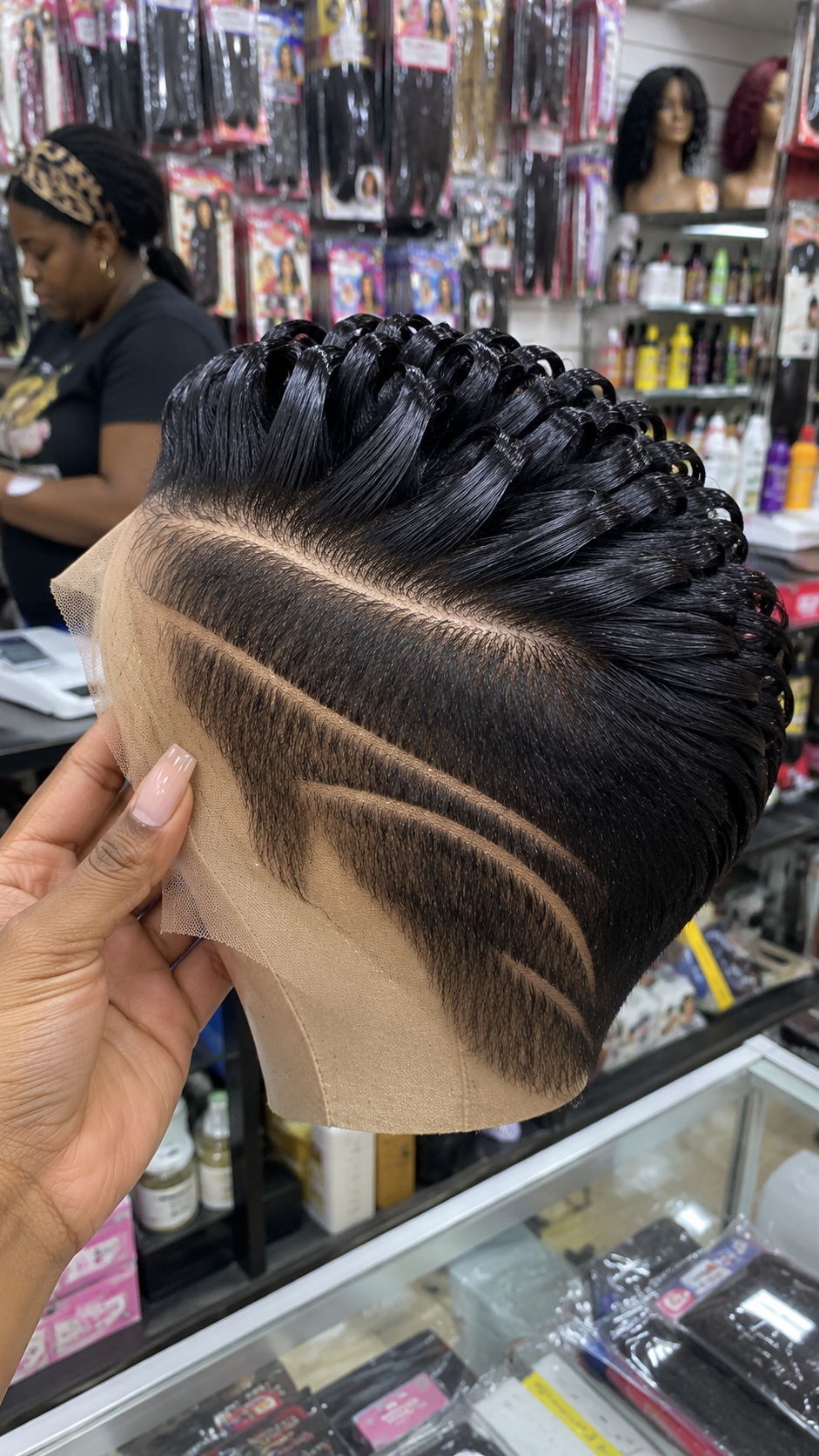
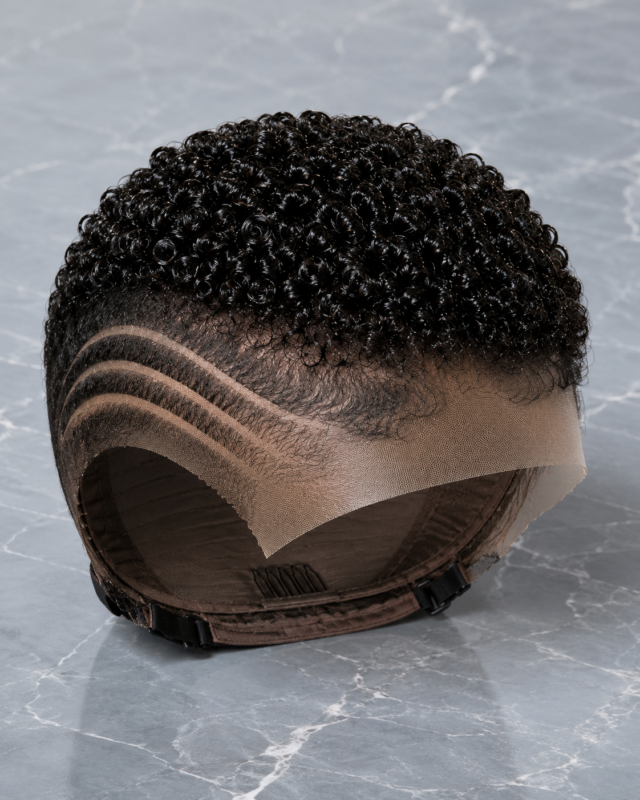
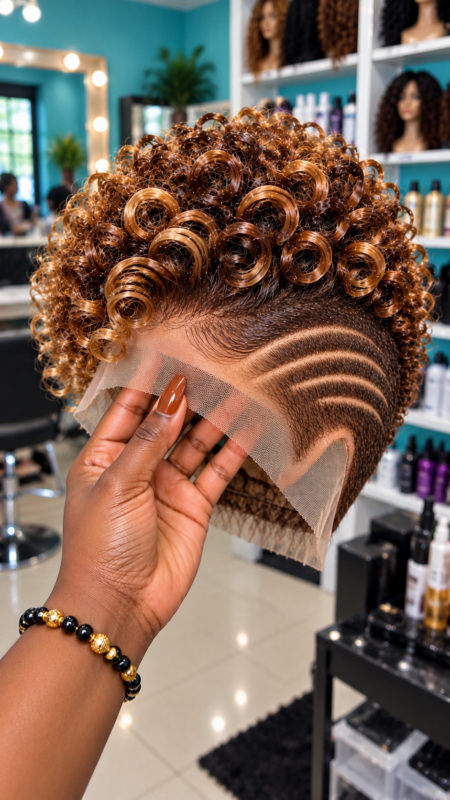
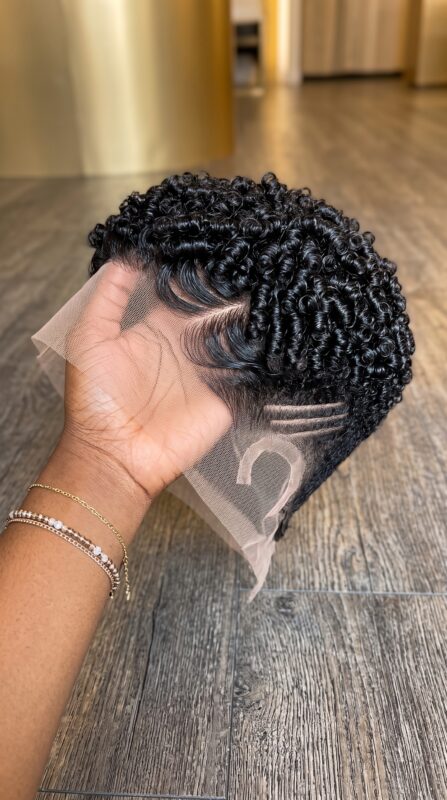
There is a particular kind of precision that separates a sculpted pixie wig from an ordinary cropped hairstyle. It becomes apparent when the hair is viewed from the side: the upper strands move in one coordinated direction, the lower hair follows the contour of the head, and narrow exposed channels create distinct boundaries between those areas. This jet black lace wig demonstrates that approach through an elevated arrangement of elongated ribbon loops and a striking pair of diagonal side separations.
The photograph captures the wig inside a beauty supply store, supported by one hand with the lace and lower side facing the camera. Unlike designs built around small circular ringlets, the upper hair is arranged in broader, elongated sections that rise from the front and sweep backward. Several strands bend into narrow loops along the upper ridge, while others continue into a closely layered pattern toward the visible rear.
The lower portion introduces a different visual language. Two long diagonal channels divide the dark side hair into distinct sections. The upper separation follows the boundary beneath the elevated hairstyle, while the lower channel runs across the side panel and curves downward toward the visible rear. The hair between these channels remains dark and closely arranged, creating a deliberate contrast with the more prominent upper styling.
Because the wig is photographed before installation, the beige lace is still visible around the front and lower side. The image does not establish the complete cap construction, fiber material, or finished fit. However, it provides enough detail to guide a careful discussion with a wig maker about the hairstyle’s proportions, parting placement, and preparation requirements.
A Different Approach to the Classic Black Pixie Silhouette
Many black pixie wigs rely on loose curls, compact finger coils, or a relatively flat brushed arrangement. This design takes a different approach by lifting the upper strands into elongated sculpted sections.
Near the front of the crown, several broad bands of hair rise almost vertically before bending backward. Their reflective surfaces make the direction of the strands particularly noticeable. The arrangement continues toward the visible rear, where the elevated sections gradually become more closely layered.
Some upper strands form open loops, but these openings are longer and narrower than the circular rings commonly seen in spiral-coil wigs. Other sections resemble folded ribbons, with the hair traveling in a continuous curve before returning toward the foundation.
This difference matters when shopping. A product advertised simply as a black curly pixie may contain tightly wound curls or loose spirals that look nothing like the reference. A more useful description emphasizes swept ribbon loops, an elevated upper ridge, and closely directed side hair.
The overall hairstyle remains compact despite the height created by the raised strands. The visible hair does not extend into long hanging sections, and the upper volume is concentrated near the head rather than expanding outward excessively.
How the Upper Sections Create Movement Without Excessive Volume
The hairstyle gains visual movement through changes in strand direction rather than through additional length. The front sections rise prominently, while neighboring strands bend backward and overlap the next section.
This arrangement creates a sequence of raised ridges across the crown. The openings between some of the loops reveal darker recessed areas, giving the upper hair depth even though it uses one dominant color.
A custom wig maker should reproduce the relative height and direction of these sections instead of increasing the amount of hair indiscriminately. Too much density could obscure the loop openings and produce a bulky upper surface.
Similarly, reducing the height excessively could make the hairstyle appear like an ordinary brushed-back pixie. The raised front and backward progression are central to its identity.
For a custom order, request photographs from the side and slightly above the crown. These views can reveal whether the elongated loops maintain their intended proportions.
The Two Diagonal Channels Are More Important Than Decorative Razor Artwork
The side design contains two prominent exposed channels, but their arrangement differs from conventional parallel barber stripes.
The upper channel begins near the front of the visible side and travels diagonally backward beneath the elevated crown. It separates the upper styling from a substantial dark side section.
The lower channel follows a related diagonal direction farther down the side. It begins near the front and gradually curves downward as it approaches the rear-facing portion of the wig.
The dark hair between these channels creates a broad, tapered band. This band is not simply empty space between decorative lines; it is a substantial part of the hairstyle’s side structure.
Below the lower channel, another closely arranged section of dark hair remains visible. Its strands follow the contour of the wig and become narrower toward the lower rear edge.
The result is a layered side profile composed of an elevated upper hairstyle, a central dark band, and a lower tapered section. The exposed channels establish the boundaries between them.
Why the Channels Should Not Be Made Wider
In a photograph, exposed partings can appear more dramatic because the lighter foundation contrasts strongly with black hair. A stylist attempting to exaggerate that effect by widening the channels may unintentionally change the proportions.
The reference shows relatively narrow separations compared with the surrounding dark sections. The central band retains considerable hair coverage, and the lower panel remains visible beneath the second channel.
Removing additional hair could reduce the width of those sections and expose more of the lace foundation than intended.
When ordering, ask the wig maker to preserve the relationship between the channels and the dark hair rather than specifying an arbitrary line width.
If the design requires additional cutting after delivery, the stylist should evaluate the existing hair density before making any permanent changes.
The Side Hair Is Arranged in Three Distinct Directions
A close examination reveals that the dark strands do not all follow the same path.
The upper hair rises and bends backward into ribbon-like formations. The central side section lies closer to the foundation, with strands directed diagonally toward the rear. The lower section follows a downward-sloping path beneath the second channel.
These changes in direction are responsible for much of the hairstyle’s visual structure. Without them, the exposed lines might appear as isolated decorative cuts rather than part of a coordinated design.
The central band is particularly important because its dark hair creates a strong visual separation between the elevated crown and the lower side.
For a custom reproduction, the stylist should pay attention to the direction of the strands surrounding each channel. A correctly placed line can still look inaccurate if the adjacent hair is arranged differently.
Maintaining the Lower Tapered Section
The lower side contains fine dark strands that appear closely arranged over the foundation. The hair becomes narrower toward the visible rear edge, producing a tapered appearance.
This area should not be mistaken for completely bare skin. The photograph shows dark hair coverage, although the exact cutting technique and hair density cannot be established with certainty.
A barber working on a similar wig should avoid removing unnecessary hair from the lower section. Excessive cutting could expose the cap or eliminate the narrow tapered shape.
The intended result should retain visible dark strands beneath the lower channel, with the hair following the contour of the wig.
Why Jet Black Works Particularly Well With Ribbon Styling
The hair appears predominantly jet black, with glossy reflections along the raised sections. Under the store lighting, some strands show charcoal-gray highlights, but the photograph does not establish a deliberate second hair color.
The reflective appearance is especially noticeable on the upper ribbon loops, where broad surfaces catch the light. The recessed areas between those loops appear considerably darker.
This contrast makes the sculpted arrangement visible without requiring blonde, silver, or copper highlights.
The lower side appears less reflective because the strands lie closer to the foundation and are viewed from a different angle. That difference reinforces the contrast between the elevated upper hair and the closely arranged side sections.
A buyer requesting this appearance should prioritize a consistent deep black color rather than introducing additional highlights that could change the design.
Evaluating Shine Without Assuming the Material
The glossy surface may resemble carefully styled human hair, but appearance alone cannot confirm the fiber. Synthetic hair and blends can also produce strong reflections under indoor lighting.
Ask the seller to identify the material and provide information about its styling limitations.
If the wig is made from synthetic fiber, heat compatibility should be confirmed before attempting to reshape the ribbon loops. If it contains human hair, previous processing and the products used to create the style may still affect how it responds to heat or washing.
Do not assume that the shine indicates a particular quality grade, coating, or styling product. Those details require reliable information from the supplier.
The Untrimmed Lace Shows the Wig Before Final Fitting
The photograph shows a broad beige lace area extending beyond the front and lower side hairline. The mesh remains untrimmed, indicating that the wig has not yet been customized for an individual wearer.
Fine dark strands are visible near the upper edge of the lace, particularly where the raised crown transitions into the side panel.
The lace extends beneath the lower tapered section, creating a visible area of mesh around the side. Its apparent beige color is influenced by the store lighting and the background beneath it.
The photograph does not establish the exact lace grade or manufacturing specification. It should not automatically be described as HD lace.
Only a limited portion of the interior is visible from this angle. The complete cap construction, attachment hardware, and adjustment system cannot be confirmed.
Fitting the Wig Without Disturbing the Side Geometry
Cap fit is particularly important for a hairstyle with long diagonal channels. If the wig sits too far forward or backward, the separations may appear at unintended angles relative to the wearer’s face.
Before installation, the stylist should verify the cap circumference, front-to-back length, and ear-to-ear measurements.
The wig should then be positioned correctly so that the upper ridge and side channels sit in their intended locations.
Only after confirming the fit should the excess lace be trimmed. Cutting too close to the hairline or lower side sections could damage the existing design.
Ask the seller for a complete underside photograph showing any combs, clips, straps, or adjustable bands. The presence of lace alone does not establish whether the wig can be worn without adhesive.
Finding a Wig Maker Experienced With Directional Ribbon Loops
This hairstyle requires a different skill set from conventional curly pixie styling. The upper hair must be arranged into elongated loops, while the side sections require accurate parting placement and controlled strand direction.
When contacting a wig maker, describe the desired unit as a jet black swept-ribbon pixie lace wig with two diagonal side channels and a tapered lower section.
Send the original photograph and identify the features that must remain consistent: elevated front loops, backward hair movement, narrow exposed channels, and dark hair coverage between the separations.
Ask whether the maker has experience with sculpted ribbon styling rather than only loose curls or ordinary finger coils.
Examples of previous completed work can help establish whether the stylist understands how to create elongated loops without excessive volume.
Where to Search and What to Verify
Online wig marketplaces, specialist lace wig boutiques, independent wig makers, and local beauty supply stores are possible places to begin searching.
However, a product listing that shows a similar hairstyle does not guarantee that the delivered unit will match the reference.
Request photographs of the exact wig or examples of comparable completed custom orders. A side view is particularly important because the two diagonal channels are central to the design.
Ask whether the unit arrives fully styled or requires additional professional work. Some suppliers may provide a base wig with the correct hair length but leave the ribbon arrangement or side detailing to a local stylist.
Confirm the fiber material, cap measurements, lace specifications, and attachment method before paying.
Planning a Salon Appointment Around the Existing Structure
The most useful salon appointment begins with an inspection rather than immediate restyling.
The stylist should compare the delivered wig with the reference photograph, paying attention to the height of the upper loops and the direction of the side hair.
Next, the cap should be fitted to the intended wearer. The diagonal channels should be evaluated at the final wearing position before any cutting is considered.
If the upper ribbon loops have shifted during shipping, a specialist may need to restore their arrangement. The appropriate method will depend on the confirmed fiber and original styling technique.
Ask whether the appointment includes lace trimming, hairline customization, loop adjustments, and any necessary barber work.
These services may be charged separately, so an itemized quotation is useful before booking.
Illustrative Purchase Budgets for a Black Ribbon Pixie Lace Wig
The following USD amounts are illustrative planning ranges, not verified live prices for the photographed wig. Actual quotations may vary according to supplier, location, hair material, cap construction, styling complexity, and included services.
| Wig Category |
Illustrative USD Range |
Potential Cost Considerations |
| Premium Custom |
$320–$800+ |
Individual cap construction, elongated ribbon styling, precision diagonal channels, and possible personalized fitting |
| Standard Custom |
$175–$420 |
Customized upper loop arrangement, selected cap options, directional side styling, and specified parting placement |
| Basic Human Hair |
$90–$250 |
Base human-hair unit with potential additional charges for sculpted styling and side detailing |
| Premium Synthetic |
$60–$185 |
Pre-styled ribbon loops, cap specifications, and fiber-dependent maintenance limitations |
| Basic Synthetic |
$25–$100 |
General black pixie resemblance, simpler construction, and potentially less accurate ribbon or side details |
These categories represent possible purchasing alternatives. The photograph does not establish whether the wig contains human hair, synthetic fiber, or a blend.
Because the hairstyle uses one dominant black color, the main cost consideration may be the labor involved in arranging the elongated loops and creating the diagonal side channels.
A basic black pixie wig may be relatively straightforward to purchase, but reproducing the raised ribbon structure and layered side sections can require additional professional work.
Cap customization, lace fitting, installation, shipping, taxes, and barber services may not be included in the advertised price.
Ask for an itemized quotation that identifies the base wig cost and any separate styling or installation charges.
Maintaining the Ribbon Loops Without Flattening the Crown
The upper hairstyle depends on keeping the elongated loops in their intended positions. Aggressive brushing or repeated pulling could separate the strands and reduce the height of the raised sections.
Before washing or restyling, ask the supplier how the loops were created and which products are compatible with the actual fiber.
Synthetic hair may have restrictions involving heat and certain styling products. Human hair may permit different treatments, but its processing history and the original styling method still matter.
Do not attempt to restore flattened loops using high heat until the material and its temperature limitations have been confirmed.
Heavy product buildup may also cause neighboring strands to stick together, reducing the visibility of the individual ribbon formations.
Protecting the Diagonal Channels During Everyday Handling
The side design should be handled carefully because its appearance depends on the spacing between the exposed channels and the dark hair sections.
If nearby strands begin covering the separations, a stylist should first assess whether repositioning can restore their visibility.
Repeatedly widening the channels through cutting may permanently alter the design or expose excessive foundation material.
When storing the wig, use an appropriately sized support that does not compress the upper loops or stretch the cap.
Avoid folding the lace sharply across the lower side, as this could place unnecessary stress on the mesh and nearby hair.
What a Finished Reproduction Should Preserve
A successful custom version should be evaluated through the relationship between the upper and lower sections rather than through the overall silhouette alone.
The crown should contain elongated, glossy black ribbon loops that rise from the front and sweep backward. The loops should remain recognizable without creating excessive height or fullness.
The side should contain two long diagonal channels separated by a substantial dark band. The lower section should retain visible hair coverage and follow a tapered path toward the rear.
The color should remain predominantly deep black, with any lighter reflections arising naturally from the hair surface and lighting unless the buyer specifically requests additional coloring.
Finally, the cap measurements, lace specifications, and attachment method should be confirmed before permanent trimming or installation.
The defining quality of this wig is its directional construction. Raised ribbon loops create movement above, while the diagonal channels organize the darker side into distinct layers. Preserving that relationship produces a more faithful result than adding extra curls, decorative stripes, or unnecessary volume. For buyers seeking a precision-styled black pixie lace wig, this design offers a strong example of how controlled hair direction can become the central element of a hairstyle.
Search Terms
jet black swept ribbon pixie wig · elongated loop crown lace hairpiece · two diagonal side channels black wig · layered dark side parting pixie · glossy black backward ribbon curls · tapered lower side lace wig · beige untrimmed lace black pixie · sculpted black upper ridge with diagonal lines