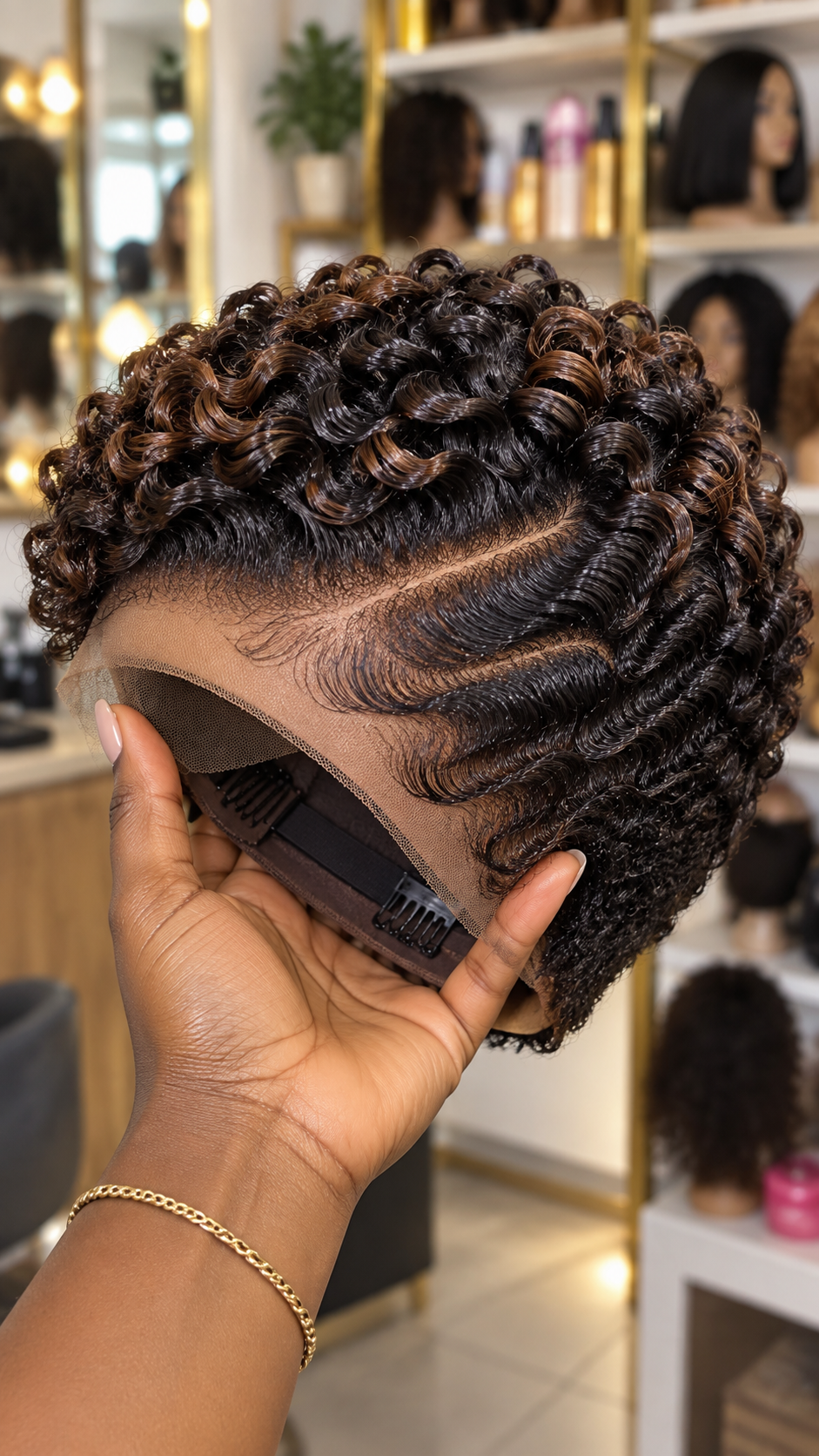
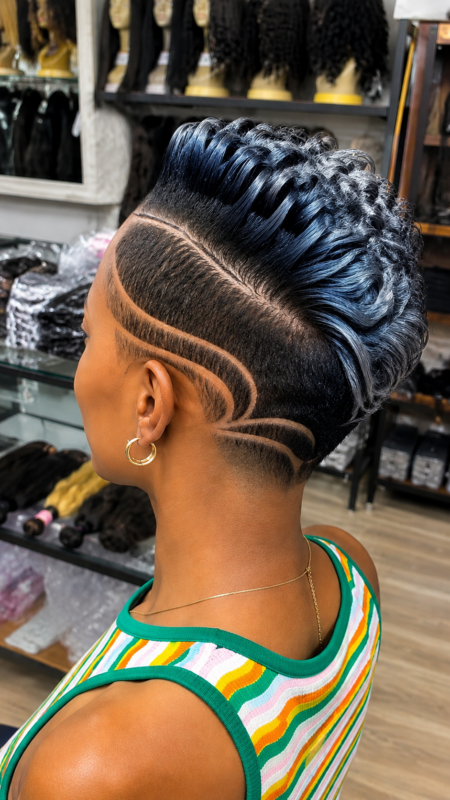
For anyone comparing sculpted pixie wigs, the most revealing detail in this photograph is the way the side hair rises into a sequence of glossy, dimensional wave ridges. Rather than relying on a shaved-looking pattern or sharply carved temple artwork, this design creates its decorative effect by arranging the hair itself into raised, overlapping curves. Above those waves sits a compact collection of espresso-brown curls accented with warm caramel reflections.
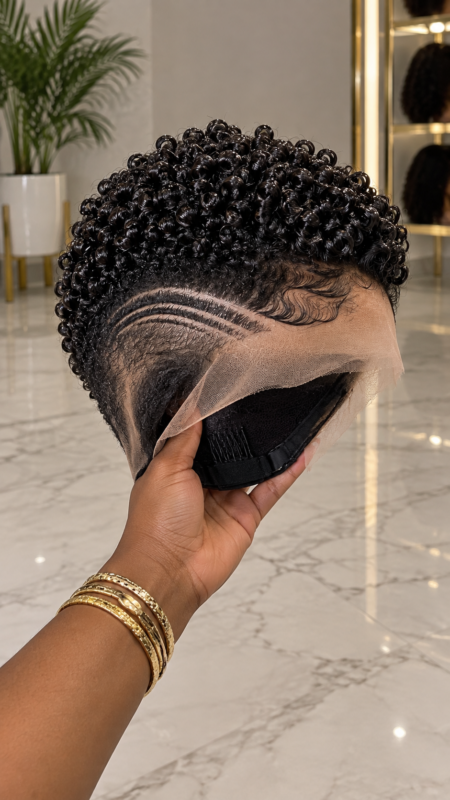
The wig is photographed before installation inside a hair salon, supported by one hand with its front lace and part of the interior cap exposed. Its upper section contains numerous compact spiral formations, ranging from small open loops to broader curls that bend backward. The coloring is predominantly deep espresso brown, with warmer chestnut and caramel tones visible across selected curls. Beneath the crown, a diagonal parting separates the upper hair from a series of closely arranged finger-wave sections that descend toward the temple and lower side.
This hairstyle offers a different interpretation of the curly pixie. Its most distinctive quality is not simply the number of curls or the contrast between dark and light strands. The defining characteristic is the progression from compact upper coils into increasingly prominent, sculpted wave ridges along the side. That relationship should guide anyone hoping to purchase, commission, or recreate a similar wig.
The Side Waves Deserve Attention Before the Curls
Many buyers begin evaluating a curly wig by looking at the crown. In this case, the side construction provides equally important information about the hairstyle’s character and the level of styling skill involved.
The visible temple contains several glossy wave formations arranged in descending layers. The upper wave begins beneath a diagonal exposed parting and curves toward the rearward portion of the side. Below it, additional ridges follow related paths, creating a cascading effect.
These waves are not flat decorative stripes. Their surfaces appear slightly elevated, with closely aligned strands producing noticeable ridges and reflections. The wave sections overlap visually, making the side appear sculpted rather than merely combed into place.
Near the lower temple, the arrangement transitions into smaller curved formations before reaching the darker, more compact hair beneath.
The result is a side profile that contains movement even though the hair remains relatively close to the cap. The upper curls provide height, while the finger-wave ridges create a second form of dimension along the side.
Separating a Wave Ridge From an Exposed Parting
The photograph shows a diagonal exposed channel between the crown and the first major wave section. This channel is visibly lighter than the surrounding hair and helps establish the boundary between the two styling areas.
Below that separation, much of the decorative pattern comes from the arrangement of the hair rather than from additional exposed channels.
This distinction matters when describing the hairstyle to a stylist. Asking for several shaved-looking side lines would introduce a different design. The reference instead emphasizes raised finger-wave ridges and carefully controlled strand direction.
A wig maker should study how each wave curves into the next and how the lower sections become progressively smaller.
Espresso Roots and Caramel Reflections Across the Crown
The upper hair displays a predominantly dark espresso-brown color. In the deepest areas, the strands approach black, particularly between the overlapping curls and near the roots.
Warm caramel and chestnut reflections appear across selected upper curls, creating subtle contrast without transforming the hairstyle into a predominantly blonde or copper-colored wig.
Some of the lighter strands are concentrated near the curved outer surfaces of the curls, where the salon lighting makes them especially visible. Other sections retain a darker brown appearance.
The photograph does not establish the exact coloring process or commercial shade numbers. The lighter areas may represent actual color variation, lighting reflections, or a combination of both.
For a custom order, a useful description would be deep espresso brown with restrained caramel-brown accents concentrated through the upper curls.
Why the Dark Base Is Essential
The dark foundation provides contrast between the individual curl formations and gives the side waves a strong reflective appearance.
If the entire wig were colored a lighter caramel shade, the relationship between the upper curls and lower wave ridges would look different.
The deeper color also emphasizes the diagonal parting because the exposed channel appears noticeably lighter than the surrounding hair.
Customers should therefore confirm whether the proposed wig will retain a predominantly espresso-brown foundation rather than an evenly distributed light-brown color.
Actual color samples or photographs taken under ordinary lighting are more useful than relying exclusively on commercial color names.
Compact Coils With an Irregular Circular Arrangement
The crown contains numerous small and medium curls arranged closely together. Some form visible circular openings, while others resemble overlapping spiral ribbons or compact coils.
The curls vary in orientation. Several face outward, revealing dark centers, while others bend backward or overlap neighboring sections.
This variation creates a rounded but not perfectly uniform crown. The upper hair appears full without extending into an excessively tall silhouette.
The front edge contains smaller curls that approach the hairline, while the central area includes broader loops with more noticeable openings.
The arrangement differs from a conventional loose curly pixie because the curls appear deliberately positioned rather than simply allowed to fall naturally.
Matching the Crown’s Proportions
A custom stylist should consider the size and placement of the curls before recommending additional density.
Excessive hair could make the crown appear bulky and conceal the individual coil shapes. Insufficient hair might leave visible gaps between the curls.
The reference shows a compact upper arrangement with enough separation for the curls to remain individually recognizable.
The exact setting method cannot be determined from the photograph. Buyers should ask whether the proposed material can support the desired coil arrangement and how the curls will behave after washing.
A rear photograph would also help establish how the curls continue around the back of the wig.
The Diagonal Parting Establishes the Styling Boundary
A visible diagonal channel separates the compact crown from the first prominent finger-wave section. Its path travels across the upper side, following a gentle curve rather than a perfectly straight line.
The exposed foundation appears beige against the surrounding dark strands. This creates a clear boundary between the elevated curls and the flatter side arrangement.
Hair immediately above the parting rises into the upper coils. Hair below it follows a more controlled directional pattern, curving toward the temple.
The channel therefore serves a structural visual purpose. It helps organize the hairstyle into two distinct areas without making them appear disconnected.
The photograph does not establish the precise technique used to create the parting. Because this is a wig, it should not automatically be described as a shaved line on natural skin.
Positioning the Parting on the Wearer’s Head
The final appearance of the diagonal separation will depend partly on how the wig fits.
If the cap sits too far forward or backward, the parting may appear to occupy a different position relative to the temple.
A custom maker should consider the customer’s head measurements and preferred side orientation before completing the styling.
The customer should specify whether the decorative waves are intended for the left or right side when worn.
Any permanent alteration to the parting or surrounding hair should be planned carefully because it could change the relationship between the crown and temple.
Examining the Lace and Interior Construction
The wig is displayed with beige lace extending beyond the visible front hairline. The mesh remains untrimmed, allowing the viewer to distinguish the hairline from the surrounding material.
Part of the interior cap is visible beneath the lace. The cap appears dark brown, with stitched fabric sections and several visible attachment combs.
An elastic adjustment section can also be seen inside the unit. These components provide useful information about the wig’s construction, although the complete interior is not shown.
The photograph does not establish the exact lace grade, cap dimensions, or complete attachment system.
It would be inaccurate to identify the lace as HD lace solely from its appearance. The seller should confirm any specialized lace classification.
What the Visible Combs Mean for Fitting
Interior combs may assist with positioning and retention, depending on the cap design and the wearer’s needs.
However, their presence does not prove that the wig is suitable for adhesive-free wear in every situation.
Before purchasing, ask the seller for the cap circumference, front-to-nape measurement, ear-to-ear width, and a complete underside photograph.
The appropriate installation method should be determined after evaluating the actual cap and the wearer’s head shape.
The lace should remain untrimmed until the fitting position has been established.
Finding a Stylist Who Can Build Raised Finger Waves
This hairstyle requires more than ordinary curl setting. The lower side contains several sculpted wave ridges that must remain aligned and visually distinct.
Look for wig makers or specialist salons with experience in finger-wave styling, sculpted pixie wigs, and lace-front customization.
Portfolios showing close-up side photographs are particularly useful because they reveal whether the stylist can control the shape and spacing of individual waves.
When contacting a potential maker, send the reference photograph and explain that the side should contain layered finger-wave ridges rather than carved-looking geometric lines.
The stylist should also understand the desired compact crown and restrained caramel accents.
Questions to Ask During the Consultation
Confirm whether the maker can reproduce the diagonal parting and the descending wave arrangement.
Ask whether the wig will arrive fully styled or require additional work at a local salon.
Discuss the proposed hair material, cap construction, lace dimensions, and preferred side orientation.
Request photographs of previous work involving sculpted waves and compact curls.
The seller should provide a written quotation explaining which styling and installation services are included.
Choosing Between a Prepared Wig and a Custom Commission
A ready-made espresso-brown curly pixie may offer a similar color and general silhouette. However, the layered finger-wave side makes this reference more specialized.
Ready-made options may be suitable for customers who are flexible about the exact wave arrangement.
A custom order becomes more appropriate when the descending ridges and diagonal parting are essential.
Before purchasing a base wig for later styling, ask whether its hair length, density, and cap construction can support the intended wave pattern.
Some units may require extensive corrective work, increasing the final cost.
The most economical option is the one that provides the required appearance without unnecessary reconstruction.
Illustrative Pricing for Espresso Brown Sculpted Pixie Wigs
The potential cost of this hairstyle depends on the selected hair material, cap construction, compact coil styling, caramel color placement, and labor involved in creating the layered finger-wave ridges.
The following USD amounts are illustrative planning ranges only. They are not verified live retail prices or quotations for the photographed wig.
| Wig Category |
Illustrative USD Range |
Possible Cost Considerations |
| Premium Custom |
$355–$820+ |
Individual coil placement, layered finger-wave construction, custom cap fitting, and selective caramel color work. |
| Standard Custom |
$180–$415 |
Compact espresso curls and sculpted side waves on a suitable prepared wig foundation. |
| Basic Human Hair |
$100–$260 |
A possible starting unit requiring additional curl setting, wave styling, and color adjustment. |
| Premium Synthetic |
$70–$190 |
May offer a pre-styled dark brown curly alternative if the fiber and construction support the sculpted arrangement. |
| Basic Synthetic |
$25–$95 |
A lower-budget option for a similar dark curly silhouette, potentially without the layered finger-wave detail. |
The photograph does not establish whether the displayed wig contains human hair, synthetic fiber, or a blend. These categories describe possible purchasing routes rather than verified properties of the product.
Additional charges may include lace trimming, cap adjustment, professional installation, shipping, and future styling restoration.
When comparing quotations, ask whether the sculpted side waves are included in the price. A generic curly wig should not be compared directly with a fully customized unit.
Maintaining the Layered Wave Ridges
The lower side is likely to require careful handling because the wave ridges depend on the strands remaining aligned.
Repeated brushing or rubbing across the waves could disturb their shape and reduce the visible separation between neighboring sections.
A stylist should explain how to refresh the wave arrangement without flattening the ridges.
Customers should avoid adding excessive styling products merely to imitate the glossy appearance in the photograph.
Product buildup could affect the alignment of the strands and make the wave pattern harder to maintain.
Preserving the Compact Upper Coils
The crown requires a different maintenance approach from the lower side. Its small circular curls should remain individually recognizable.
Pulling the coils apart may increase apparent volume but reduce the compact silhouette.
If the wig contains human hair, cleansing should account for any coloring and setting products used during preparation.
If synthetic fiber is used, follow the manufacturer’s instructions and confirm heat tolerance before attempting to restyle the curls.
The maker should explain whether the coils can be refreshed at home or whether professional restyling is recommended after washing.
Inspecting the Wig Before Installation
When the unit arrives, compare the espresso-brown foundation and caramel accents with the approved reference.
Examine the upper coils to determine whether their size and arrangement match the intended compact silhouette.
Next, inspect the diagonal parting and layered finger-wave ridges. The waves should remain distinct and follow the agreed directional pattern.
Check the lace, interior combs, and visible stitching for damage before fitting.
If the wig was custom-made, any significant differences should be discussed with the seller before permanent trimming or restyling.
Who Might Prefer This Espresso Pixie?
This hairstyle may appeal to customers who enjoy sculpted curls but prefer a darker, more restrained color arrangement.
The espresso foundation provides depth, while the caramel reflections introduce warmth without dominating the hairstyle.
The layered finger waves create a distinctive side profile that can work well for celebrations, portrait photography, fashion events, or personal everyday styling.
The dark brown coloring can coordinate with cream, beige, black, chocolate, and other complementary clothing tones.
For frequent wear, the buyer should consider the maintenance required to preserve both the compact coils and the raised side waves.
The Value Lies in the Wave Construction
This wig demonstrates how a compact curly pixie can gain a distinctive identity through the careful arrangement of its lower side.
The espresso-brown coils provide a rounded upper silhouette, while caramel reflections add subtle color variation. Beneath them, the diagonal parting introduces a series of raised finger-wave ridges that create movement without relying on elaborate carved-looking artwork.
The exposed beige lace and visible interior hardware also make proper fitting and construction verification important before installation.
For buyers seeking a faithful reproduction, the priority should be a wig maker who understands the relationship between compact coils, directional parting, and layered finger-wave styling.
When those elements are reproduced accurately, the result captures the distinctive character of this espresso-toned sculpted lace pixie.
Search Terms
Espresso brown sculpted finger wave wig · Caramel tipped compact pixie coils · Layered raised temple wave lace wig · Dark chocolate spiral crown hairstyle · Diagonal side part espresso pixie · Beige lace dark brown curly wig · Glossy cascading finger wave ridges · Espresso black curls with caramel accents