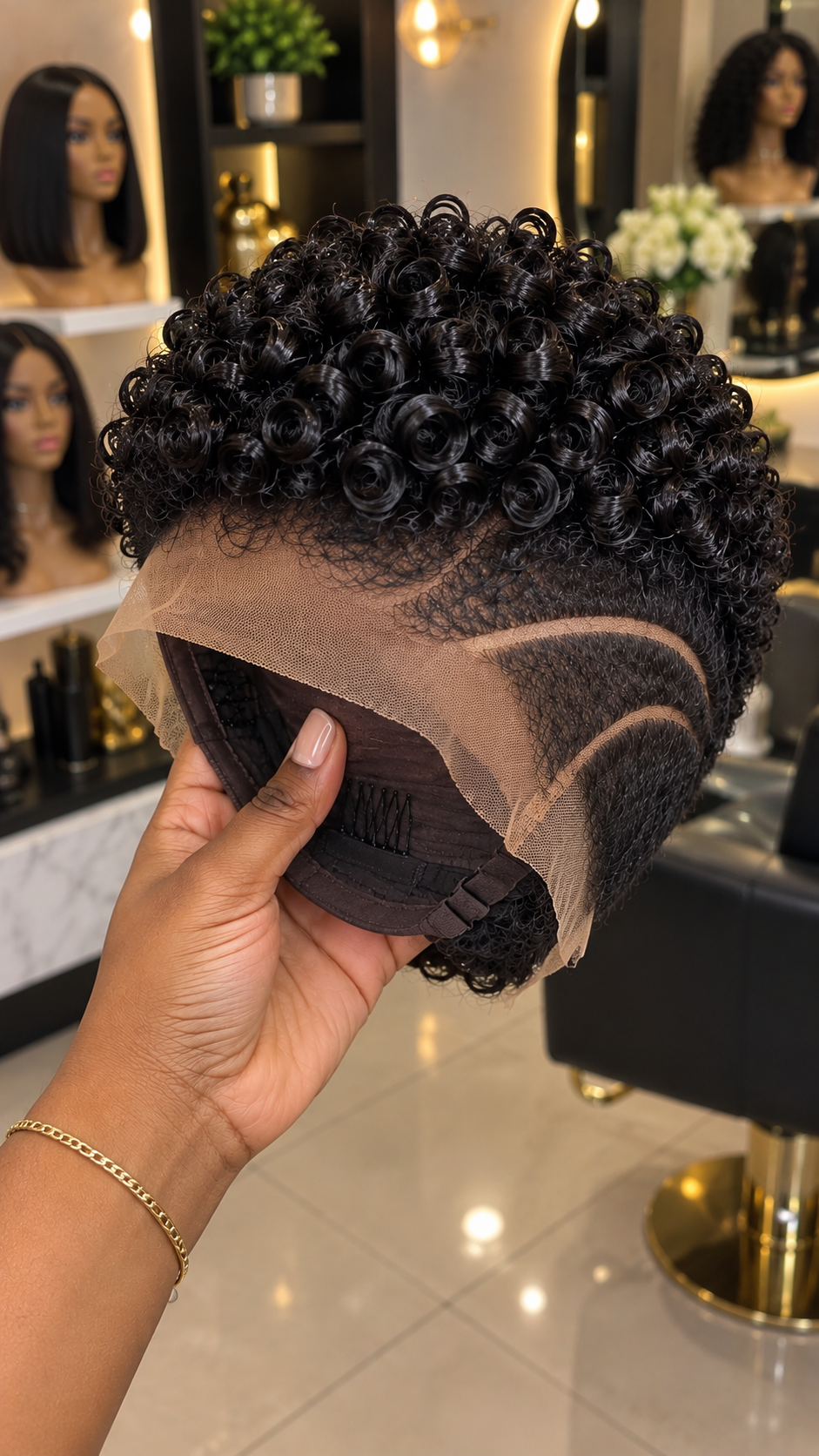
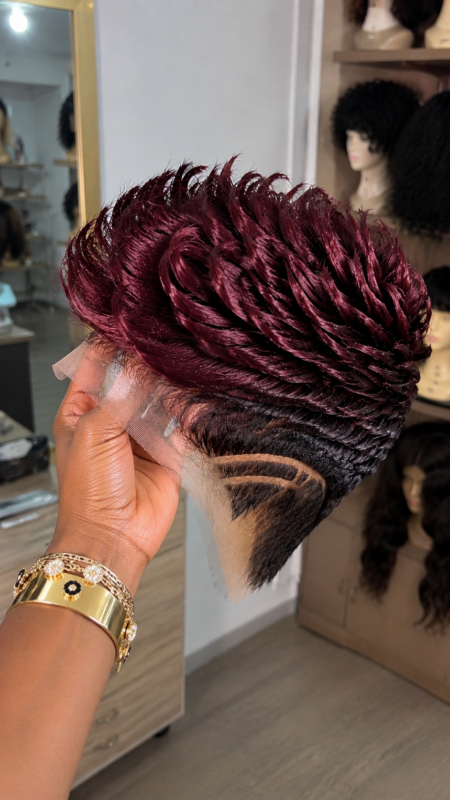
Two carefully positioned curves can completely change the character of a curly pixie wig. In this photograph, a dense arrangement of glossy raven-black circular coils rises above a closely fitted temple, where two sweeping exposed channels create a distinctive layered pattern. The contrast is not created through different hair colors. Instead, the design relies on the relationship between raised ringlets, compact side hair, and the pale curved separations that remain visible beneath the dark strands.
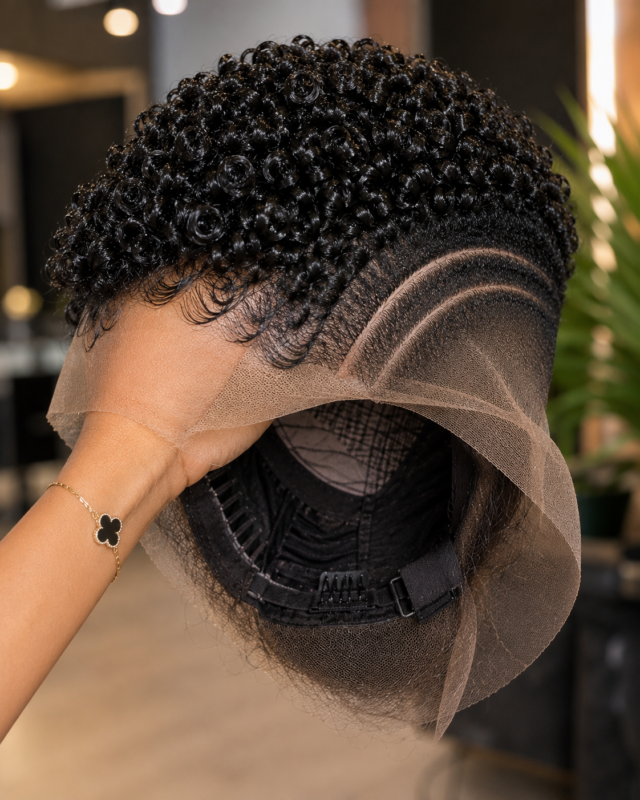
The wig is being held in one hand inside a salon environment, allowing the viewer to examine its construction before installation. A broad section of beige lace extends beyond the front hairline and continues around the visible temple. Beneath the opening, a dark brown cap, stitched construction, and a black adjustment strap can be seen. These practical details make the photograph useful for buyers who want to understand what they are purchasing rather than judging the hairstyle solely by its appearance on a mannequin.
The upper hair contains numerous compact circular formations, many with visible hollow centers. Some loops face outward, while others overlap or turn at slight angles. The crown appears rounded and relatively full, but the volume remains concentrated above the closely fitted side. Unlike a wig with long hanging spirals, this hairstyle creates its shape through tightly coordinated circular coils arranged near the head.
For a customer considering this design, the most important purchasing decisions involve the diameter of the circular coils, the placement of the two curved temple channels, the cap fit, and the amount of finishing required around the lace perimeter. Understanding these details before ordering can help prevent expensive styling corrections later.
Begin With the Temple Curves When Comparing Similar Wigs
Many black curly pixie wigs appear similar when viewed only from the front. Their differences become much clearer when the side is examined. This particular design contains two prominent curved channels arranged one above the other along the visible temple.
The upper channel begins near the front-side area and follows a broad, gently descending arc toward the rearward visible section. Beneath it, a second channel curves around a smaller, closely fitted dark hair panel. The two paths are not identical, and their different curvature gives the side a layered appearance.
The hair between the channels is directed close to the foundation. Its compact placement contrasts with the raised circular coils above, helping the separations remain visually distinct.
Although the channels resemble carved barber designs, the photograph does not establish whether they were created by shaving, controlled parting, or another wig-construction technique. On a lace wig, an exposed separation may be formed through hair placement rather than cutting into an existing foundation.
This distinction is especially important for customers who intend to customize a ready-made unit. A barber experienced with natural hair may be able to create comparable curves on a person’s head, but the same technique should not automatically be applied to a wig cap.
Why the Lower Curve Should Remain Rounded
The lower channel forms a noticeable curved boundary around the compact temple section. Its shape contributes to the design by creating a smaller visual area beneath the broader upper separation.
If this lower curve were replaced with a straight diagonal line, the side would appear more angular. Adding extra channels could also change the intended appearance.
For a close reproduction, ask the wig maker to preserve the two visible curves without introducing unnecessary decorative patterns. Their relative spacing matters because the dark hair between them helps establish the layered effect.
The Crown Is Built Around Hollow Circular Coils
Above the temple, the hairstyle changes into a dense collection of rounded coils. The individual formations resemble compact rings, with many displaying hollow centers that remain visible despite the closely arranged hair.
Several larger loops occupy the central upper area, while smaller formations fill the spaces toward the sides. Some curls sit nearly upright, and others lean forward or backward. Their varied orientation gives the crown dimension without making the arrangement appear completely uniform.
The hair is predominantly raven black, with reflective charcoal tones appearing where salon lighting strikes the curved surfaces. These reflections should not be confused with silver or gray dye. No clear contrasting highlight color is visible.
The crown has a rounded silhouette rather than an elongated quiff. Its volume appears concentrated near the upper head, with the circular coils forming a compact but richly detailed surface.
A customer requesting this style should discuss the approximate coil diameter and overall crown height with the maker. Larger loops could create a more open arrangement, while smaller coils might produce a tighter appearance with less visible circular structure.
Understanding the Difference Between Ringlets and Ordinary Curls
Not every curly pixie wig will reproduce this crown. Loose spirals generally hang or fall outward, while the circular coils shown here are arranged into compact loops that sit closely together.
The visible openings are part of the hairstyle’s identity. If the loops collapse or are brushed apart, the upper section may lose its recognizable structure.
When reviewing a seller’s portfolio, look for examples of circular coil styling rather than relying only on photographs of ordinary curly wigs.
Ask for a close view from above. That angle can reveal whether the curls remain organized across the crown or whether the arrangement is concentrated only at the front.
Black Hair Makes the Styling Technique More Important
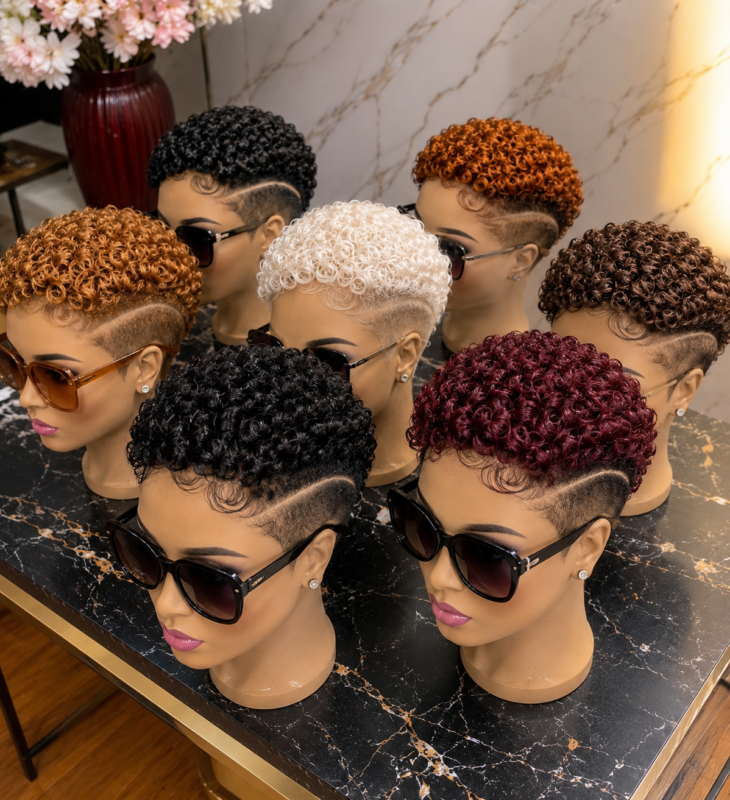
The photograph contains no obvious blonde, copper, burgundy, or silver accents. The hairstyle instead uses a predominantly deep black color that allows the circular formations and temple channels to become the main visual elements.
Light reflects along the outer surfaces of the coils, producing narrow bright areas against darker spaces inside the loops. This gives the crown depth even without multiple hair colors.
The lower side reflects light differently because its strands lie much closer to the foundation. The contrast between raised coils and compact side hair creates a noticeable change in surface appearance.
For buyers, this means the quality of the styling is particularly important. A dark wig with poorly arranged curls may appear less detailed than a carefully constructed unit, even if both use a similar black shade.
Request photographs under ordinary indoor lighting and natural daylight when possible. Very bright promotional lighting may exaggerate the reflective appearance, while dim photographs can conceal the individual coil formations.
The Front Hairline Is Less Elaborate Than the Temple
The front edge contains fine dark strands that transition from the circular crown toward the extended lace. These hairs create an irregular, natural-looking boundary beneath the raised curls.
Unlike wigs with large decorative finger waves extending across the entire forehead, the most prominent sculpted pattern in this photograph is concentrated along the visible temple.
The front hairline should therefore be evaluated separately from the side design. Adding exaggerated forehead waves could change the intended appearance.
During customization, the stylist should consider how the front strands will sit after the wig is positioned on the wearer. The photograph shows the unit off the head, so the exact hairline placement cannot be established for an individual customer.
The Extended Lace Indicates an Unfinished Installation Stage
A broad beige lace section projects beyond the front hairline and continues around the visible side. The mesh remains untrimmed, with its edges clearly extending beyond the styled hair.
This is an important purchasing detail because the wig will require fitting before the excess lace is removed. The appropriate trimming boundary depends on the wearer’s forehead shape, cap position, and intended installation method.
The photograph confirms the presence of lace but does not establish its commercial grade. It should not be described as HD lace without product-specific verification.
Ask the seller to identify the lace material, coverage area, and available lace colors. A close photograph against a neutral background can help buyers assess its appearance.
Trimming should be performed only after the wig has been positioned correctly. Removing too much lace may affect the hairline and reduce the material available for later adjustments.
Particular care is needed around the temple because the decorative curves extend relatively close to the lace perimeter.
The Visible Adjustment Strap Deserves a Closer Look
The photograph exposes part of the dark brown interior cap. A black adjustable fastening strap is visible near the lower opening, together with stitched fabric sections and internal construction.
This confirms that the photographed unit contains at least one visible adjustment component. However, the complete underside is not shown, so the full securing system cannot be established.
The image does not confirm the number of internal combs, the complete lace coverage, or whether additional elastic components are present elsewhere inside the cap.
Before purchasing, request a photograph showing the entire underside. Ask the seller to explain how the adjustment system works and what cap measurements are available.
A visible adjustment strap does not automatically establish that the wig can be worn securely without adhesive. Suitability for adhesive-free wear depends on the full construction and the wearer’s fit.
Measurements to Discuss With the Seller
For a custom cap, the maker may request head circumference, front-to-nape distance, ear-to-ear measurements, and other dimensions according to their construction method.
These measurements should be taken following the supplier’s instructions. Guessing a cap size based on an existing wig can lead to fitting problems if the manufacturers use different sizing systems.
A secure, comfortable fit is especially important for this hairstyle because shifting the cap may change the apparent position of the temple curves.
Finding a Specialist for Circular Coil Pixie Wigs
Customers seeking this design should look for wig makers who have experience with compact circular coils and carefully arranged temple patterns.
A general curly wig seller may offer units with similar length and color, but not necessarily the same coil structure or side geometry.
When contacting a stylist, send the reference photograph and explain that the desired hairstyle includes a rounded raven-black circular coil crown and two curved temple channels.
Ask whether the stylist can reproduce the visible side pattern without damaging the cap foundation. Examples of previous work involving sculpted pixie wigs are particularly useful.
Local wig salons may provide opportunities to inspect materials and discuss fit in person. Online custom makers may also accept reference-based orders, but their construction methods and previous work should be verified.
Questions That Help Separate a Suitable Wig From a Generic Alternative
Begin by asking whether the seller has the exact unit available or intends to produce a similar design. A photograph used for advertising does not guarantee that the pictured wig is currently in stock.
Request current photographs of the actual product from the front, visible side, opposite side, above, and rear.
The rear view is particularly important because the supplied photograph does not reveal how the circular coils continue around the back.
Ask for an underside photograph showing the cap, adjustment system, and any securing components.
Confirm the fiber composition, cap measurements, lace specifications, and whether styling adjustments are included in the purchase.
Before paying a deposit for custom production, establish the expected completion time, payment terms, shipping arrangements, and revision policy.
Choosing Between Ready-Made and Custom Production
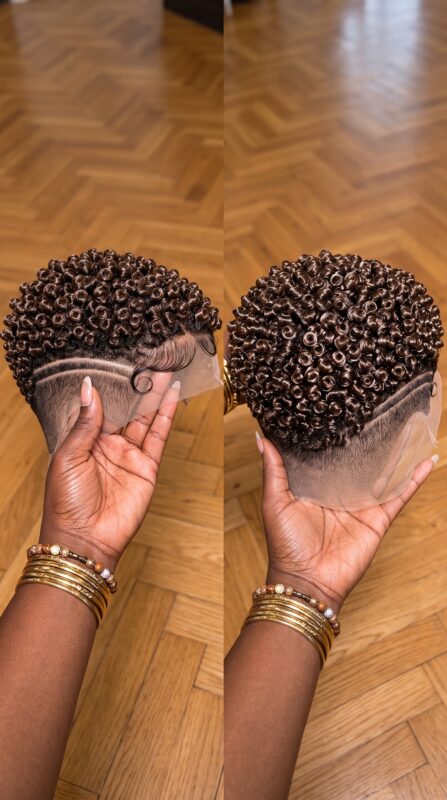
A ready-made black curly pixie may provide a faster purchasing option. However, the circular coil structure and twin temple curves may be difficult to match in a generic unit.
Some ready-made wigs contain loose spirals, spring-shaped curls, or uniformly distributed hair that does not form the same hollow circular openings.
The side pattern may also differ. A wig with three straight channels or a completely uncarved temple would not reproduce the photographed arrangement.
Custom production offers greater control over the coil diameter, crown density, temple geometry, and cap measurements.
However, a custom order may require additional labor and a longer production timeline. Buyers should establish which details are essential before deciding whether the additional cost is justified.
If considering restyling an existing wig, ask a qualified stylist to inspect the material and foundation first. Cutting or removing hair to create temple channels may be irreversible.
Illustrative Costs for Raven Black Circular Coil Wigs
The following USD ranges are illustrative planning estimates rather than verified current prices or quotations for the photographed wig. Actual costs depend on fiber composition, cap construction, styling complexity, seller location, and included services.
| Wig Category |
Illustrative USD Range |
Potential Purchase Scope |
| Premium Custom |
$285–$665+ |
Individual cap planning, detailed circular coil styling, twin temple channel construction, and personalized finishing. |
| Standard Custom |
$150–$335 |
Reference-based coil styling and curved side customization with fewer individualized construction options. |
| Basic Human Hair |
$85–$220 |
A human-hair pixie base that may require separate circular coil setting and temple styling. |
| Premium Synthetic |
$60–$155 |
A manufactured-fiber alternative with prearranged curls, depending on availability. |
| Basic Synthetic |
$25–$75 |
An entry-level black curly pixie option that may approximate the silhouette without reproducing the detailed coil and temple arrangement. |
These categories represent possible purchasing options. The photograph does not establish whether the displayed wig contains human hair, synthetic fibers, or a blend.
The most significant labor costs may arise from forming numerous circular coils and reproducing the two curved temple channels with appropriate spacing.
Ask whether the quotation includes the finished wig, lace trimming, installation, shipping, taxes, and future adjustments.
Comparing complete service packages is more useful than comparing base prices alone.
Preserving the Hollow Coil Structure During Wear
The crown requires careful handling because the circular openings are central to the hairstyle’s appearance. Aggressive brushing can separate the strands and cause the loops to lose their shape.
Before cleaning, ask the maker how the coils were formed and secured. The correct maintenance method depends on the fiber composition and any styling products used during construction.
Do not apply high heat until the material and permitted temperature range are confirmed. Some synthetic fibers cannot tolerate conventional heated tools, while human hair may also be damaged by excessive styling.
If individual coils begin to flatten, professional resetting may be preferable to repeated home attempts.
For storage, choose a support that maintains the cap shape without compressing the upper curls. Avoid placing heavy objects against the crown.
Keeping the Twin Temple Curves Distinct
The temple requires a different maintenance approach from the crown. Its appearance depends on the exposed channels remaining visible and the surrounding strands retaining their intended direction.
Repeated friction, rough combing, or pressure from tight headwear may disturb the styling.
When removing the wig, avoid pulling directly on the decorative side or delicate lace perimeter.
If the curves become less visible, consult a stylist before attempting to widen them. Cutting into the hair or foundation could permanently alter the design.
The objective is to preserve the original two-channel arrangement rather than introducing additional lines during maintenance.
Planning a Careful Installation Appointment
After receiving the wig, inspect the circular crown, temple geometry, lace perimeter, and visible cap construction before making permanent changes.
Book a stylist experienced in lace-front wigs and sculpted pixie hairstyles. Explain that the goal is to preserve the rounded raven-black coils and the two curved temple channels.
The stylist should first check the cap position and hairline placement. Once the wig sits appropriately, the excess lace can be trimmed according to the wearer’s needs.
Any additional styling should be conservative. Changing the coil diameter or introducing extra temple lines could produce a hairstyle noticeably different from the reference.
Before completing the appointment, inspect the wig from the front, side, and above. These angles help confirm that the circular coils remain proportional and the temple curves retain their intended arrangement.
Evaluating the Finished Black Pixie Design
The distinctive character of this wig comes from its carefully organized structure. The raven-black circular coils create a rounded upper silhouette, while the two sweeping temple channels introduce a controlled geometric detail beneath them.
The monochromatic coloring allows the styling itself to remain the primary attraction. Rather than depending on contrasting highlights, the hairstyle uses reflective surfaces, coil direction, and exposed separations to create dimension.
For buyers seeking a faithful reproduction, the priorities should be the compact hollow coils, the twin curved temple design, the closely fitted lower section, and appropriate lace and cap fitting.
A reliable supplier should be able to explain the construction, confirm the material, provide additional photographs, and clarify the services included in the purchase.
With those details established, this reference can guide the selection or commissioning of a distinctive raven-black circular coil pixie wig that preserves the relationship between its sculpted crown and carefully arranged temple curves.
Search Terms
Raven black hollow circular coil pixie wig · Twin curved temple channel lace wig · Black compact ringlet crown hairstyle · Beige untrimmed lace spiral pixie · Two sweeping side curves curly wig · Adjustable strap black coil lace wig · Rounded raven black ringlet pixie · Sculpted temple arc black crown wig