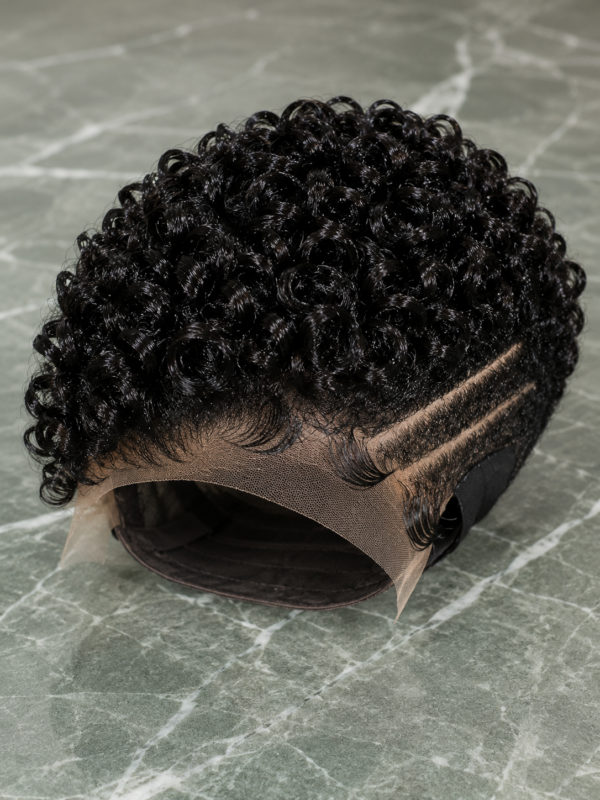
When shopping for a short curly pixie wig, most buyers immediately look at the curls, color, and overall shape. Those details matter, but there is another feature that can completely change how easy the wig is to install: the width and construction of the lace around the front perimeter.
On a short unit, the lace is especially important because there is very little long hair available to hide installation problems. The front, temples, and sides remain visible, so the construction underneath the hairstyle deserves just as much attention as the curls on top.
A well-designed lace area gives the buyer enough material to customize the hairline, position the wig correctly, and trim the excess according to the shape of the forehead and temples. If the lace area is too narrow or poorly constructed, customization becomes much more limited.
This is why buyers should inspect the actual lace before ordering rather than judging a short wig only from photographs of the finished hairstyle.
Where To Buy A Short Curly Pixie Wig With Good Lace Construction
Custom wig makers. A custom maker is one of the best options when lace placement is important. You can provide your head measurements and discuss exactly how much lace you want around the front and temple areas.
Local wig boutiques. Shopping locally gives you an opportunity to turn the wig inside out and examine the construction before paying. Check the lace, cap, elastic, combs, clips, stitching, and the way the short side sections are attached.
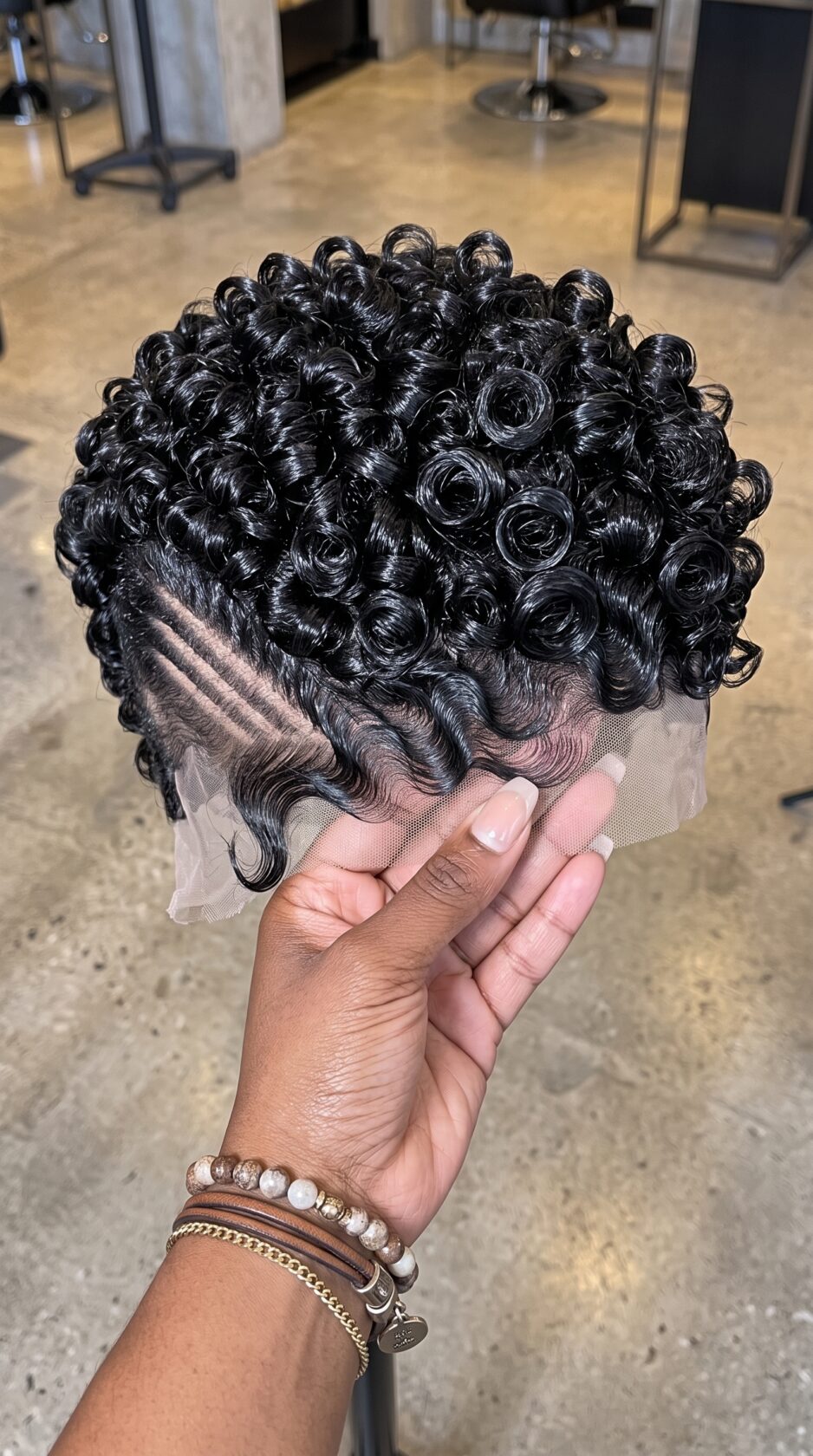
Instagram and TikTok wig sellers. Look for sellers who show their units before installation. Videos of wigs being held in the hand can reveal much more about lace width than photographs taken after the wig has already been fitted to a model.
Etsy wig makers. Independent sellers may provide options for cap measurements, lace type, density, curl pattern, color, and customized side details. Ask for photographs of the actual construction if the listing does not show it.
Online wig stores. Search for short curly pixie wigs, glueless pixie wigs, lace-front pixie wigs, and short human-hair curly wigs. Product descriptions should explain what type of lace and cap construction are included.
Online marketplaces. Amazon, AliExpress, Temu, and similar marketplaces may provide lower-cost choices. Pay close attention to customer photographs because stock images do not always show the exact amount of lace supplied with the product.
Salon-made units. Some wig stylists create custom short units themselves. This can be useful when you want the wig fitted, trimmed, and styled by the same professional.
Wholesale vendors. If you sell wigs yourself, request a physical sample before purchasing a larger quantity. Small differences in lace dimensions can significantly affect customer satisfaction with short styles.
Order inquiries: WhatsApp [WhatsApp: +XX XXX XXX XX XX]
How Much Does A Short Lace Pixie Wig Cost?
Pricing depends on hair type, lace quality, cap construction, customization, density, curl preparation, and whether the unit is ready to wear.
Premium Custom Human Hair: approximately $260–$500+. Premium units may include higher-grade human hair, customized measurements, HD or high-quality Swiss lace, smaller knots, detailed hairline work, hand-set curls, and customized side sections.
Standard Custom Human Hair: approximately $180–$350. This range can provide good-quality human hair with customized styling and dependable lace construction without the highest premium features.
Basic Human Hair: approximately $120–$240. These units may offer genuine human hair with simpler cap construction and less customization.
Premium Synthetic: approximately $65–$160. Better synthetic fibres can hold short curls extremely well, although buyers should still investigate the lace and cap rather than focusing only on the fibre.
Basic Synthetic: approximately $25–$80. Affordable synthetic pixies can reproduce the general appearance, but lace quality, hairline realism, and customization options may be more limited.
Professional installation, shipping, customs charges, knot bleaching, additional cutting, coloring, and restyling can increase the final cost.
A new lace wig may arrive with a noticeable section of lace extending beyond the hairline. Buyers who are unfamiliar with wig construction sometimes assume this means the unit is unfinished or incorrectly made.
In many cases, that extra material is intentional.
It allows the installer to position the wig first and trim the lace according to the wearer’s natural forehead and temple shape.
It is generally better to receive enough workable lace than to receive a unit where the lace has already been cut too close to the hairline.
Do Not Ask The Seller To Cut Everything Away Too Early
Pre-cut lace can be convenient, especially on ready-to-wear glueless wigs. However, it also removes some of the buyer’s ability to customize the perimeter.
Once lace has been removed, it cannot simply be added back.
If you have a particular hairline shape or plan to use a professional installer, consider receiving the wig with sufficient lace and allowing the stylist to perform the final trimming.
Check How Far The Lace Extends Across The Front
Do not inspect only the center of the forehead.
Follow the lace from one side of the unit to the other.
Look at how it continues toward the temples and where the lace transitions into the rest of the cap construction.
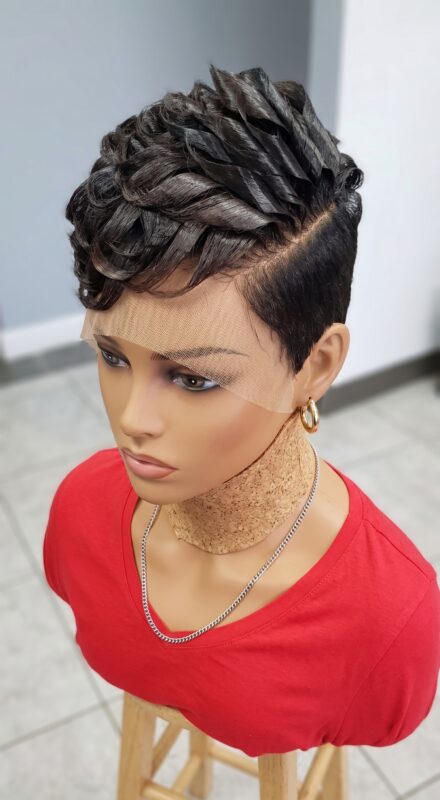
A photograph taken directly from the front can hide these transitions. Side-angle photographs are much more useful.
The Temple Area Is Critical On A Pixie
Long wigs can sometimes hide temple construction under layers of hair.
A pixie cannot.
The sides are deliberately short, which means the temple area is exposed and becomes part of the hairstyle.
Before purchasing, inspect how the lace, short hair, and cap meet around this area.
Ask the seller for close-up photographs if necessary.
Lace Color Matters
Lace should be capable of blending convincingly with the wearer’s skin once installed.
Different manufacturers may offer transparent, light brown, medium brown, dark brown, HD, or other lace options.
The names are not perfectly standardized between sellers, so photographs can be more useful than labels alone.
If possible, ask the vendor to place the lace against skin under normal lighting before you order.
HD Lace And Swiss Lace Are Not Exactly The Same
Buyers frequently encounter terms such as HD lace and Swiss lace.
HD lace is generally selected for its thin, less-visible appearance. Swiss lace is also widely used and can provide a good combination of appearance and practical durability depending on the specific material.
Do not choose based only on the name.
Ask about thickness, durability, color, and how the material performs with the intended installation method.
Thin Lace Requires Careful Handling
Very fine lace can create a beautiful appearance, but thinner material can also require gentler handling.
A short pixie may be installed and removed frequently, especially if it is designed as a glueless unit.
If durability is a priority, discuss this with the seller rather than automatically requesting the thinnest available lace.
Inspect The Knots Along The Front
The small knots where individual hairs are attached to the lace affect how the hairline appears.
Large, dark knots can become noticeable when the lace is installed.
Ask whether the unit has smaller knots around the front and whether the knots are bleached.
Bleached knots can help reduce their visibility, but over-processing may weaken the hair attachment, so the work needs to be performed carefully.
Hair Density Immediately Behind The Lace Matters
A lace front can be excellent while the finished wig still looks unnatural if too much hair is packed immediately behind the hairline.
Short styles require a thoughtful transition from the perimeter into the crown.
Look closely at the first few rows of hair.
The density should support the hairstyle without creating an unnecessarily heavy wall of hair behind the lace.
Ask Whether The Hairline Is Pre-Plucked
A pre-plucked hairline has some density removed around the perimeter to create a more gradual transition.
This can reduce the amount of customization required after purchase.
However, the quality of pre-plucking varies.
Too much removal can create thin areas that are difficult to repair, particularly on a short wig where the front remains highly visible.
The Lace Must Work With The Side Design
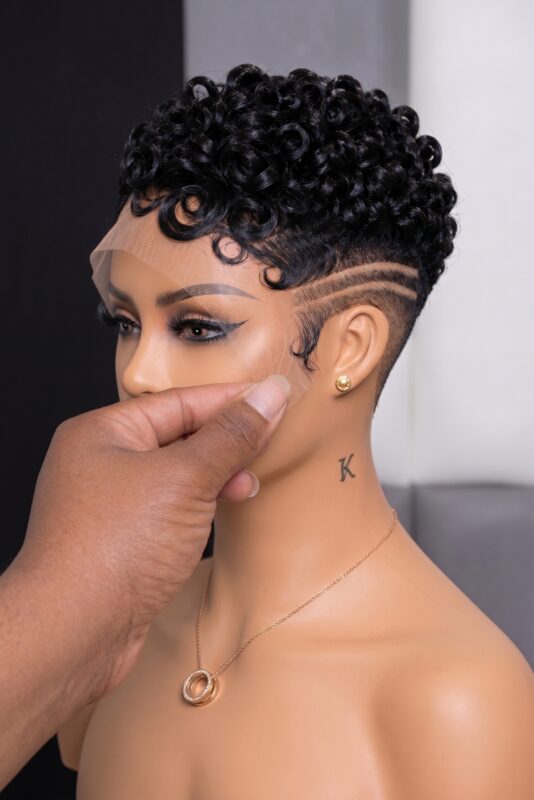
Short curly pixie wigs sometimes include shaved-looking side sections or decorative lines.
These details make construction more complicated because the transition between lace and the short side area becomes visible.
Look at whether the design begins naturally beneath the curly crown and whether the surrounding hair remains dense enough to disguise the cap.
The decorative section should appear intentional rather than simply attached to the side of the unit.
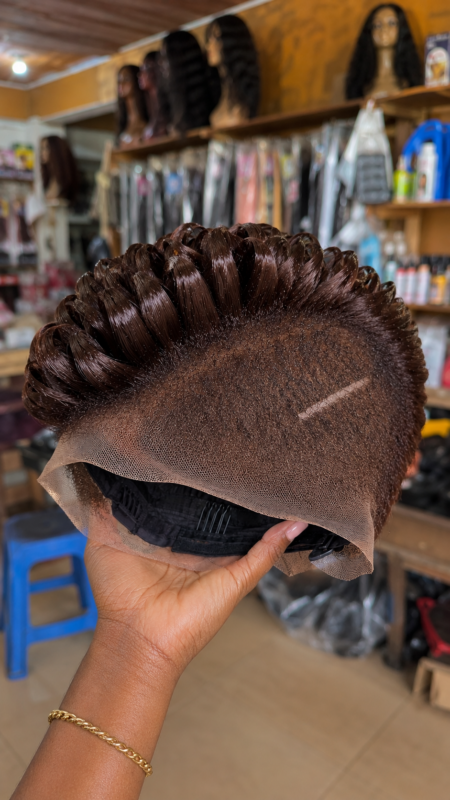
Ask For An Inside-Cap Photograph
This is one of the most useful things you can request before buying a wig online.
Turned inside out, the unit reveals information that styling photographs cannot show.
You can inspect the amount of lace, stitching, elastic band, adjustable straps, combs, clips, ventilation areas, and the general cap structure.
If a seller is producing a custom unit, ask for this photograph before shipment.
Understand Frontal Versus Closure Construction
Not every short lace wig uses the same construction.
Some units have broader frontal coverage, while others use a smaller lace section or closure-style construction.
This affects where the wig can realistically be parted and how much of the front perimeter can be customized.
Ask for the actual lace dimensions rather than assuming that every product described as a “lace wig” offers the same coverage.
Cap Size Still Matters
Good lace cannot compensate for a badly fitting cap.
If the cap is too large, the wig may shift and the lace can wrinkle. If it is too small, the perimeter may sit under excessive tension.
For custom orders, provide the measurements requested by the wig maker.
These may include head circumference, front-to-nape, ear-to-ear measurements, and temple-to-temple measurements.
Check The Glueless Features
If the unit is advertised as glueless, ask what actually keeps it secure.
Look for an adjustable elastic band, adjustable straps, combs, clips, or other internal features.
A glueless wig should fit securely enough that the wearer is not depending entirely on the lace itself to keep the unit positioned correctly.
Do Not Confuse Excess Lace With A Finished Hairline
The lace visible on a new wig is working material.
The finished result depends on how that material is trimmed, positioned, and blended.
Therefore, judging an uninstalled wig by the appearance of the uncut lace can be misleading.
Instead, evaluate the quality of the lace, the knots, hair placement, and whether there is enough material for customization.
How Much Lace Should You Leave When Cutting?
There is no universal measurement that works for every wearer and every wig.
The safest approach is to position the wig correctly before making major cuts.
Trim gradually rather than removing a large amount in one pass.
Follow the intended hairline instead of cutting a perfectly straight line across the forehead.
If you have never trimmed lace before, professional installation can prevent an expensive mistake.
Never Cut The Lace While Guessing The Fit
Before trimming, make sure the wig is sitting where you actually intend to wear it.
A unit that is positioned too far forward during cutting may later appear too short when moved backward.
Likewise, incorrect temple placement can cause problems on the sides.
Fit first. Inspect second. Cut last.
Why Short Wigs Reveal Installation Mistakes Quickly
A long wig gives the installer more styling options for disguising minor imperfections.
A short pixie leaves far less room for correction.
The eye can easily move from the curls to the front hairline and then directly to the exposed side area.
That is why good lace preparation is especially valuable for this category.
Ask For Natural-Light Photos
Studio lights and filters can make lace appear less visible than it actually is.
When buying an expensive custom wig, ask for at least one photograph or short video under ordinary daylight.
Look specifically at the lace mesh and knots.
This provides a more realistic impression of what you will receive.
Video Is Better Than One Perfect Photograph
A photograph captures only one angle.
A short rotation video can reveal the complete perimeter.
Ask the seller to slowly rotate the wig from front to side, back, opposite side, and front again.
If possible, request a second clip showing the inside of the cap.
These two videos can answer many questions before payment.
How To Find A Wig Stylist For Installation
Search for a lace wig installer, pixie wig specialist, short wig stylist, or glueless wig specialist in your area.
Review their portfolio before booking.
Look specifically for short hairstyles because installing a pixie requires attention to areas that may be hidden on longer units.
Send a photograph of your wig before the appointment and explain whether the lace is already cut.
Appointments can commonly be requested through the salon website, telephone, WhatsApp, Facebook page, or Instagram DM.
What To Ask A Seller Before Ordering
- What type of lace does this wig use?
- What are the actual lace dimensions?
- Is the lace supplied uncut or pre-cut?
- Are the knots bleached?
- Is the hairline pre-plucked?
- Can you show me the temple construction?
- Can you send an inside-cap photograph?
- Does the unit include an adjustable elastic band?
- What cap sizes are available?
- Can I see the exact wig before it is shipped?
Buying A Wig Online: A Simple Inspection Routine
Start with the finished hairstyle to determine whether you like the general appearance. Then stop looking at the curls for a moment and concentrate entirely on construction.
Zoom into the front lace.
Inspect both temples.
Look at the short side sections.
Request a photograph of the inside cap.
Ask for lace dimensions and cap size.
Finally, request a short video of the actual unit.
This process gives you far more information than simply asking, “Is this wig good quality?”
Maintaining The Lace After Purchase
Lace should be handled carefully during installation, removal, washing, and storage.
Avoid aggressively pulling the mesh when removing adhesive or adjusting the wig.
If adhesive is used, follow an appropriate removal process instead of pulling the lace away from the skin.
When washing the unit, support the lace rather than twisting or stretching it.
Protect The Hairline During Storage
Do not throw a short lace wig into a drawer where the front can become folded underneath the unit.
Repeated folding can distort the lace and affect the perimeter.
Store the wig so the front remains supported and the curly crown is not crushed.
A suitable wig stand or mannequin head can help preserve both areas.
Search Terms
short curly pixie lace wig · lace front pixie wig for black women · glueless curly pixie wig · short human hair lace wig · curly pixie wig with shaved sides · HD lace pixie wig · short ringlet lace wig · black curly pixie wig · short curly wig with side design · pre-plucked pixie wig · custom curly pixie wig · short glueless human hair wig
Final Thoughts
The visible lace on a new short pixie wig is not simply excess material that should be ignored. It is part of the construction that determines how much freedom the wearer or stylist has during installation.
Before purchasing, inspect how wide the lace is, how it reaches the temples, what type of material is used, how the knots appear, and how the lace connects to the short side sections.
Ask for actual measurements rather than relying only on terms such as “lace front” or “HD lace.” Request inside-cap photographs and videos of the exact unit whenever possible.
A beautiful curly crown can attract attention first, but thoughtful lace construction can make the difference between a wig that is frustrating to install and one that can be customized comfortably to the wearer.
For short pixie wigs in particular, the front perimeter deserves serious attention before you place the order.