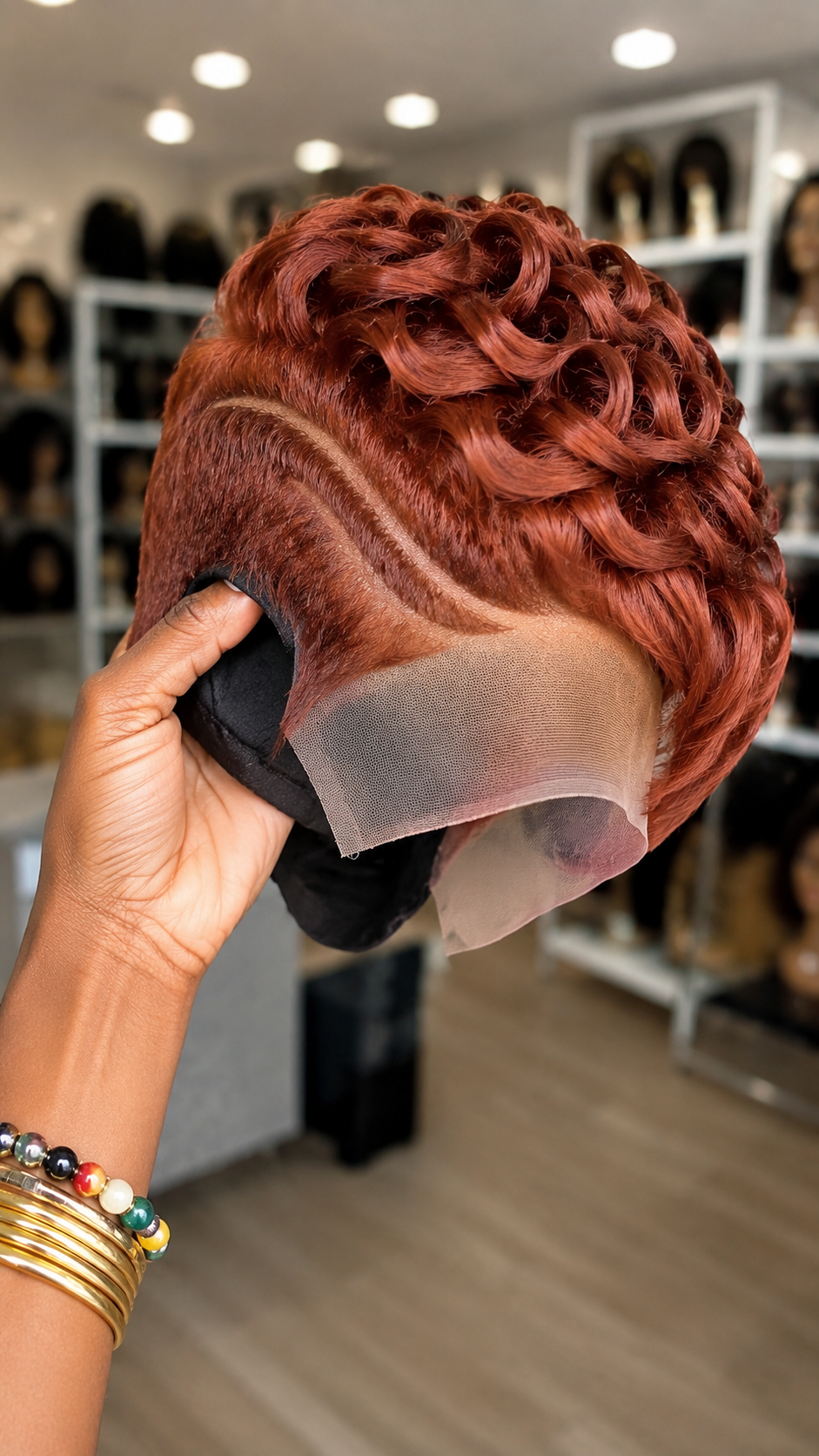
The most flattering part of this parting is also the hardest one to maintain. Instead of a straight line or a simple diagonal, the part on this unit curves in a soft S-shape from the crown toward the front, and that shape is doing more work than most buyers realize when they see it in a single, well-lit photo.
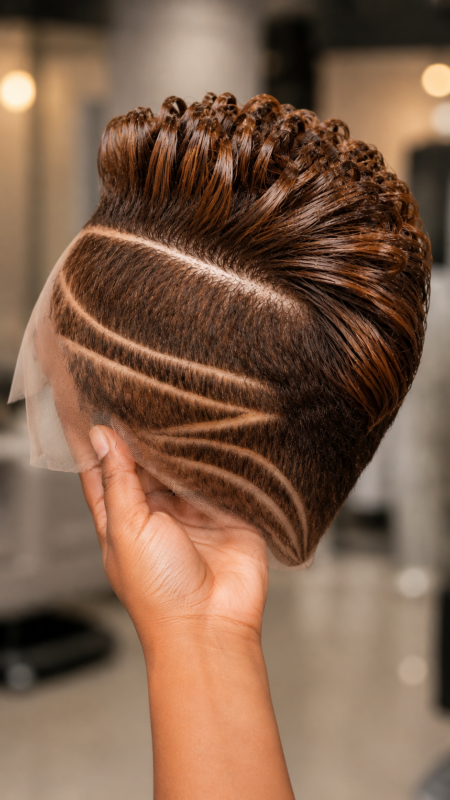
This is a solid copper-auburn curly pixie wig, shown mounted on a display stand with the lace lifted away by hand to reveal the base underneath. Tight ringlet curls cluster at the crown, loosening slightly toward the front, and the S-curve part runs like a wave through the smoother section along the top before disappearing into the curl.
A straight or deep diagonal part holds its line with basic maintenance. A curved, S-shaped part is a different kind of commitment, and understanding what that commitment involves matters more than admiring how good it looks in this one photo.
Where To Buy This Copper Curly Pixie Wig
Custom makers can replicate a specific part shape like this one if you send a clear reference photo, since curved parts are typically set by hand during construction rather than adjustable after the fact.
Instagram and TikTok sellers photograph curved or swoop parts often because they read as more editorial and camera-ready than a straight part, but rarely mention how much daily upkeep is needed to keep that curve looking crisp.
Etsy listings occasionally note whether a part is fixed or adjustable, which is worth checking specifically for a curved style like this one.
Marketplaces like Amazon, AliExpress, and Temu typically sell units with straight or simple diagonal parts as standard, since a curved part adds a production step that mass manufacturers tend to skip.
Local beauty supply shops and salons let you test whether the curve actually holds when you run a comb through it, which tells you more than any photo about how much daily styling it will need.
Vendors and wholesalers direct are usually where a part shape like this originates, hand-cut into the base at the construction stage rather than styled afterward by an individual reseller.
Regionally, curved and swoop-part curly units in copper and auburn tones show up often through vendors in Lagos, Accra, Atlanta, London, and South African hair districts.
Vet the seller by asking whether the S-curve part is cut into the base permanently or achieved through daily styling and product, since that changes what you are actually committing to as a buyer.
Red flags include listings with only one photo angle of the part, no answer about whether the curve is permanent or styled, and no willingness to show the part after a wash rather than fresh out of the box.
When you order, send your natural part preference and hairline shape, and ask specifically whether the S-curve can be adjusted to sit closer to your own part direction rather than a generic template.
Contact / order inquiries: WhatsApp [WhatsApp: +XX XXX XXX XX XX]
How Much It Costs
Tiered pricing for a solid copper-auburn curly pixie with a hand-set curved part runs $170–$430 for human hair, with the part construction itself adding a modest $20–$50 over a standard straight-part unit, since it requires more precise cutting at the base. A good synthetic version runs $65–$155, and a basic synthetic falls between $28–$75.
What that includes and excludes typically covers the unit and its part as delivered, not the daily styling product needed to maintain the curve, and not a service to reset the part if it flattens with repeated wear.
Shipping and duty add $15–$60 depending on origin, with curved-part units sometimes shipped on a form or stand to help preserve the shape in transit rather than folded flat.
Ongoing costs include a lightweight pomade or edge product to redefine the curve when it starts to soften, a wide-tooth comb to reshape it without disturbing the surrounding curls, and periodic professional attention if the part begins to shift permanently out of place.
First-year total, including the unit, upkeep products, and one professional check on the part, tends to land between $250 and $540 for a well-maintained human hair version.
Cost per wear on a $300 unit worn twice a week for a year comes out to roughly $2.90 per wear, a useful way to weigh the upfront cost of a more labor-intensive part construction.
What a very low price signals on a unit with a defined curved part like this is usually a part that is styled fresh for the listing photo rather than cut into the base, meaning it will not hold that shape once you wash or wear the unit yourself.
Deposit structure for a custom part-and-curl combination like this commonly runs 30–50% upfront, remainder due before shipment, kept on a payment method that allows a dispute if the delivered part does not hold the shape shown in photos.
Shipping, Delivery, And What To Expect After Ordering
A hand-cut curved part takes more precision than a standard straight one — expect 6–13 business days before a custom order ships, longer if the curl work at the crown is done strand by strand rather than pre-set in bulk. International delivery adds another 7–21 days.
What arrives should let the part hold its S-shape with light combing, not require the full-strength styling product used to set it for the original listing photo. If the part looks flat or unclear straight out of the packaging, ask the seller whether it needs reactivating with water or product before judging the shape.
Photograph the part from directly above, the day the unit arrives, before touching it with any product. That overhead angle shows the actual curve clearly and becomes your reference if the shape shifts with wear.
Reading An S-Curve Part vs A Straight Or Diagonal One
A straight part is the easiest to maintain because there is only one line to keep clean, and it does not curve or change direction anywhere along its length. A diagonal part adds a single angle but still runs in one consistent direction from start to finish. An S-curve part does neither — it bends one way near the crown and the opposite way as it moves forward, which means it needs attention at two separate points rather than one.
That double-curve construction is also more visually forgiving of asymmetry in a face, since the S-shape draws the eye in a soft, moving line rather than a hard, straight-edged division. It photographs beautifully for exactly that reason, which is also why it shows up so often in promotional shots rather than everyday styling content.
The trade-off is upkeep. Every time the unit is combed, brushed, or slept on, there is a real chance the curve softens or shifts slightly out of its original shape. A straight part can be redrawn in seconds with a comb. An S-curve part usually needs product and a bit more patience to reset cleanly.
Solid Copper-Auburn Colour, Not Two-Tone Placement
The colour on this unit runs consistently from root to curl tip, without the darker root or contrasting back section seen on two-tone copper units covered previously in this category. That makes maintenance more predictable in one specific way: there is no drift between two different tones ageing at different speeds, since the whole unit is dyed to a single shade.
The trade-off is that a solid, all-over colour like this shows fading more uniformly and more visibly over time, since there is no darker section to mask gradual lightening the way a two-tone root does. Expect the crown, which gets the most light and heat exposure, to show the earliest signs of that fade.
Why Curl Density Changes Between Crown And Front
The curls at the crown sit tighter and more tightly ringleted than the looser, more relaxed curl visible closer to the front. That is not an inconsistency — it is a common construction choice, since a tighter, denser curl at the crown holds volume and shape through the part of the day when a unit gets the most handling, while a slightly looser curl near the front softens the framing around the face.
If you are used to units with a single, uniform curl pattern across the whole head, this graduated approach can look uneven in a still photo without context. In motion, and against the S-curve part specifically, the transition from tight to loose curl actually supports the part’s shape rather than fighting it — the denser curl at the crown holds the part’s origin point in place, while the looser curl toward the front lets the line soften naturally as it approaches the hairline.
Before You Pay
- Is the S-curve part cut into the base construction, or styled fresh for the listing photo?
- Will the curve hold with light daily combing, or does it need product every time you wear the unit?
- How does a solid, all-over copper tone fade compared to a two-tone version you may have seen elsewhere?
- Has the seller shown the part after a wash, not just fresh out of the packaging?
- What is included if the part construction does not hold the shape shown in the photos?
Trimming The Lace
Trim carefully along the section closest to where the S-curve part meets the hairline, since that curved area sits differently against the lace than a straight part would, and an uneven cut there is more noticeable given how much attention the curve already draws.
Work in small sections and check the fit against your own hairline periodically, leaving a slightly wider margin near the curve itself than you would along a straight edge.
Search Terms
s-curve part curly pixie wig · swoop part copper curly wig · solid copper auburn pixie wig · curved part human hair pixie · deep wave part curly pixie wig · copper ringlet pixie wig lace front · hand cut curved part wig · solid colour copper curly pixie
Final Thoughts
A curved, S-shaped part is one of the small construction details that photographs beautifully and gets almost no scrutiny before purchase. It is not a flaw or a shortcut — it is simply a more demanding shape to maintain than a straight or diagonal line, and worth knowing that going in rather than discovering it after the first wash.
Ask whether the part is cut permanently into the base or styled for the photo, and ask to see it after normal handling, not just fresh out of the box. The solid copper colour underneath is straightforward by comparison — it is the curve on top that actually needs your attention before you commit to it.
Small construction choices like a curved part or a graduated curl density rarely make it into a product description, but they are exactly the details that determine how much daily effort a unit will actually demand. A photo can show you the shape. Only a direct question to the seller, or a chance to handle the unit yourself, tells you whether that shape is something you are buying once or maintaining every single day.

How do we buy them please??