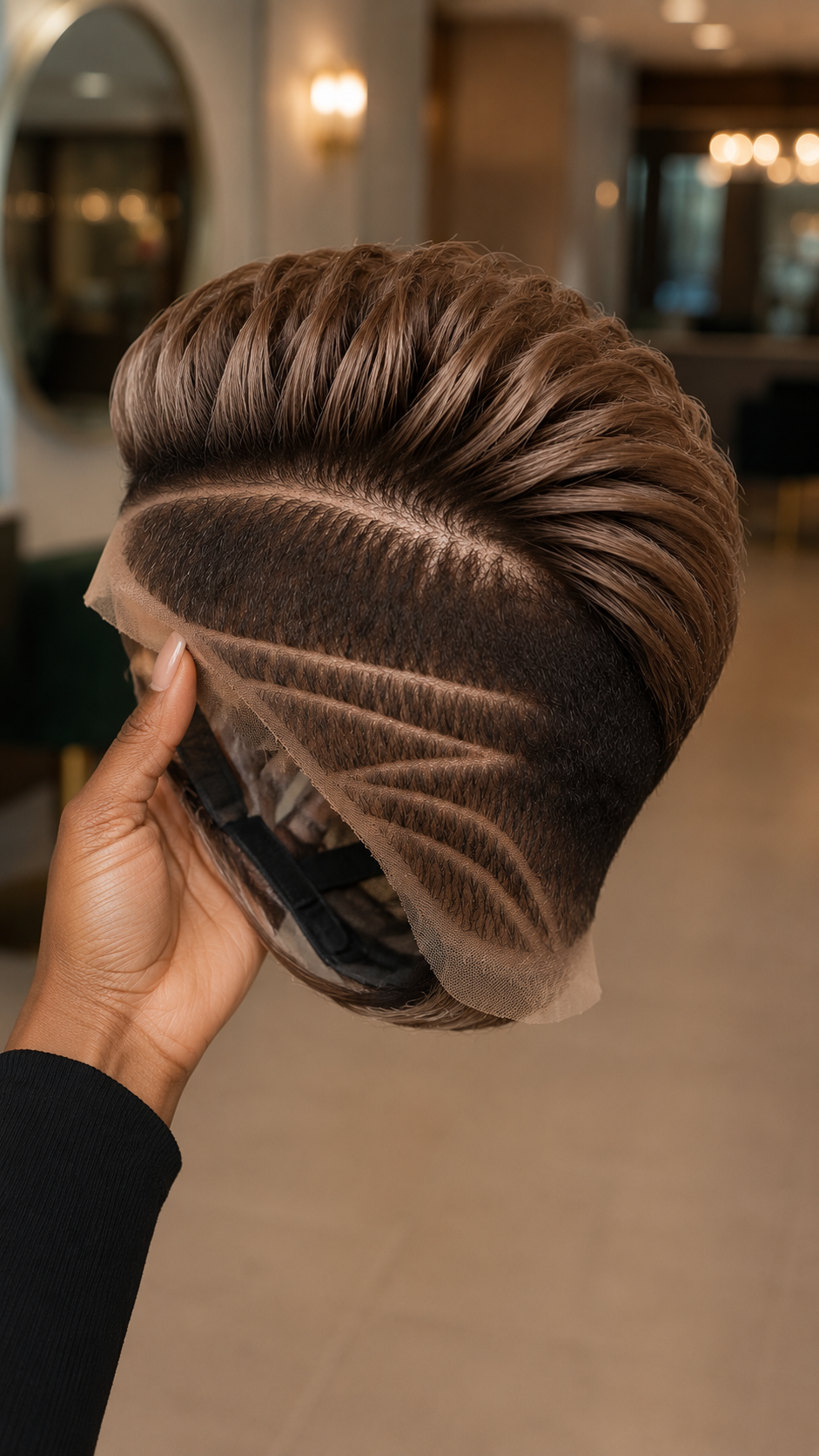
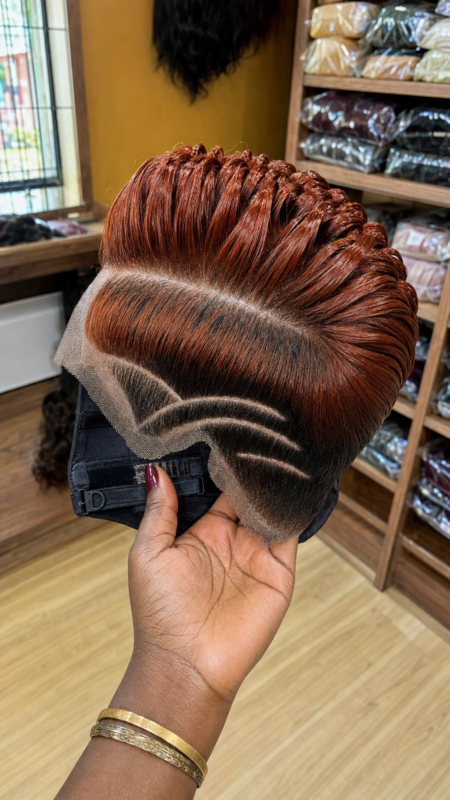
Most buyers assume a brown pixie starts with a brown cap. Looking closely at this dimensional carved unit reveals a far more complex construction: a dark, natural-black hair base hand-ventilated along the nape and side fade, seamlessly transitioning into a warm chestnut-brown pompadour top. When geometric razor-lines cut through the side panel, the contrast between the lighter top volume and the deep black stippled roots under the lace creates a realistic skin-fade shadow that single-tone units fail to deliver.
Achieving this two-tone effect on a ultra-short length requires specialized color placement prior to cap ventilation. Bleaching and lifting short hair strands after they are already knotted onto delicate Swiss lace risks damaging the lace grid and causing severe root shedding. Instead, the ventilation artist selects pre-colored warm brown bundles for the crown while maintaining untouched dark virgin strands for the fine single-knotted fade beneath the carved geometric tracks.
Understanding the labor behind two-tone ventilation, preserving the lifted warm highlights, and knowing how to evaluate custom lace construction ensures you invest in a unit built for longevity rather than a temporary surface dye.
Where To Buy A Chestnut Carved Pixie Wig
Custom makers and lace studios
Custom wig ventilation artists and dedicated lace studios are the premier source for two-tone carved pixie units. Because achieving a crisp contrast between chestnut top volume and dark stippled sides requires manual strand distribution, these pieces cannot be mass-produced on factory assembly lines. Expect lead times between 3 to 5 weeks. Always ask custom makers whether the crown lift was colored prior to ventilation to protect the lace foundation.
Instagram and TikTok sellers
Independent stylists actively showcase dimensional short units in high-definition video clips. Look specifically for sellers who demonstrate the unit under direct natural light and rotate the cap to show the underside of the carved parting. Avoid accounts that rely solely on heavily filtered still photos, as digital filters often blur the critical boundary between the dark fade and the light crown.
Etsy
Etsy connects buyers with independent custom wig makers who specialize in complex color gradients and short precision cuts. Review the seller’s portfolio carefully to ensure they use real customer photos rather than studio stock images stolen from high-end stylists. Look for verified reviews mentioning lace durability and color fidelity after washing.
Marketplaces (Amazon, AliExpress, Temu)
Mass-market e-commerce platforms offer low-cost pixie wigs, but they consistently fall short on two-tone carved designs. Factory units typically feature single-tone synthetic fibers or flat-dyed human hair with heavy double knots that look dark and bulky along the parting line. These budget options rarely capture the crisp dimensional taper seen on custom hand-knotted units.
Local beauty supply / salon
Local salons specializing in short lace installs offer the advantage of trying on cap sizes and inspecting the tone contrast in person. While salon prices carry a 30% to 50% markup over online direct options, being able to verify how the chestnut shade complements your skin tone in real-time eliminates post-purchase color mismatch.
Vendor / wholesaler direct
Direct factory vendors require minimum order quantities (usually 3 to 10 units), making this path ideal for stylists or salon owners. Factory stock units arrive in raw black or uniform brown, requiring a professional stylist to perform post-purchase root shading, knot bleaching, and custom side carving.
Regional notes
Sourcing options vary by location. Custom ventilation studios in London and Atlanta excel at multi-tonal dimensional short units. Stylists across Lagos and Accra lead in high-density hand-knotted geometric designs, while online vendors in South Africa frequently offer ready-to-wear pre-cut short tapers with custom root shading.
Auditing the seller
Before making a payment, check the operational age of the seller’s business account and ask for a live video showing the interior lace construction. Message the seller with technical questions regarding the knot bleaching along the carved geometric tracks to evaluate their expertise. Always verify their return or revision policy for custom color pieces.
Red flags to avoid
Steer clear of sellers using generic stock photos across multiple listings, those who refuse to send real-time video verification, vendors charging suspiciously low prices for hand-knotted dimensional lace, or sellers demanding non-refundable payment via unprotected methods.
What to submit when ordering
Send exact head measurements (circumference, ear-to-ear across forehead, and front-to-nape). Provide high-resolution reference photos indicating your desired top color shade, the placement of the geometric side tracks, and your target delivery date.
Payment security
Standard custom ordering protocols require a 30% to 50% deposit upfront to secure hair materials and initiate ventilation. The remaining balance is paid after reviewing final video approval of the completed unit prior to shipping. Always utilize payment platforms with built-in buyer protection.
Contact / Order Inquiries: WhatsApp [WhatsApp: +XX XXX XXX XX XX]
How Much It Costs
| Tier |
Description |
Price Range |
| Full Custom |
Human Hair, Two-Tone Color, HD Frontal, Hand-Carved |
$260 – $520 |
| Mid-Range |
Human Hair, Single Tone Brown, Swiss Lace, Basic Part |
$180 – $340 |
| Budget / Basic |
Human Hair Blend, Machine Cap, Factory Dye |
$80 – $170 |
| Premium Synthetic |
Heat-Resistant Fiber, Dimensional Tone, HD Part |
$65 – $135 |
| Basic Synthetic |
Standard Fiber, Single Tone, Hard Cap |
$30 – $60 |
Included and excluded costs
Custom quotes for dimensional short units should explicitly cover the multi-tone hair formulation, hand-knotted HD lace base, bleached single knots along the carved track, and thermal root shaping. Express shipping, custom cap resizing, and specialized maintenance products are typically billed separately.
Color premiums
Creating a natural transition from a dark natural base to a warm chestnut or hazel brown adds a custom color premium of $40 to $90 over plain jet-black units. Pushing the crown highlights further toward honey or blonde tones increases the processing time and cost accordingly.
Shipping and customs
International express shipping generally ranges from $30 to $65 depending on carrier and destination. Regional import duties and value-added taxes are set by local government authorities and are the buyer’s responsibility upon delivery.
After-purchase costs
Proper upkeep requires dedicated tools: a canvas block head ($15–$25), a thermal hot comb ($30–$55), styling wax and foam ($15–$30), and color-safe moisturizing spray ($12–$22). Budgeting for a professional reset every 3 to 4 months ($50–$90 per session) ensures the short silhouette stays sharp.
First-year total cost of ownership
A high-quality $320 custom chestnut pixie unit, combined with $45 shipping, $70 in essential styling tools/products, and two professional resets ($120 total), results in a realistic first-year investment of approximately $555.
Cost per wear
Wearing the unit three times a week over one year (156 wears) brings the effective cost down to approximately $3.55 per wear, making a custom hand-built piece a durable and cost-effective styling asset.
What a bargain price hides
Unusually cheap brown pixie wigs often hide significant compromises: machine tracks exposed along the temples, synthetic fiber blends that melt under thermal tools, flat dip-dye coloring that looks muddy in natural light, and thick dark knots that ruin the carved scalp illusion.
Deposit structure
Custom makers require a 30% to 50% non-refundable deposit before sourcing materials and hand-knotting the lace. The final balance is remitted only after the buyer inspects and approves video footage of the finished unit.
Shipping, Delivery, And What To Expect After Ordering
Dimensional short units require protective packaging to maintain their structural shape during international transit. Request that your vendor box the unit on a foam head form or insert internal structural support to prevent the elevated crown pompadour from collapsing under parcel pressure. Insist on tracked express courier service to monitor transit milestones.
When the package arrives, carefully inspect the unit under natural light before cutting the perimeter lace. Verify that the chestnut top shade matches your order specifications and check that the carved geometric lines are cleanly defined. A brief transit period may flatten the top volume slightly; a quick touch with a thermal hot comb and wax stick will easily restore the crest height.
Dual-Tone Ventilation and Shadow Contrast
The defining visual element of this chestnut pixie is the stark contrast between the bright, warm crown and the deep black stippled fade along the side. Achieving this requires precise dual-zone ventilation: dark virgin hair is knotted along the perimeter and side tracks, while pre-dyed chestnut strands are placed exclusively across the upper crown section.
This two-zone approach creates a natural drop-shadow effect underneath the carved geometric lines. When light hits the elevated top, the dark roots underneath simulate the realistic depth of a natural razor-cut haircut, preventing the wig from looking like a uniform, flat hair helmet.
Knot Bleaching on Multi-Color Lace Foundations
Bleaching knots on a two-tone unit requires extreme chemical control. The single knots along the carved geometric lines must be lightened to dissolve dark specks on the lace, but the bleach mixture must not migrate upward into the pre-colored chestnut hair strands, which would cause unwanted brassiness or severe hair breakage.
Professional ventilation artists apply a high-viscosity bleaching paste exclusively to the grid underside, neutralizing the dark knot visibility while keeping the hair shaft intact. This careful processing ensures the scalp illusion remains crisp along every millimeter of the exposed design track.
Maintaining Pompadour Elevation and Directional Memory
The swept pompadour top requires built-in directional knotting during the ventilation process. Hair strands at the front hairline are tied at forward-and-upward angles, forcing the hair to maintain natural lift without depending solely on heavy styling gels.
To maintain this elevation at home, use a fine-tooth comb and a thermal hot comb set to medium heat. Glide the hot comb from the carved parting line upward toward the crown peak, following with a lightweight wax stick to lock the textured ridges in place. Avoid heavy oils that weigh down the short fibers and flatten the crown shape.
HD Lace Integration for Warm Brown Hair Tones
Warm hair colors like chestnut and hazel brown expose lace grid lines more readily than solid black hair if the lace shade is mismatched. High-definition (HD) Swiss lace is essential here because its delicate, transparent mesh melts seamlessly into various skin undertones without creating a visible gray cast along the hairline.
Because ultra-thin HD lace is sensitive to friction, always handle the unit by holding the reinforced ear tabs or internal cap elastic. Avoid pulling directly on the frontal lace edge when positioning the wig on your head.
Before You Pay
-
Was the chestnut crown hair colored prior to ventilation or bleached on the lace base afterward?
-
Are the single knots along the carved geometric tracks fully bleached and toned?
-
What specific lace mesh is used—ultra-thin HD lace or standard durable Swiss lace?
-
Does the internal cap construction feature adjustable elastic bands and side security combs?
-
What is the maker’s policy regarding shade adjustments if the brown tone differs from the reference photo?
Trimming The Lace
Trimming perimeter lace on a short carved unit demands extreme care due to the close proximity of the geometric side tracks to the cap edge. Secure the wig on a correctly sized canvas block or hold it flush against your natural hairline before attempting any cuts.
Use sharp micro-tip embroidery scissors or a precision razor blade to remove excess lace. Make tiny, staggered zig-zag cuts following the natural hairline rather than cutting a straight line. Leave a narrow 1 to 2 millimeter border of bare lace in front of the knotted hairline to prevent cutting into the perimeter ventilation and causing unraveling.
Search Terms
chestnut carved pixie wig • two tone short pixie unit • brown pompadour lace wig • geometric side part wig • HD lace short taper wig • razor line carved pixie • dimensional short brown unit • hand knotted fade pixie
Final Thoughts
A chestnut carved pixie wig represents the pinnacle of modern custom ventilation and color design. By pairing a warm, volumized crown with dark, hand-stippled side panels, this unit creates a striking barber-cut aesthetic that standard single-tone wigs simply cannot replicate. The structural success of the look relies on careful density balance, precise knot bleaching, and high-definition lace integration.
Investing in a well-constructed custom piece ensures that the sharp geometric lines and rich dimensional tones hold their clarity over time. By following proper thermal maintenance techniques and protecting the delicate HD lace foundation, you maintain a sophisticated, salon-quality style that delivers exceptional value wear after wear.