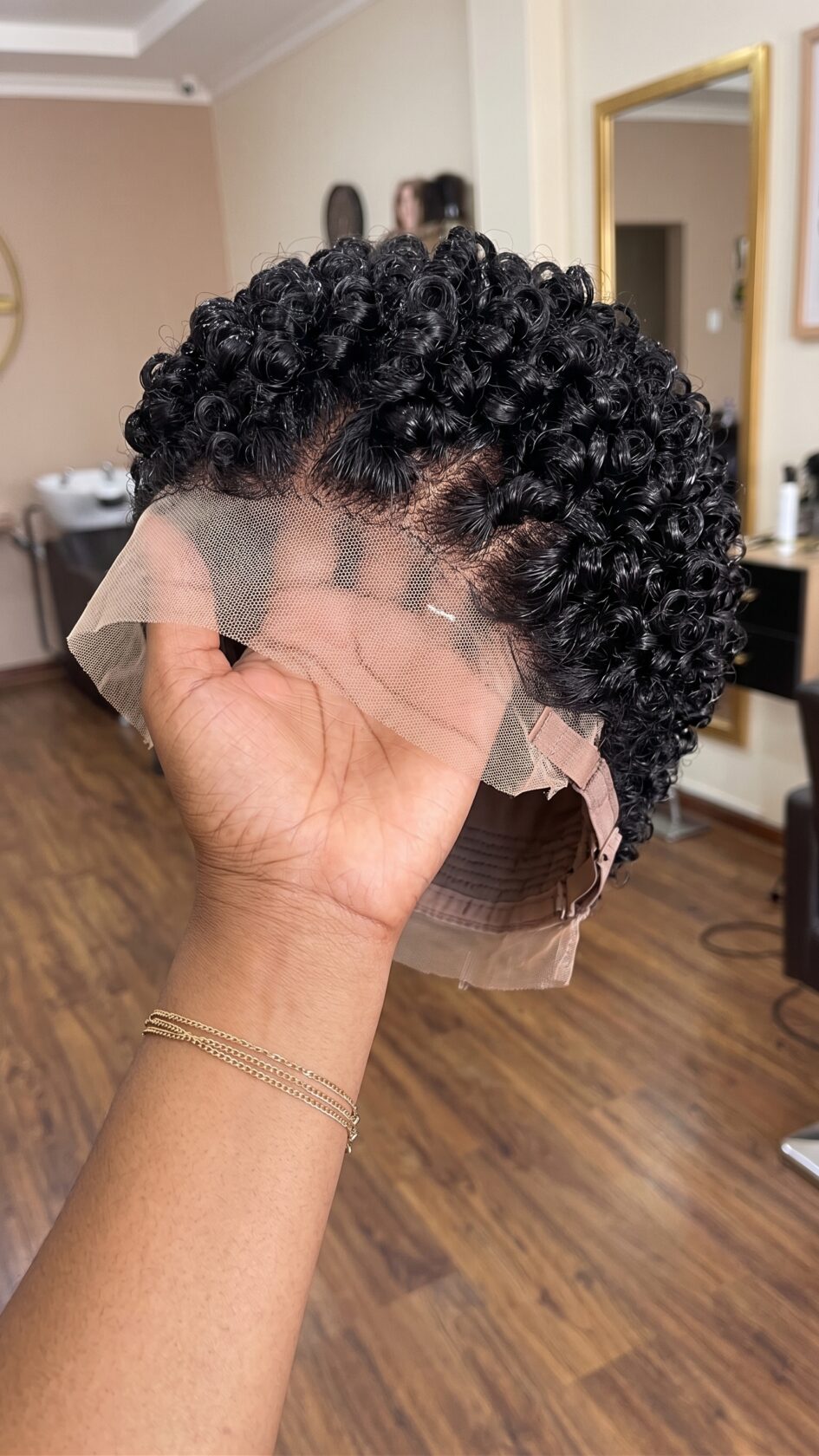
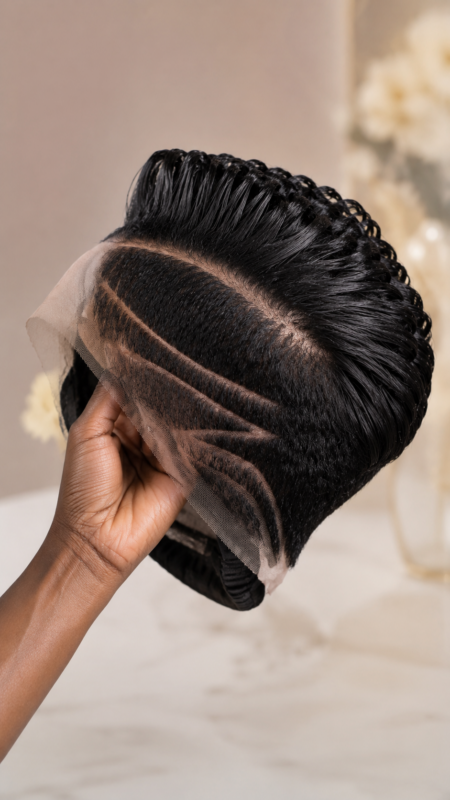
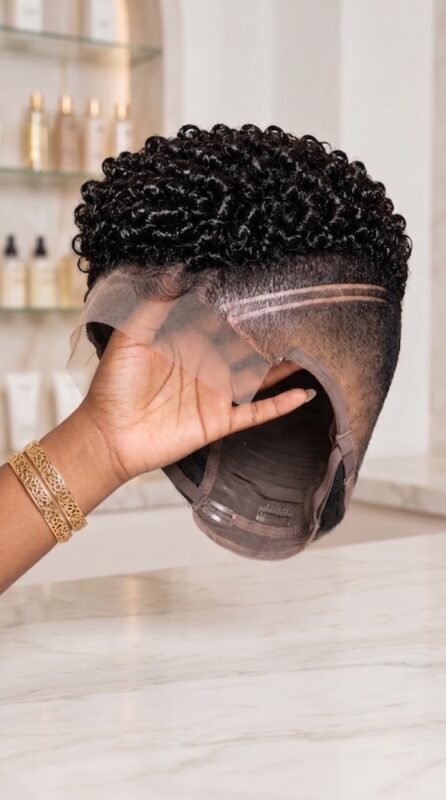
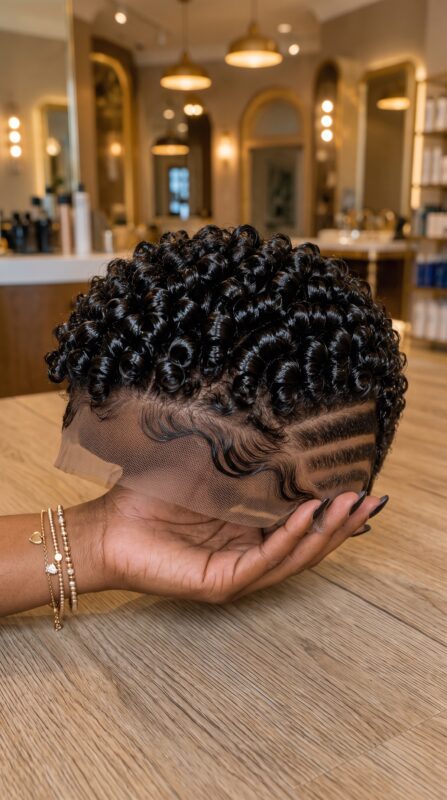
Good lace hides thousands of tiny holes in every inch; cheap lace shows a coarser few you can pick out with your eye. That density is not a detail, it is the whole reason a unit either disappears into your skin or sits on your forehead as a faint film. Look at the lace held up here and how the fingers behind it read clearly through the mesh. The finer and more transparent that mesh, the more it vanishes against skin. The coarser it is, the more it reads as a grid, no matter how good the curls above it are. On a curly pixie wig the hairline is right out in the open, so the grade of the lace is doing more work than almost anything else on the cap.
Here is the part sellers rely on you not knowing: “HD lace,” “transparent lace,” and “Swiss lace” are not interchangeable marketing words, they describe real differences in how thin the thread is and how many holes sit in a given space. And the term most abused is HD. Plenty of listings say HD and ship a regular lace that shows on skin, because the label costs nothing and the mesh is hard to judge in a photo. You verify grade by holding the lace to your own skin in daylight and looking at whether the mesh nearly disappears, not by trusting the word in the title.
There is a trade underneath all of this. The finer and more invisible the lace, the more fragile it is, so a true HD melts beautifully and tears sooner, while a slightly thicker lace shows a little more and lasts a lot longer. Neither is simply better. The grade you want depends on whether you are chasing an invisible hairline or a durable one.
Where To Buy A Curly Pixie Wig With Lace That Actually Melts
Custom makers should name the exact lace grade and show it against skin, not just say HD. Ask what thickness they use and to see the lace held to a forearm in daylight. A maker who works with genuine fine lace will show you the mesh vanish; one relying on the label will keep the lace at a distance.
Instagram and TikTok sellers lean on the word HD heavily, so ask for a clip of the lace pressed to skin in ordinary light rather than a studio close-up that flatters any mesh. A curly pixie wig with a truly fine lace can be shown melting on camera; a coarse one cannot.
Etsy works with makers who photograph the lace on skin and have reviews mentioning how invisible it stayed. The risk is a listing that says HD in the title and shows only the styled front. Read reviews for anyone describing a visible lace or a grid on the forehead.
Marketplaces like Amazon, AliExpress, and Temu are where the HD label is stretched furthest, since it adds no cost and sells units. Some fine laces there are genuine and many are ordinary. Judge by on-skin photos and reviews about visibility, never by the word alone.
Local beauty supply shops and salons let you press the lace to your own skin and see the mesh in real light, which settles the question instantly. You pay a premium in-store, but lace grade is the one spec a screen cannot confirm.
Vendors and wholesalers direct make sense across several units with a minimum, and lace grade is usually consistent within a batch, so a sample tells you what the rest will be. For one unit, a maker who proves the grade beats an unseen HD claim.
Regionally, genuine fine and HD laces come strongly out of Lagos, Accra, Atlanta, London, and across South Africa, where sellers who will show the lace on skin are easy to find on video.
Vet the seller the usual way plus a lace test: check the account age, look for real buyer photos, time a plain question for a genuine reply, and ask them to show the lace pressed to skin. How they handle that request tells you whether the HD claim is real.
Red flags: an HD claim with no on-skin photo, a lace shown only from a flattering distance, a price far under other fine-lace units, and vague answers about the grade or thickness.
When you order, send your skin tone reference and your measurements, and ask for the specific lace grade and to see it against skin before they finish. Say that a lace that melts matters to you, so they know you will check on arrival.
On payment, thirty to fifty percent down with the balance before shipping is standard for custom work. Use a method you can dispute, and ask for an on-skin photo of the finished lace before releasing the last part.
Contact / Order Inquiries: WhatsApp [WhatsApp: +XX XXX XXX XX XX]
How Much It Costs
Lace grade is one of the quieter price levers on a curly pixie wig, and it is the one most often charged for and least often delivered, so knowing it protects your money directly.
Human hair, full build with a genuine fine or HD front lace, bleached knots, and a graded hairline: roughly $210 to $440. Human hair, mid build with a good standard lace: about $150 to $310. Human hair, basic cap with a plain, more visible lace: around $80 to $190. Good synthetic on a decent lace: $60 to $140. Basic synthetic: $20 to $55.
The catch is that an HD label often adds twenty to fifty to a price while the lace inside is ordinary, so you are paying the premium for a word. A real fine lace is worth that premium because it disappears on skin; a fake one is money spent on nothing you can see the benefit of. This is why an on-skin photo is worth more than any spec in the listing. You are paying for a mesh that vanishes, and only skin tells you whether it does.
Shipping and any customs charge sit outside the price and change with where you live, so plan a realistic band and confirm your own country’s import rate rather than trusting a single quoted figure.
Then the later costs, which the lace grade shapes. A finer lace needs gentler handling and replacing sooner because it tears, while a thicker lace lasts longer but may want a light tint to sit invisibly. Budget for a lace tint if yours ships pale, and for eventual replacement of a very fine lace that wears at the hairline. First-year math, honestly: a fine-lace human unit plus shipping plus any customs plus a small kit plus upkeep tends to land between a low three-figure total and somewhat above the sticker, with the fragile lace being the part most likely to need attention.
Per wear, a durable mid-grade lace can be the better value than a fragile HD if you wear the unit hard, because it survives longer for less fuss. A very low price on a unit sold as HD almost always means the lace is ordinary, so treat the bargain HD claim as the ordinary lace it usually is.
Deposits follow the custom pattern: thirty to fifty percent to start, balance before shipping, and an on-skin photo of the finished lace before the last payment clears.
Shipping, Delivery, And What To Expect After Ordering
The first thing to do on arrival is press the front lace to your own skin in daylight and judge whether the mesh disappears, because that is the claim you paid for and the moment to confirm it. Ask that the unit ship so the lace is not creased, choose a tracked service for custom work, and check your country’s import charge before it lands. When it arrives, a genuine fine lace will nearly vanish against skin while an ordinary one shows a faint film or grid; if it shows, a light tint helps but cannot turn coarse lace into fine. What you unbox should match the grade you were promised, and skin is the only honest test.
HD Is A Label, Not A Guarantee
Because the word HD adds no manufacturing cost and sells units, it appears on laces that are nowhere near HD grade. The only reliable check is physical: pressed to skin in daylight, a true fine lace lets your skin tone read straight through with the mesh almost gone, while an ordinary one leaves a visible haze. Learn that test and the label stops mattering, because you are judging the mesh itself.
Finer Lace Melts Better And Tears Sooner
Transparency and durability pull against each other in lace. The thinner the thread and the finer the mesh, the more invisible it is and the more easily it rips, especially at the stressed hairline. A slightly heavier lace shows marginally more but survives far more handling. Decide which you value: an almost invisible hairline you replace sooner, or a slightly visible one that lasts. There is no grade that gives you both.
Lace Colour Still Has To Match You
Even a fine lace shows if its colour is far from your skin, so grade and tint work together. A pale lace on deeper skin reads regardless of how thin the mesh is. Ask whether the lace is tinted or needs tinting to your tone, because the most invisible hairline is a fine mesh in the right shade, not one without the other. Grade gets you most of the way; colour closes the gap.
Before You Pay
- Is the lace a genuine fine or HD grade, shown against skin, or just labelled HD?
- Does the mesh nearly disappear on skin in daylight, or leave a visible film?
- Am I paying an HD premium for a lace that is actually ordinary?
- Given finer lace tears sooner, do I want maximum invisibility or more durability?
- Does the lace colour match my skin, or will it need a tint to sit unseen?
Trimming The Lace
Fine lace demands a lighter touch than most, because the more invisible it is, the more easily it frays and tears as you cut. Trim in small offset steps and leave a shallow margin rather than going flush, use sharp small scissors, and support the lace so it does not pull while you cut. On a very fine grade, a ragged edge frays further with wear, so a clean cut matters more here than on a thicker lace. If this is your first fine-lace unit, let a stylist make the first pass, since a delicate mesh is far easier to ruin than a sturdy one.
Search Terms
curly pixie wig · hd lace pixie wig · transparent lace curly pixie · fine mesh lace short wig · melted lace pixie unit · glueless hd lace curly wig · invisible hairline pixie · swiss lace short curly wig
Final Thoughts
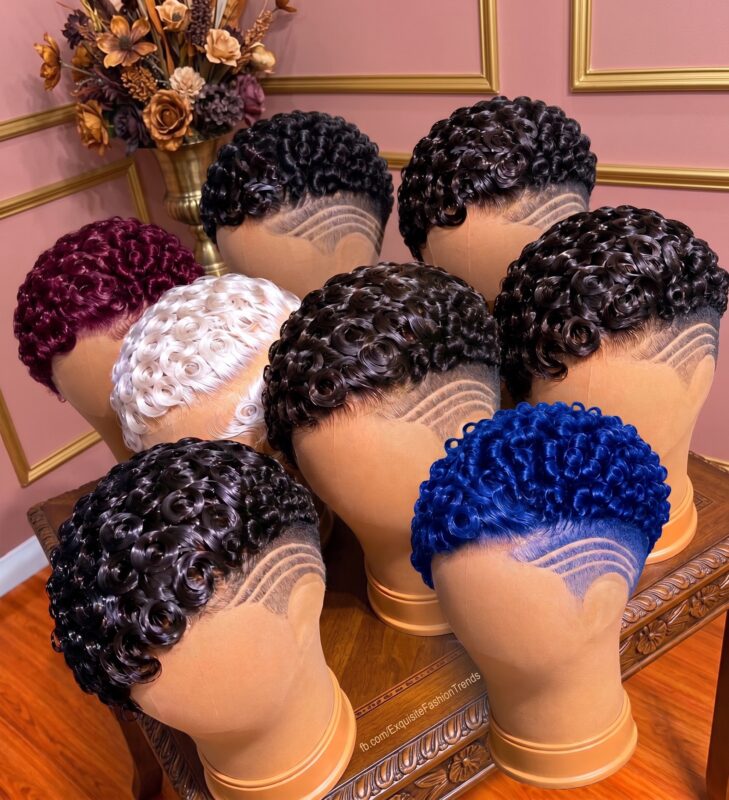
The curls are what draw the eye in this photo, but the lace is what decides whether the finished unit looks like your own hairline or like a wig. Mesh grade, how fine and transparent the lace is, does more for realism than density or shine, and it is the spec most often renamed and least often delivered. An HD label proves nothing; the mesh pressed to skin proves everything.
Buy it by testing the lace, not reading it. Press it to your skin, judge whether it vanishes, and match the grade to how you wear the unit, since the most invisible lace is also the most fragile. A genuine fine lace in the right tint gives a curly pixie wig a hairline that disappears, and that is worth paying for. A regular lace behind an HD label is a premium spent on a word. The curls sell the photo. The mesh decides whether anyone can tell it is a wig.