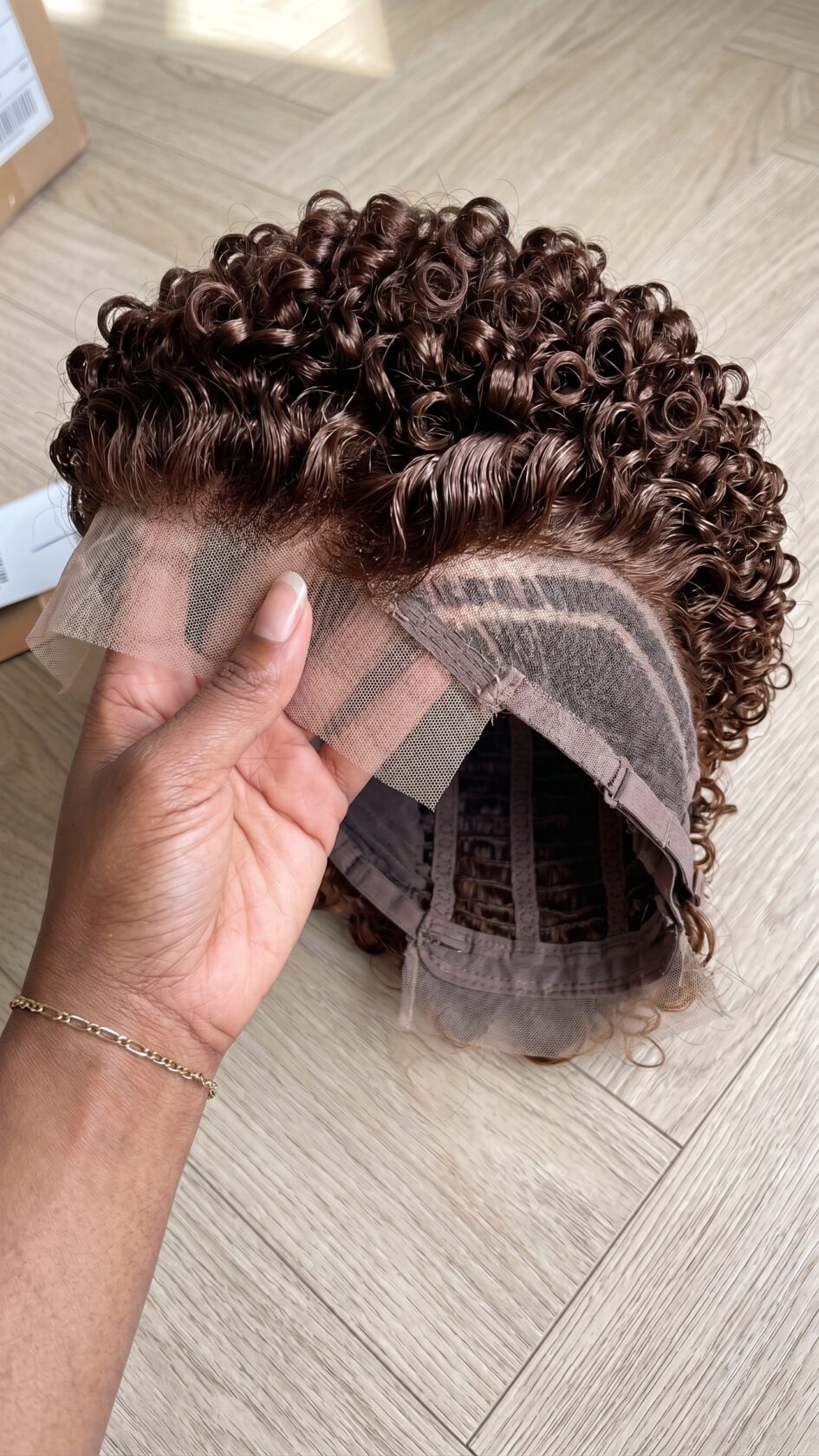
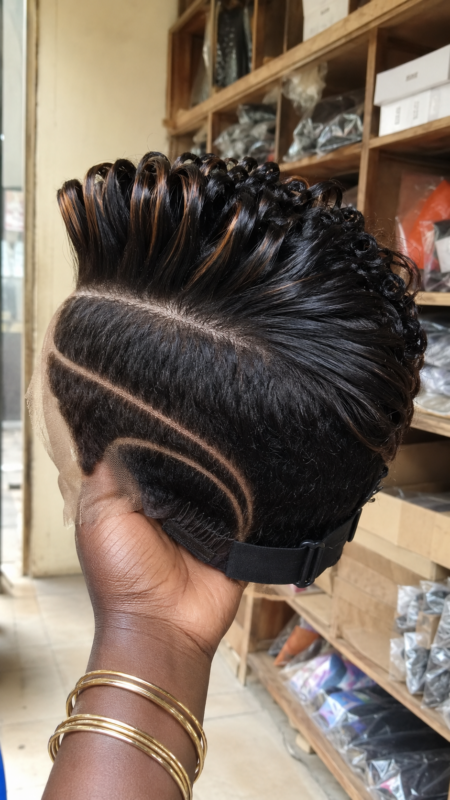
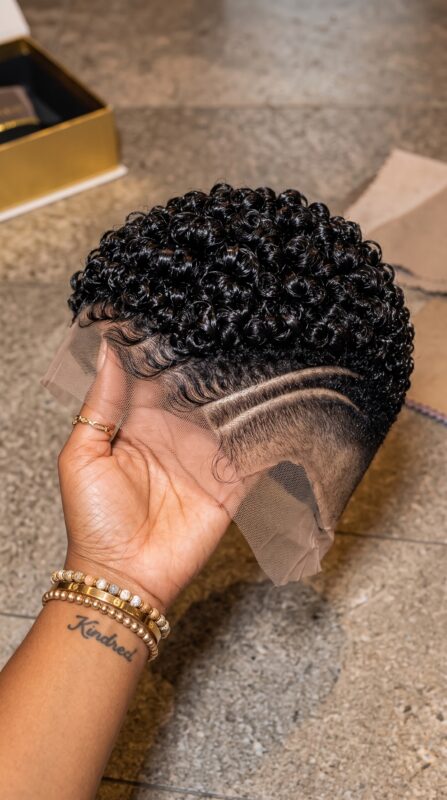
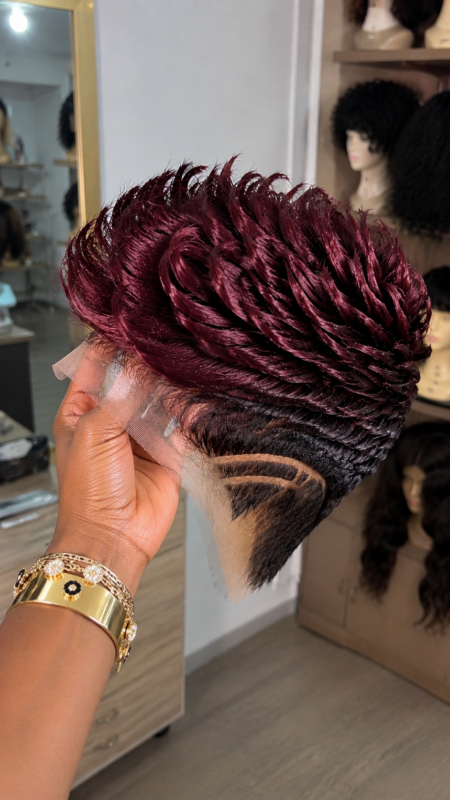
Most short units do not wear out. They shed out. Held open like this, the inside of the cap tells you the thing the front never will: how the hair is actually held on. Those horizontal rows sewn across the dome are wefts, tracks of hair machine-stitched to the cap, and how well they are sewn decides how much this unit sheds and how long it survives daily wear. The curls can be beautiful and the colour rich, but if the wefts are single-stitched and loose, the hair starts leaving the cap within weeks, and no amount of good hair saves a unit that is shedding from the inside.
This is a different question from what kind of cap it is. A wefted cap can be excellent or poor, and the difference is entirely in the stitching: double-sewn rows with sealed returns hold hair for years, while thin single rows with open ends let it slip free every time you touch the curls. On a curly unit this matters more than on a straight one, because every coil tugs on its weft when you detangle or when curls catch each other, so a curly pixie wig puts more strain on its tracks than almost any other style. The interior is where that strain is either well anchored or waiting to fail.
So when you finally get to see inside a cap, look past the curls at the rows holding them. Tight, doubled, sealed wefts are the quiet reason a unit lasts. Loose ones are the quiet reason it does not.
Where To Buy A Curly Pixie Wig That Will Not Shed Out
Custom makers should be willing to show you the inside of the cap and describe how the wefts are sewn. Ask whether the tracks are double-stitched and the returns sealed, because those two details predict shedding better than anything on the front. A maker proud of their construction will show the interior without being pushed.
Instagram and TikTok sellers almost never film the inside, so ask specifically for a video of the open cap and a close look at the wefts. A curly pixie wig that only ever appears from the front is hiding the exact thing that determines its lifespan.
Etsy works with makers who post interior photos and have reviews mentioning shedding, or the happy absence of it. The risk is a listing that shows only styled curls and stays silent on construction. Read reviews for the word shed specifically.
Marketplaces like Amazon, AliExpress, and Temu are where weft quality varies most, since cheap units cut corners in the stitching where a photo cannot show it. Some are well made and many are not. Judge by interior photos and reviews about shedding, not by how full the curls look.
Local beauty supply shops and salons let you turn the cap out and even tug gently at a weft to feel how secure it is, which no online photo allows. You pay more in-store, but you can test the construction with your own hands.
Vendors and wholesalers direct make sense across several units with a minimum, and weft construction is usually consistent within a batch, so a sample tells you about the rest. For one unit, a maker who shows sealed wefts beats unseen stock.
Regionally, well-constructed wefted curly units come strongly out of Lagos, Accra, Atlanta, London, and across South Africa, where you can find sellers who show the inside of the cap on video.
Vet the seller the usual way with a shedding test: check the account age, look for real buyer photos, time a plain question for a genuine reply, and ask directly how the wefts are sewn and whether the unit sheds. Vague answers about construction are their own red flag.
Red flags: no interior photo, no answer on how the wefts are sewn, reviews mentioning shedding, and a price so low the stitching was clearly where they saved.
When you order, send your measurements and a direct question about weft construction, and ask for an interior photo of the finished cap. Say that low shedding matters to you, so the maker knows you will check.
On payment, thirty to fifty percent down with the balance before shipping is standard for custom work. Use a method you can dispute, and ask for a close interior photo of the wefts before releasing the last part.
Contact / Order Inquiries: WhatsApp [WhatsApp: +XX XXX XXX XX XX]
How Much It Costs
On a curly pixie wig, the price of good weft construction hides inside the cap where buyers never look, so knowing it exists keeps you from paying for curls on top of a cap that will shed.
Human hair, full build with double-sewn sealed wefts, bleached knots, and a fine front lace: roughly $190 to $410. Human hair, mid build with decent stitching: about $150 to $310. Human hair, basic cap with single-row wefts more prone to shedding: around $80 to $190. Good synthetic on a well-sewn cap: $60 to $140. Basic synthetic: $20 to $55, and this is where loose wefts and heavy shedding show up most.
The difference in weft quality rarely appears on the price tag as a line item, which is the trap. Two units can look identical from the front and cost the same, and one sheds out in a month while the other lasts two years, entirely because of the stitching inside. That is why the interior photo is worth more than the front one when you are comparing prices. You are not paying for curls; you are paying for how long they stay attached.
Shipping and any customs charge sit outside the price and change with where you live, so plan a realistic band and confirm your own country’s import rate rather than trusting a single quoted figure.
Then the later costs, which shedding drives. A canvas block and pins, gentle detangling by hand rather than a comb to spare the wefts, curl product, and possibly a weft sealer to reinforce tracks if they start to loosen. First-year math, honestly: a well-wefted human unit plus shipping plus any customs plus a small kit plus gentle upkeep tends to land between a low three-figure total and somewhat above the sticker, and it lasts. A badly wefted unit costs the same to buy and far more in frustration as it sheds.
Per wear, a well-sewn wefted curly unit is a strong value because durability is the whole point of a wefted cap done right. A very low price almost always means the saving came from the stitching, and you pay it back in shedding within weeks.
Deposits follow the custom pattern: thirty to fifty percent to start, balance before shipping, and a close interior photo of the wefts before the last payment clears.
Shipping, Delivery, And What To Expect After Ordering
A little loose hair in the box on arrival is normal fallout from handling and is not the same as shedding from the wefts, so do not panic at a few strands. Ask that the unit ship boxed so the cap holds its shape, choose a tracked service for custom work, and check your country’s import charge before it lands. When it arrives, turn it inside out and gently test a weft or two; hair that stays put is a good sign, hair that slides free with light pressure is a warning. What you unbox should shed only lightly at first and settle quickly, and steady shedding that never slows is a construction fault, not a break-in period.
Curly Units Strain Their Wefts Harder
Every time you detangle a curl or two coils catch and pull apart, the force travels down to the weft holding those strands. Straight hair slides; curls grip and tug. That is why curly wefted units shed more readily than straight ones and why the stitching has to be better to survive the same wear. Detangle with your fingers and conditioner rather than dragging a comb through, and you spare the wefts the worst of the strain.
Shedding Can Be Slowed, Not Reversed
If wefts begin to loosen, a weft sealer or a careful line of glue along the track can slow the loss, but it is a patch on a construction problem, not a cure. You cannot re-sew a whole cap at home, and few makers will. This is why the stitching you buy is the stitching you keep, and why checking the interior before you pay matters far more than any repair you can do after.
The Band And Straps Hold It, The Wefts Fill It
The elastic band and adjustable straps around the edge keep the unit on your head, while the wefts across the dome give it its hair. They are separate jobs, and a unit can fit beautifully and still shed if the wefts are poor. Check the straps adjust to your head for a secure glueless hold, but do not let a good fit distract you from inspecting the stitching that actually holds the hair.
Before You Pay
- Are the wefts double-sewn with sealed returns, or single rows with open ends?
- Can I see a clear interior photo or video of the cap before I commit?
- Do reviews mention shedding, and how did the seller respond to them?
- Given curls strain wefts harder, is the stitching built for a curly unit?
- If it starts to shed, will the maker reinforce it, or am I on my own?
Trimming The Lace
Only the front lace is trimmed, and the wefted dome is left completely alone, so keep all cutting to the front panel. Trim in small offset steps and leave a shallow margin rather than cutting flush, and take care not to catch any front-edge wefts with the blade, since a nicked weft is a shedding weft. If this is your first lace cut, let a stylist shape the front while the interior stays untouched, because the cap construction you paid to inspect is not something a trim should ever reach.
Search Terms
curly pixie wig · wefted curly pixie wig · double sewn weft wig · low shedding curly unit · glueless curly pixie cap · durable short curly wig · sealed weft lace front pixie · curly pixie wig construction
Final Thoughts
This photo shows the part of a unit that decides its real lifespan and the part almost no buyer inspects. The curls are lovely and the colour warm, but the rows of wefts sewn across the cap are what determine whether this unit is still wearable in a year or shedding into your hands in a month. Construction, not curls, is the durability story, and on a curly piece the strain on those wefts is higher than on any straight style.
Buy it by looking inside first and asking how the wefts are sewn, because that single detail predicts shedding better than anything on the front. A well-built wefted curly pixie wig is one of the most durable short units you can own, sturdy and long-lived when the stitching is doubled and sealed. A poorly built one looks identical in the listing and falls apart quietly from the inside. The curls got you to click. The wefts decide whether you are still wearing it next season.