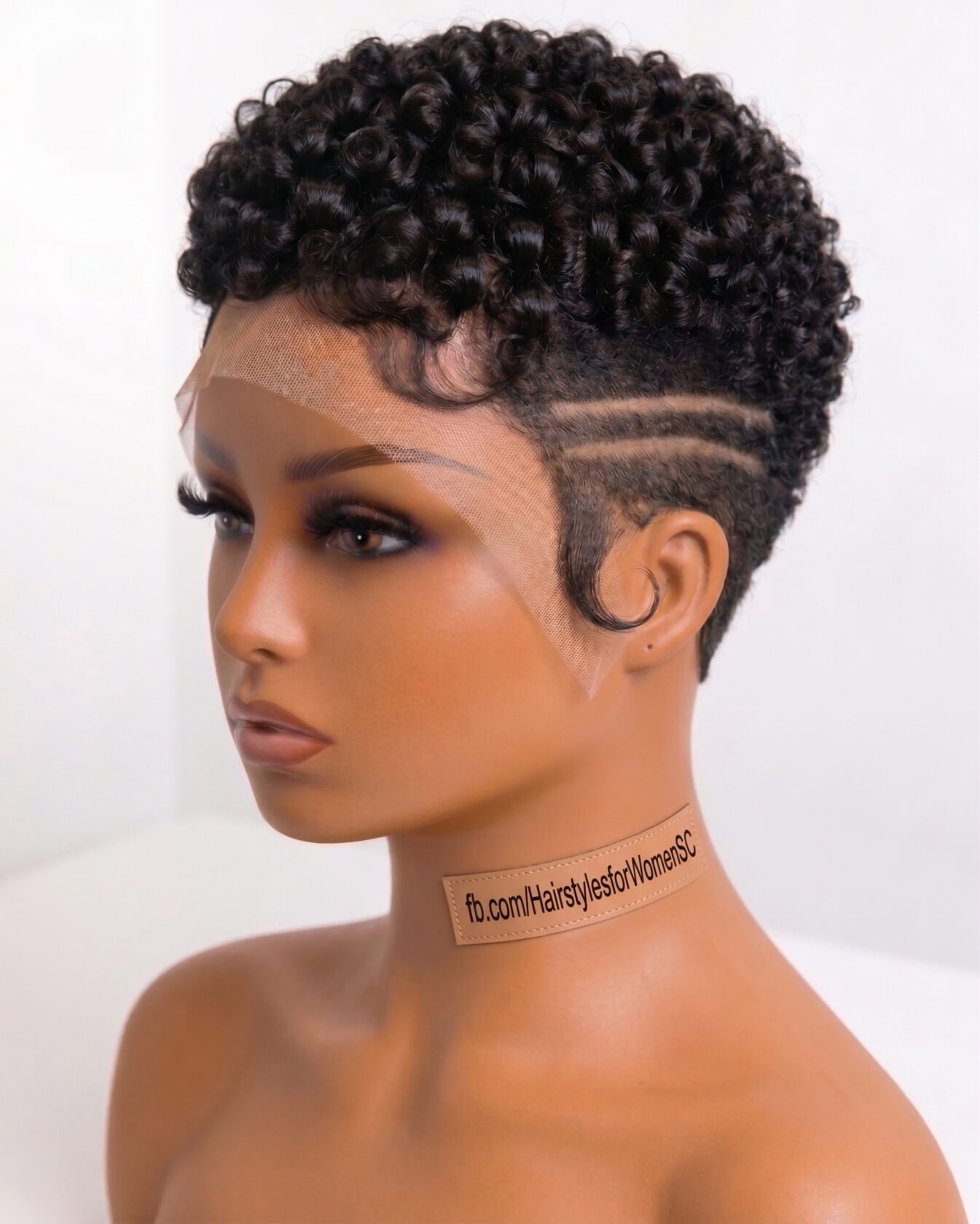
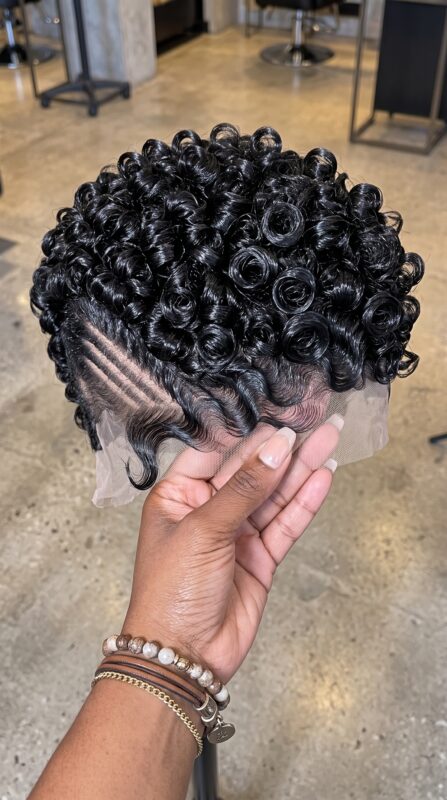
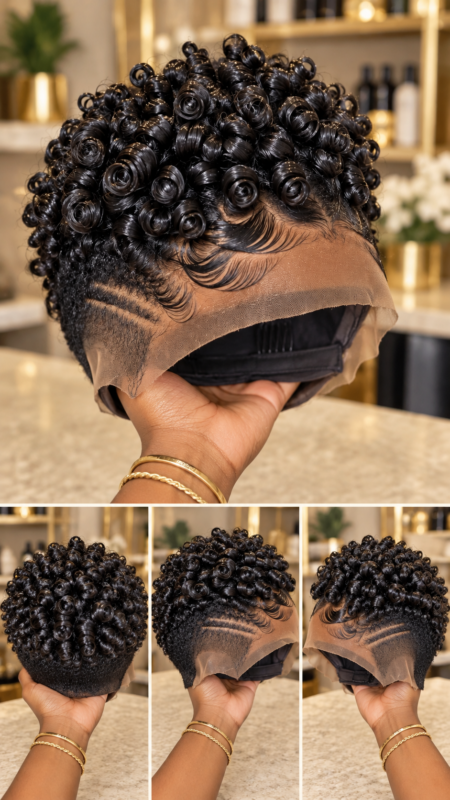
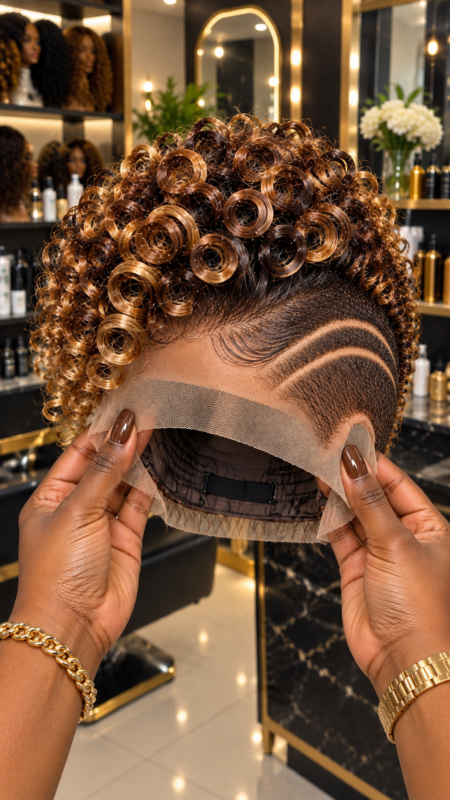
On a mannequin, three-quarter angle, tight coils framing the crown. A soft fringe of curls breaks over the forehead. And along the temple, look closely at where the lace ends — it is not one smooth curve. The edge steps in small angular points, a zigzag rather than a clean arc, before the hair takes over completely.
That is not a trimming mistake. A perfectly smooth curved lace edge is actually the less natural-looking choice, because real hairlines are not smooth curves — they are made of individual growth points that create tiny irregularities. A zigzag or notched trim is a deliberate way to fake that irregularity into the lace itself, and it is a small detail that most buyers never learn to look for.
Where To Buy A Wig Like This
A deliberately irregular lace trim is a finishing technique, not something every maker offers, and it is rarely mentioned in listings. Most sellers either trim lace themselves in a plain curve or leave it entirely untrimmed for the buyer to cut, so a unit that arrives with an already-natural, non-uniform edge signals a maker paying attention to a detail most buyers do not know to ask about.
Custom wig makers and lace studios are the main route. Search with technique-specific vocabulary rather than generic terms: “natural hairline lace trim pixie wig,” “zigzag lace edge curly wig,” “pre-plucked lace pixie wig,” “HD lace curly pixie irregular hairline.” A maker who mentions how they trim the lace, rather than only describing the hair, is worth a closer look.
Instagram and TikTok wig specialists are the richest source. Zoom into hairline close-ups in their grid rather than full-head shots — a deliberately irregular edge is only visible up close, and a maker proud of it will photograph that detail directly.
Etsy works for made-to-order pieces. Ask before ordering whether the lace will arrive pre-trimmed with a natural edge or left long for you to cut yourself. Both are legitimate, but they are very different starting points.
Contact / Order Inquiries: WhatsApp is the standard channel for independent makers. [WhatsApp: +XX XXX XXX XX XX] — send this exact photo as a reference and ask directly: “Is the lace pre-trimmed with an irregular hairline like this, or does it arrive with a straight edge for me to cut myself?” That answer tells you how much work is left for you to do after it arrives.
How Much It Costs
Solid black, no lifting or toning, so every dollar above a basic unit is buying hand-finishing, not colour.
100% human hair, sheer lace pre-trimmed to a natural irregular hairline, bleached knots, curled fringe, carved lines, glueless cap: generally $220–$460
100% human hair with a plain straight-trimmed lace edge instead of a natural irregular one: typically $170–$340
100% human hair, basic cap, lace left untrimmed and unshaped: typically $70–$180
High-quality synthetic with comparable finishing: usually $60–$140
Basic synthetic curly pixie: often $20–$55
The arithmetic worth knowing: a naturally irregular lace trim takes longer than a plain curved cut because it has to look accidental while actually being controlled, following where baby hairs are knotted rather than an even arc. Skip this step and you are doing it yourself at home with scissors, which is a harder task than most first-time buyers expect. Paying for it pre-done, if a maker offers it, is one of the more worthwhile finishing costs on a piece like this.
Shipping, Delivery, And What To Expect After Ordering
Made-to-order timing. A natural irregular hairline trim, a curled fringe, and carved lines are slow, deliberate work. Expect two to four weeks rather than a few days.
Ask specifically whether the lace will arrive already trimmed to a natural edge or left untrimmed. If it arrives pre-trimmed, handle it gently — thin points of lace at the edge of a natural trim are more fragile than a straight cut line.
International shipping is normal with Instagram, TikTok, and Etsy sellers, though delivery windows and customs fees vary by country. Ask about tracked shipping before you pay.
Returns are usually limited on custom pieces. Get the policy in writing.
Cap fit is the most common regret. Send your head measurement and ask whether they build to it.
Reading The Zigzag Lace Trim
Look closely at the temple. Instead of one continuous curve, the lace edge steps in and out in small points before disappearing under the hairline. That irregularity is intentional, and it exists because a perfectly smooth curved edge is a visual giveaway — no real hairline follows a clean arc for its entire length.
What to check on a piece like this: the irregularity should look organic, with points of varying small sizes rather than a repeating uniform zigzag pattern, which would look just as artificial as a smooth curve did. The points should follow where baby hairs are actually knotted rather than being cut independently of the hair placement. And the trim should stay close to the hairline rather than leaving excess lace that undoes the illusion.
This is a genuinely difficult thing to do well yourself with scissors, which is exactly why a pre-trimmed natural edge is worth asking about and worth paying for if it is offered as an option.
The Curled Fringe And The Earlobe Detail
The front breaks into a soft fringe of curls over the forehead rather than sitting in a flat wall of hair. This takes real curl-setting skill to hold at the very front of the piece, where there is no weight behind it to keep the shape settled. Judge it on uniformity and spring — similar ringlet size, curls that still look lively rather than starting to relax at the tips.
Near the ear, a small curl is left deliberately, tucked close to the lobe. This is a softening detail similar to what shows up on other carved-line pieces, keeping a geometric side design from looking too severe against the face. It is a small thing, but a maker who adds it consistently is paying attention to how a design actually reads on a real head, not just how it photographs from a distance.
The Carved Lines And The Fade
Two lines run parallel down the side, staying an even distance apart. Parallel lines are more forgiving to carve than diverging ones, since the first line can act as a spacing guide for the second, but both still have to hold identical width and follow the same curve all the way down. Judge them on matching — a true pair, not a main line with a rougher echo.
Beneath the lines, the fade does its usual quiet work: full curls graduating down through progressively shorter lengths into stubble that dissolves into the lace, every hair hand-knotted at a decreasing length. A bad fade has a hard stop; a good one melts, and it is that melt the carved lines and the irregular lace trim both depend on to look intentional rather than harsh.
The Tight Coils, The Knots, And The Cap
The coils are small, tight, and packed densely across the crown. Tight coils show thinness immediately, so density has to be genuinely full for the crown to read right. Ask for a short video rather than relying on a still photo, since tight coils can photograph fuller than they actually sit.
Check the knots along the hairline, especially where the irregular lace trim sits closest to the face. On a careful unit they are bleached so the lace reads as scalp rather than a scatter of dark dots.
This shot does not show the cap interior, so ask before you buy: is the cap glueless, with combs and an adjustable strap? A glueless cap secures mechanically — no adhesive on your skin, no removers, no slow traction damage to your own edges. But glueless only works if the fit is right. Measure your head with a soft tape — from the front hairline, around above the ears, around the nape, and back to the start. Most caps run 21.5–22.5 inches, but real heads vary, so ask whether the maker builds to your measurement.
Before You Pay
Is the lace pre-trimmed to a natural irregular hairline, or does it arrive straight for me to cut?
Can you show close-up photos of the hairline trim on past pieces?
How does the fringe hold its curl through the day, and what happens to it in humidity?
Are the knots bleached, and what lace type and tone are you using?
Is the cap glueless — combs and an adjustable strap — and can it be built to my head measurement?
Trimming The Lace
If your unit arrives pre-trimmed to a natural edge, resist the urge to trim it further — a naturally irregular hairline is easy to accidentally straighten out with a scissor pass meant to just clean up loose lace. If it arrives untrimmed, cut slowly and follow your natural hairline with small staggered cuts rather than one straight line, since that irregularity is exactly what you are trying to create. Leave a small margin instead of going flush. If you are new to lace, pay a stylist for the first cut and copy what they do.
Search Terms
natural hairline lace trim pixie wig · zigzag lace edge curly wig · pre-plucked lace pixie wig · curly fringe pixie wig human hair · HD lace curly pixie irregular hairline · where to buy curly pixie wigs with natural lace trim
Final Thoughts
Study this piece for the edge, not just the curls. A smooth curved lace trim looks tidy in a photo, but a genuinely convincing hairline is irregular in small, specific ways, and getting that irregularity to look accidental takes more control than cutting a clean line ever would.
Everything else here supports that detail — a curled fringe with real bounce, a soft curl near the ear, a fade that melts cleanly into the lace. But the hairline is where the eye lands first, and a lace edge trimmed to mimic natural irregularity is one of the more overlooked things separating a convincing pixie from an obvious one. Ask about it before you buy, not after.