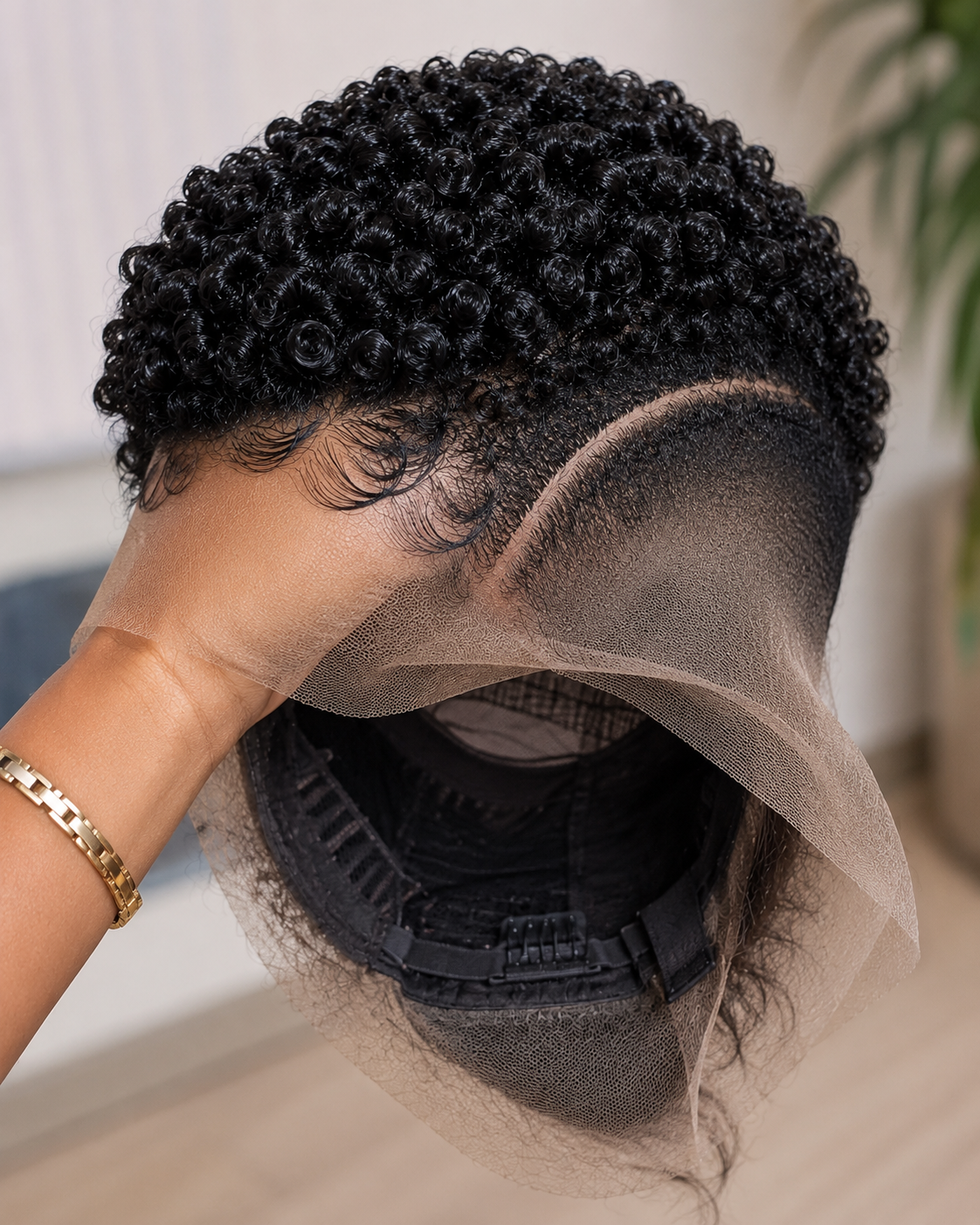
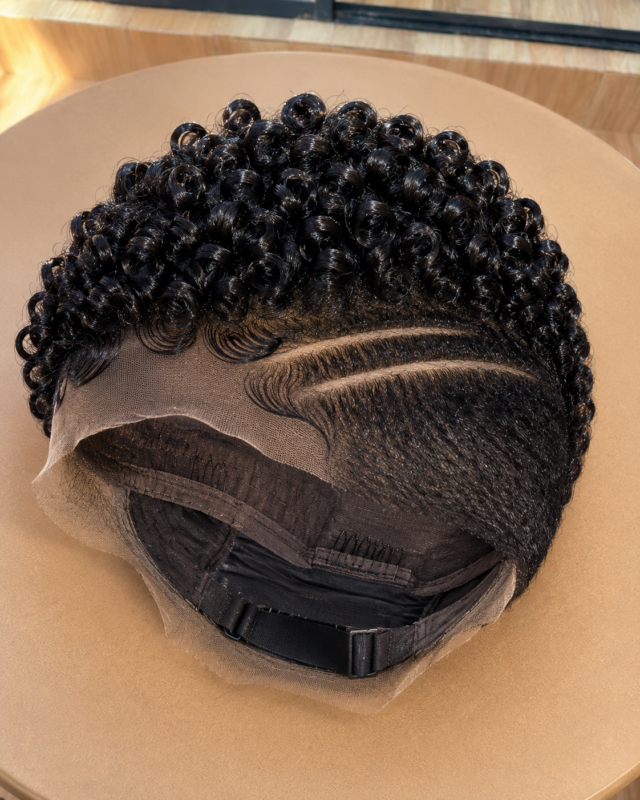
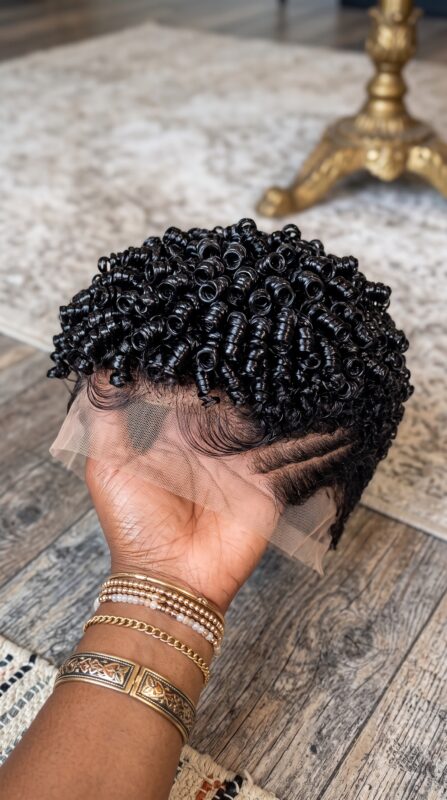
Look at where the lace goes on this piece. It doesn’t stop at the front hairline like most short units. It continues — down past the temple, over the ear, right along the entire side, with the tapered fade knotted directly into it.
Held open in natural light with the cap exposed, you can see exactly how far it extends. And that single construction choice is the difference between a wig that survives being seen from the side and one that doesn’t.
Here’s what it means, what it costs, and why almost nobody advertises it.
The Sides Are Exposed On A Short Wig — And Wefts Don’t Look Like Scalp
Every buying guide tells you to check the front hairline. Fine advice. But it’s incomplete for a pixie, and here’s why.
On a long wig, the sides of the cap are buried under a curtain of hair. Nobody sees the temple. Nobody sees above the ear. You could staple wefts to a bin bag and nobody would know.
On a short wig, there’s no length falling down to cover anything. The sides are permanently, unavoidably on display — in profile, in photographs, when someone sits beside you at a table or stands next to you in a queue.
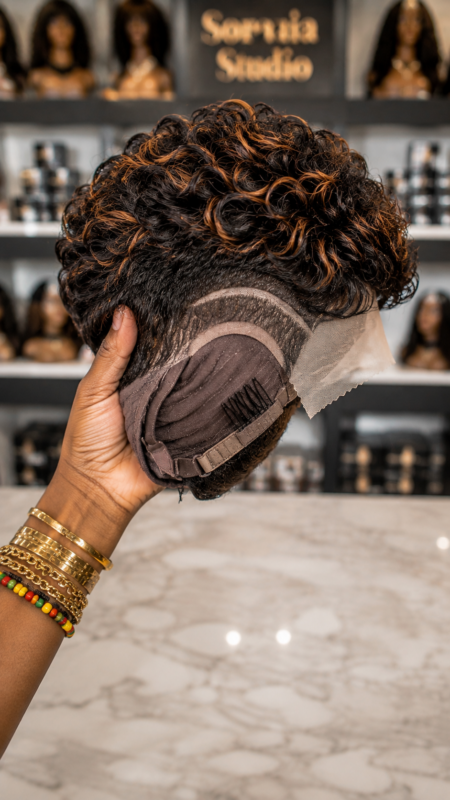
Most lace pixies handle this with wefts: rows of hair machine-stitched onto fabric. It’s fast, it’s cheap, and it works fine when hidden. The problem is that wefts have structure. You can see the stitching. You can see the fabric. At conversational distance, in ordinary light, they read as exactly what they are — hair sewn onto a base.
Lace doesn’t. When the lace extends down the side and each hair is individually knotted into that fine mesh, the taper appears to grow from skin. That’s why the fade in this piece looks like a haircut rather than an assembly.
What This Costs To Build
More lace. More hand-knotting. Vastly more hours.
Every hair in that side panel was tied by hand into the mesh, at a progressively shorter length as you move down the taper. There’s no machine shortcut. It’s why extended side lace is uncommon, why it’s rarely mentioned in listings, and why it commands a real premium.
- 100% human hair, extended side lace, bleached knots, hand-laid edges, graduated fade, glueless cap: generally $220–$450
- 100% human hair, front lace only with wefted sides, otherwise similar: typically $120–$280
- 100% human hair, basic build, no lace beyond the front, no edge work: typically $70–$180
- High-quality synthetic with extended lace: usually $60–$140
- Basic synthetic coily pixie: often $20–$55
The specific number worth knowing: extended side lace typically adds $40–$80 over an equivalent front-lace-only piece. On a short wig — where the sides are permanently visible — it’s arguably the best-value upgrade available, and it’s the one most buyers never think to ask for.
The Fade Knotted Into That Lace
Follow the side down. Full coils at the crown. Then shorter. Then shorter again. Then fine, sparse stubble. Then nothing — the hair simply dissolves into the lace with no visible boundary.
Nobody cut that. Every hair in the taper was knotted individually at a decreasing length, working down the side. It’s slow, unglamorous work, and it’s where cheap units expose themselves instantly:
- A bad fade has a hard stop where the curls simply end, patchy or bald areas within the taper, or hair that’s uniformly short rather than genuinely graduating.
- A good fade — this one — is a smooth, continuous gradient with even density throughout, blending into the lace so seamlessly there’s no edge to find.
Always ask for a side profile photo. If a seller only ever shoots front-on, there is usually a reason.
The Rest Of The Build
The lace is exceptionally fine and sheer — you can see straight through to the cap. Warm-toned, generously long, untrimmed. That excess is your margin to cut along your own hairline.
The knots are bleached. The lace reads as scalp rather than a field of dark specks. A deliberate, time-consuming step, and a reliable indicator that the maker cared.
The baby hairs are hand-laid along the hairline in soft, curved, varied strokes that thin outward into wisps. Blunt uniform rows are the fastest way a wig announces itself from across a room. The caveat: they loosen — with wear, washing, humidity, sleep. Ask your maker how to re-lay them and with what products. If you won’t maintain them, buy simpler and keep the money.
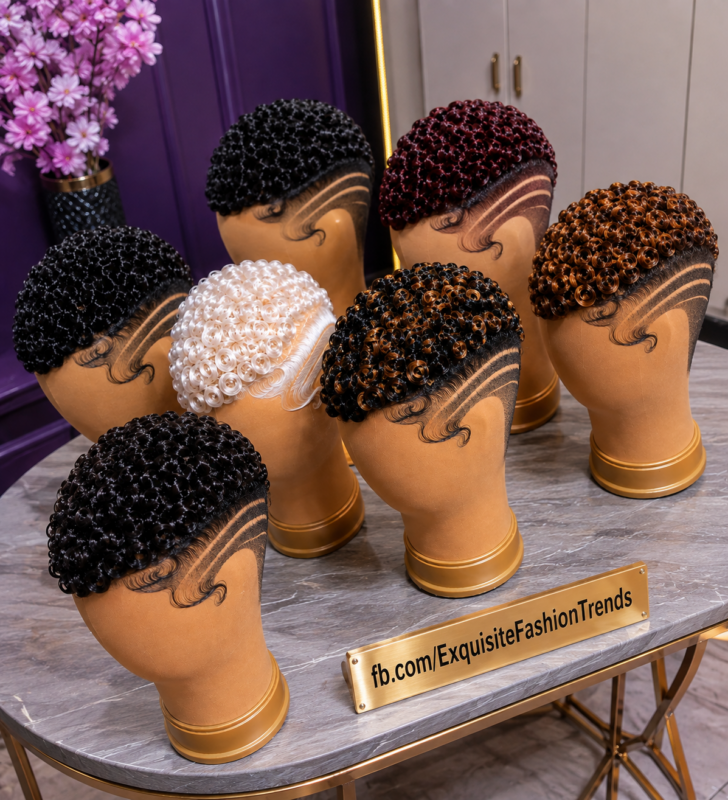
The curls are tight, glossy, evenly dense across the crown, no thin patches.
Inside the cap: combs and an adjustable strap with a buckle. Glueless — it secures mechanically, no adhesive on your skin, no chemical removers, no slow damage to your natural edges.
Glueless depends on fit. Measure your head: tape from front hairline, around above the ears, around the nape, back to the start. Most caps run 21.5–22.5 inches, but real heads vary. A maker who asks for your number is doing the job properly.
Where To Buy A Wig Built This Way
The search vocabulary matters, because most sellers simply don’t build like this and won’t appear under generic terms.
- Custom wig makers and lace studios. Search “extended lace pixie wig,” “full side lace short wig,” “lace side pixie wig human hair,” “HD lace tapered pixie.” Then look through their portfolio for side profiles. Makers proud of their fades photograph them. Makers who aren’t, quietly avoid the angle.
- Instagram and TikTok wig specialists. The richest source, because many post exactly this kind of hand-held, cap-exposed, unglamorous footage. Prioritise them.
- Etsy. Fine for made-to-order, but ask directly whether the lace extends past the front — listings almost never specify.
Contact / Order Inquiries: [WhatsApp: +XX XXX XXX XX XX] — and send this exact message, because it’s the one question that separates serious makers from the rest:
“Does the lace extend down the sides, or is it front lace with wefted sides? And can you send a side profile of the fade?”
Their answer will tell you, in one sentence, what you’re dealing with.
Before You Pay
- Does the lace extend down the sides? (The question nobody asks.)
- Can I see a close-up side profile of the fade?
- Are the knots bleached, and what lace type and tone?
- Is the cap glueless — combs and adjustable strap?
- What’s the cap circumference, and can it be built to my measurement?
- Are the baby hairs hand-laid, and how do I re-lay them?
Trimming The Lace
Ships uncut, and on a piece like this there’s considerably more of it than usual — it runs down the sides as well as across the front.
Cut slowly. Follow your natural hairline. Leave a small margin rather than going flush. Use small staggered cuts rather than one straight line. Take extra care with the side lace — it’s larger, more awkward, and mistakes there are more visible on a short wig, not less.
If you’ve never done it, pay a stylist for the first trim. The cut is permanent, and you may have several hundred invested.
Search Terms
extended lace pixie wig · full side lace short curly wig · HD lace tapered pixie wig · lace side fade wig human hair · glueless coily pixie with combs · where to buy extended lace pixie wigs
Final Thoughts
The front hairline gets all the attention, and it earns some of it. But it’s only half the problem on a short wig — because the sides are what people see when they’re standing beside you, and wefted sides do not look like scalp, no matter how immaculate the front is.
Extended side lace fixes that. It costs more, takes far longer to build, and almost nobody advertises it — which means it’s the single most useful question you can ask a seller, and the one they’ll least expect.
Ask it before you pay. The answer is worth more than any product description.

Beautiful,I’d love to have 2 different style of it
Curly pixie wig
The wig is beautiful,i want to oder it,how can i oder it
Love your pixie wigs does the lace extend down the sides and is it frontlace with wefted sides? Is it a glueless cap with comb and adjustable strap. Baby hair is hand laid?